We’ve heard it a million times before as a justification for mistreating animals: “Animals aren’t people.” We are accused of anthropomorphizing – attributing human personality to animals.
How do we break through to people who roll their eyes when we say, “Just because animals don’t speak our language doesn’t mean they don’t experience the same emotions: fear, pain, hunger, thirst, fatigue, sadness.
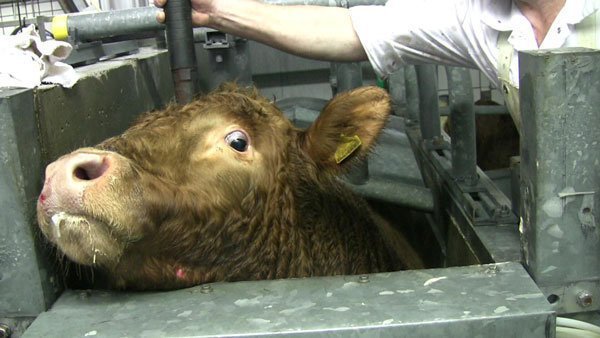
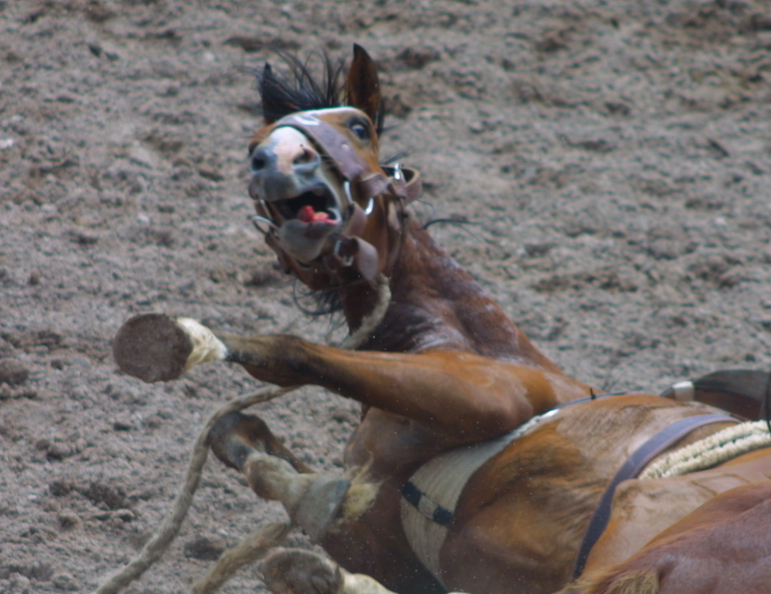
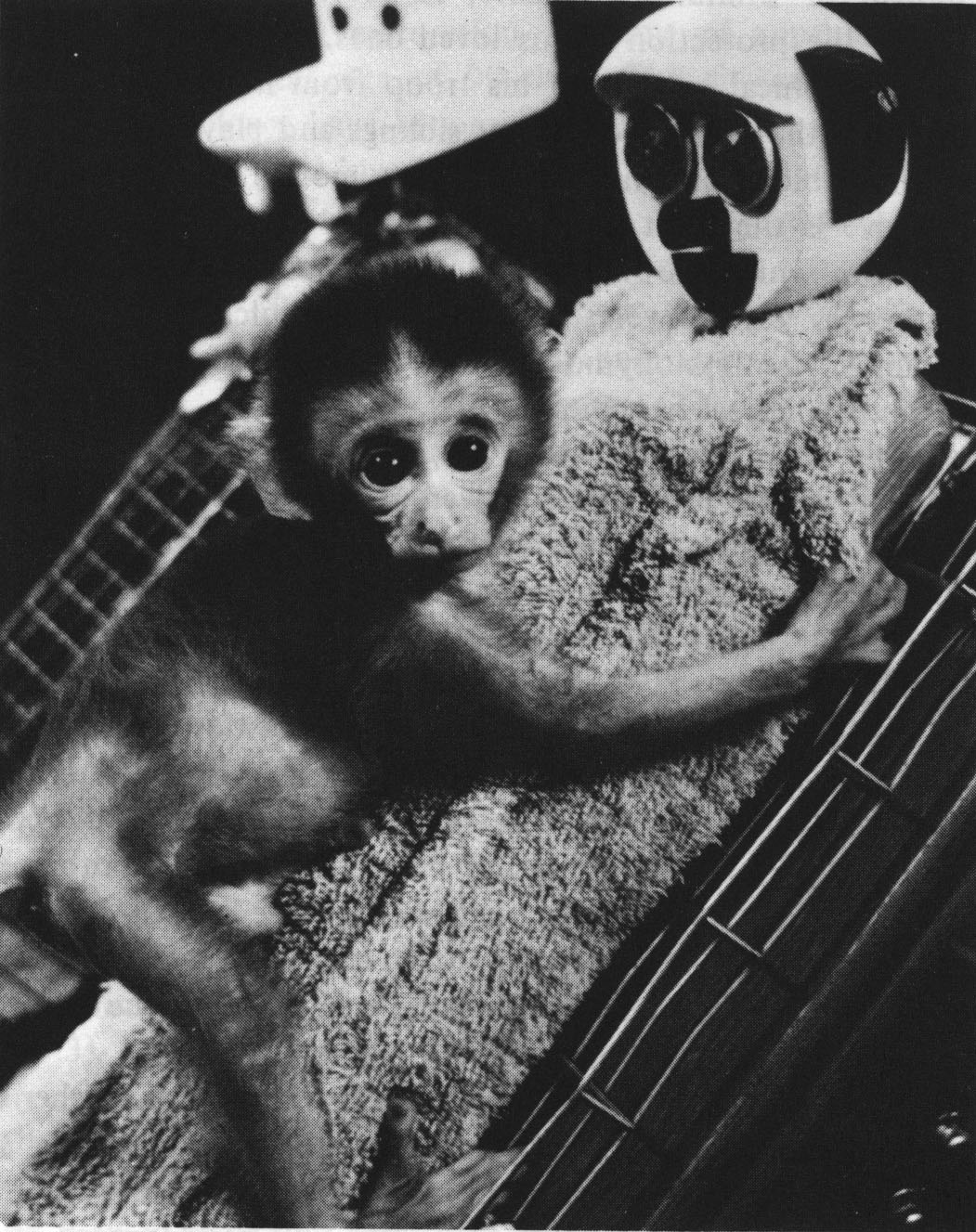
Pictures speak a thousand words. If the naysayers don’t take our words seriously, then perhaps this video and the photos that follow will help them see the light:
https://youtu.be/v33R7fAyaZk
Fear & anguish
Terror & pain (photo: SHARK)
Fear and Sadness (Baby clings to fake mother in maternal separation study)
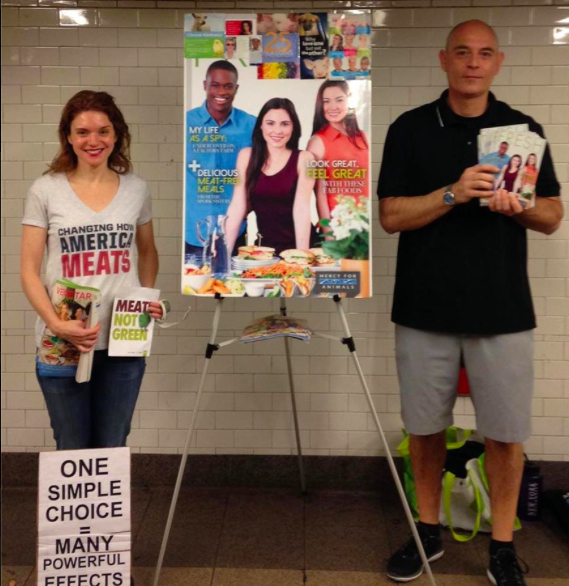
By day, he teaches physical education in a public school. By night, he descends into the bowels of NYC to do vegan outreach in subway stations. Sometimes with friends and often alone, Jim Scotto, 42, distributes thousands of pamphlets – night after night, weekend after weekend.
Vegan outreach in NYC subway
“The subway is the perfect spot,” says Scotto. “During the afternoon rush, thousands of people who come through the stations wait on the platforms and ride the trains, both of which are conducive to reading.”
To capture peoples’ attention, he also puts out booklets on columns and sets up easels with posters, whenever possible.
Scotto is convinced that his mild-mannered approach is effective: “I always keep it positive. It’s the best way to distribute the greatest number of pamphlets and make a positive impression on people. Many won’t take a pamphlet, but plenty of people do. And I know they’re making a difference because people have returned to tell me that they’ve gone vegan or are moving in the right direction.”
Scotto does above ground outreach too
Scotto receives no rewards or recognition for his under the radar activism, but he probably should. After all, he is living proof that one person – working alone – can make a big difference for the animals.
A friendly reminder of why he advocates
Your Turn
In Scotto’s words, “More people leafleting means more materials distributed. And that leads to more change.” To find out how to leaflet in your area, please see Mercy For Animals’ Guide to Leafleting.
During the winter of 2014, fur was everywhere, which made a bad winter even worse for people who care about animals. In urban areas, activists could easily cross paths with hundreds of fur wearers each day – leaving some of us feeling frustrated, helpless and hopeless.
So what do we say, if anything, to people wearing fur in 2015? Does saying nothing and turning a blind eye make us complicit? Author Jonathan Safran Foer once stated, “Not responding is a response – we are equally responsible for what we don’t do.”
But what is the most effective approach with fur wearers? Starting a dialog by asking if the fur is real? Shaming them with the hope that they’ll be skittish about wearing fur in the future? Any discomfort experienced by the people we address pales in comparison to the agony experienced by the animals who they are wearing.
Photo by Emily McCoy
I use several different approaches with the hope that one will emerge as the most effective. When I say, “I love your coat! I hate animals too,” some people respond by laughing nervously. One woman asked if I was being “nasty,” which opened the door to a dialog. She said she “couldn’t argue” with my points but that she also couldn’t give up her “vintage” fur. In the end, I used flattery with her in an attempt to effect change: “I’m sorry, ma’am, but a glamorous woman like you wearing fur encourages others to do the same.” (P.S. Nothing about her was glamorous).
Sometimes I say, “OH MY GOD. Your coat looks just like my dog” with a nonjudgmental, matter of fact tone. Invariably, people respond with a terrified “No” as if I actually thought that they were wearing my dog. By referencing a dog, my hope is to help people connect the dots between companion animals and those used for fur.
Last winter, I placed a few “I am an asshole. I wear fur” stickers on people after “accidentally” stumbling and falling into them. “I’m so sorry! I must have tripped on something.” I need to get more of those.
PETA, which is still regarded by some as the red paint throwers, suggests a polite approach that could trigger a conversation. They’ve even created an instructional video:
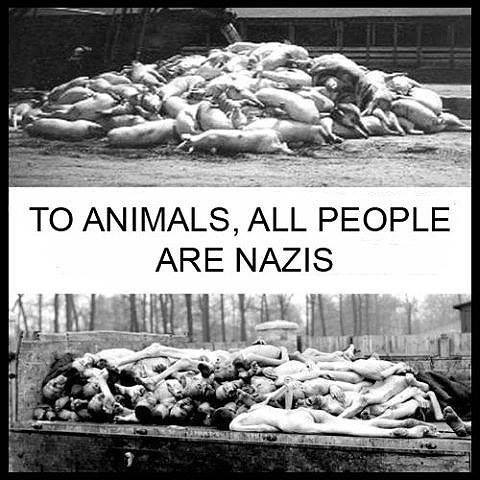
Most animal rights organizations and activists refrain from comparing animal atrocities to the Holocaust because the analogy alienates people, which could compromise its intent to effect positive change for the animals.
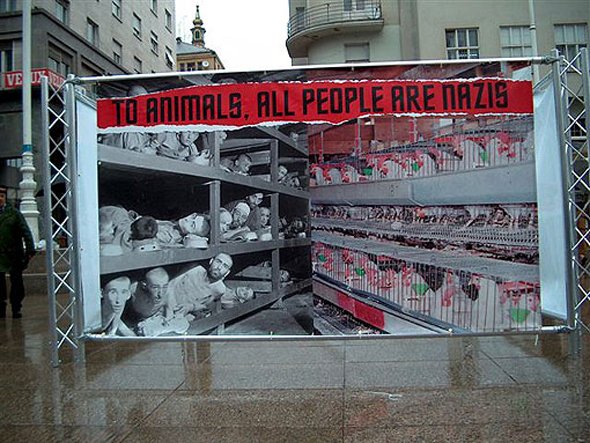
Over the years, PETA has been attacked in the press and online for producing Holocaust imagery that compares concentration camps to factory farms.
PETA’s Holocaust Campaign
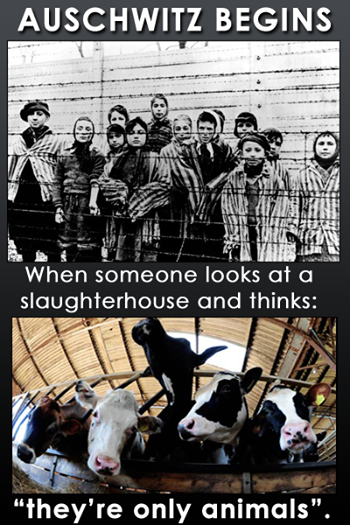
In mid-September, Australian artist Jo Frederiks produced an exhibit with Holocaust imagery called The Animal Holocaust, which, she said, was inspired by quotations from concentration camp survivors and philosophers, such as Theodor Adorno who wrote “Auschwitz begins whenever someone looks at a slaughterhouse and thinks: they are only animals.” Like PETA, Ms. Frederiks was criticized.
But what happens when a survivor invokes the Holocaust to generate attention for the billions of farm animals who are slaughtered each year? Is he above reproach?
Before being smuggled out of the Warsaw Ghetto during World War II, five year old Alex Hershaft saw Jews being beaten by Nazis in the streets. He lost most of his family during the war, but he gained empathy that helped him connect dots between the atrocities committed against humans and animals – and become one of the founders of the modern-day animal rights movement.
Holocaust Survivor Alex Hershaft
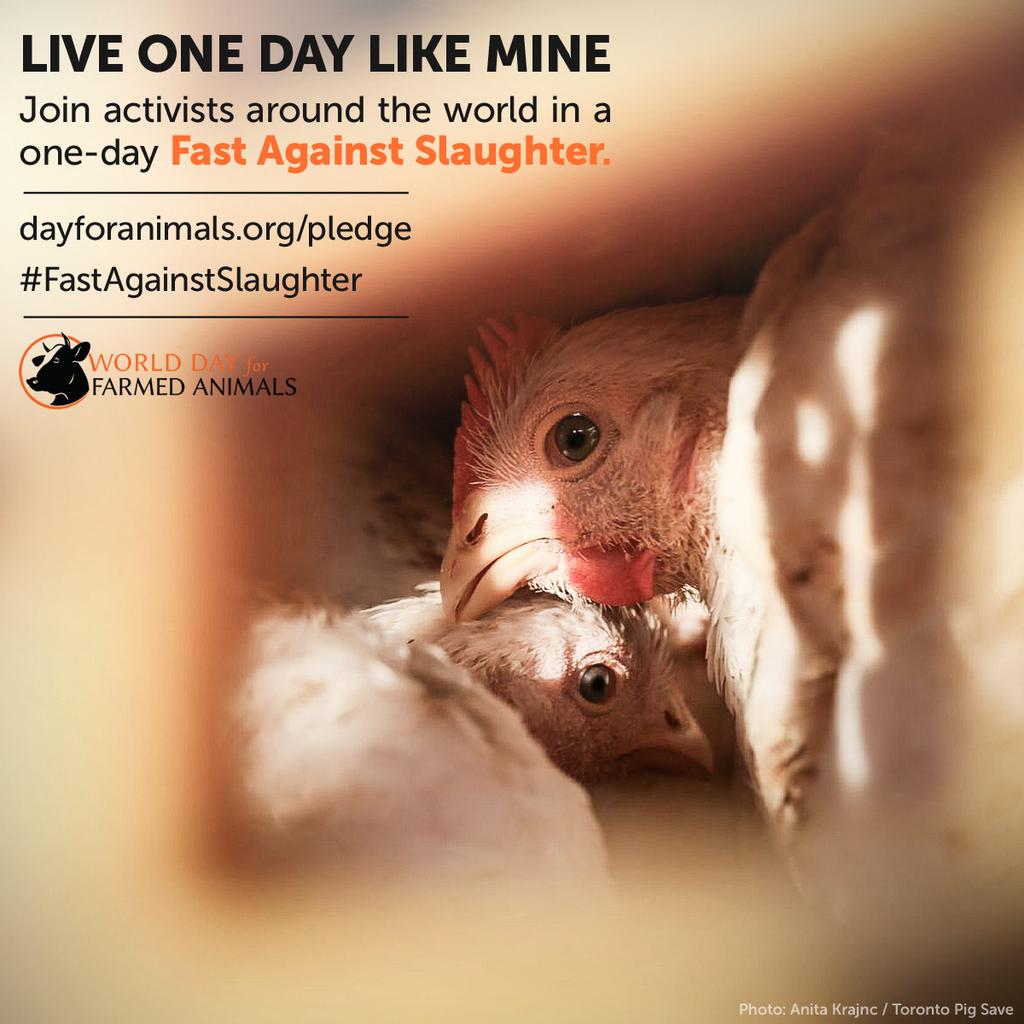
In 1976, Dr. Hershaft founded the organization that would eventually become the Farm Animal Rights Movement (FARM). In 1983, began an annual one-day fast on October 2nd as part of World Day for Farmed Animals. The fast aims to raise awareness of the plight of who are raised and killed for food. This year, about 10,000 people from 71 countries have pledged to join him.
Author Isaac Besheva Singer once said, “In their behavior toward creatures, all men are Nazis.” The cows who are branded with fire and baby pigs who are castrated with no painkillers would assuredly agree.
Animal rights activists are accustomed to being harassed and threatened during protests, but the worst abuses are rarely caught on camera because they are usually random acts – a punch thrown; a shove; someone spitting, etc.
From left to right: Vigil participant, UCLA researcher
On January 18th, however, activists with Progress for Science recorded several harrowing minutes of bullying and physical intimidation — by academic researchers, no less. On that day, 11 activists holding a peaceful vigil to honor 11 monkeys being abused for redundant and needless government-funded research in UCLA labs were met with viscous attacks by counter-protesters.
Your Turn
This video, which has been seen by only 11,100 people, should have gone viral when it was first posted – not only because of the shocking behavior of the UCLA researchers, but also because of the bravery of the activists. They courageously put themselves in harm’s way – on behalf of the animals who were being harmed.
The video also inadvertently teaches an important lesson: As activists, we must keep our rage in check because outbursts and aggression, shown by the experimenters in this case, shift attention away from the animals, which is where the spotlight should shine.
Please visit Progress for Science to help bring an end to the archaic animal experiments being conducted at UCLA.










Follow Their Turn