Their Turn - The Social Justice Movement of Our Time Their Turn - The Social Justice Movement of Our Time

Thousands of Chickens Die of Hypothermia During Kaporos in Brooklyn

October 9, 2022 by Leave a Comment


The News

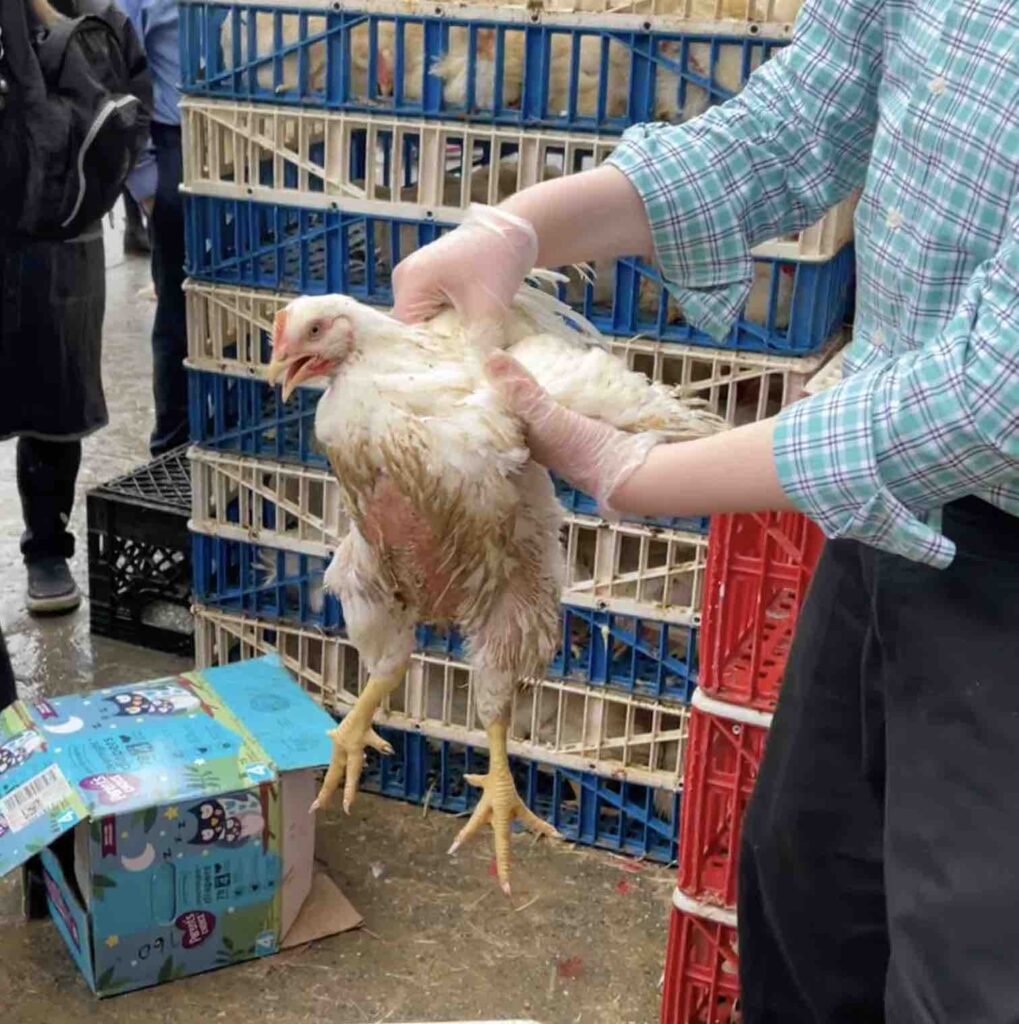
Thousands of chickens stacked in crates on the streets of Brooklyn died of hypothermia over the course of two days during Kaporos, a ritual animal slaughter that takes place each year in the days leading up to Yom Kippur, the Jewish day of atonement. After being delivered to Hasidic neighborhoods in Williamsburg, Borough Park, Crown Heights and Midwood, hundreds of crates filled with chickens were left outside in the rain, soaking tens of thousands of chickens who were being stored without shelter on public streets. 

According to Michael Dolling, who rescues and rehabilitates farm animals, young chickens have difficulty regulating their body temperature. When they are exposed to cold temperatures, wind and rain, they quickly become hypothermic. Upon seeing the wet and shivering animals at several Kaporos sites in Williamsburg, Dolling said that thousands of chickens at those sites alone would be dead within hours. In fact, many of the chickens were already dead — before even being used in the ritual. “In past years, when Kaporos took place in September, thousands of chickens slowly roasted in the crates. This year, they froze to death.”  

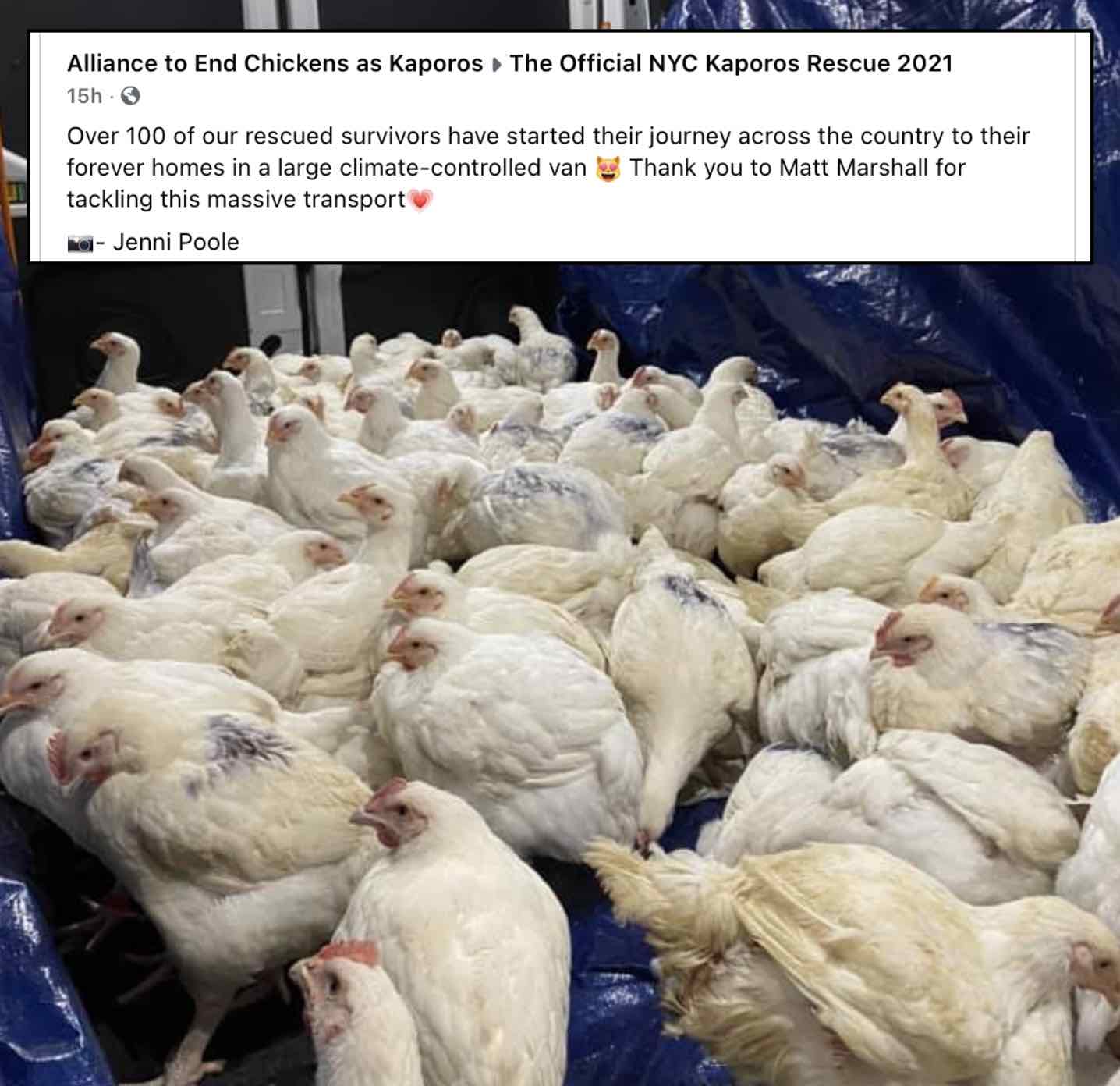
Over the course of six days, advocates rescued and saved the lives of 238 chickens who would have otherwise died of exposure or been killed during the Kaporos ritual.  The rescuers used car heaters, towels and blankets to warm the shivering birds while rushing them to a triage center for first aid. There, they used heat lamps, heat plates, hair dryers and warm water bottles to raise their body temperature while administering subcutaneous fluids and medicines to stabilize them.
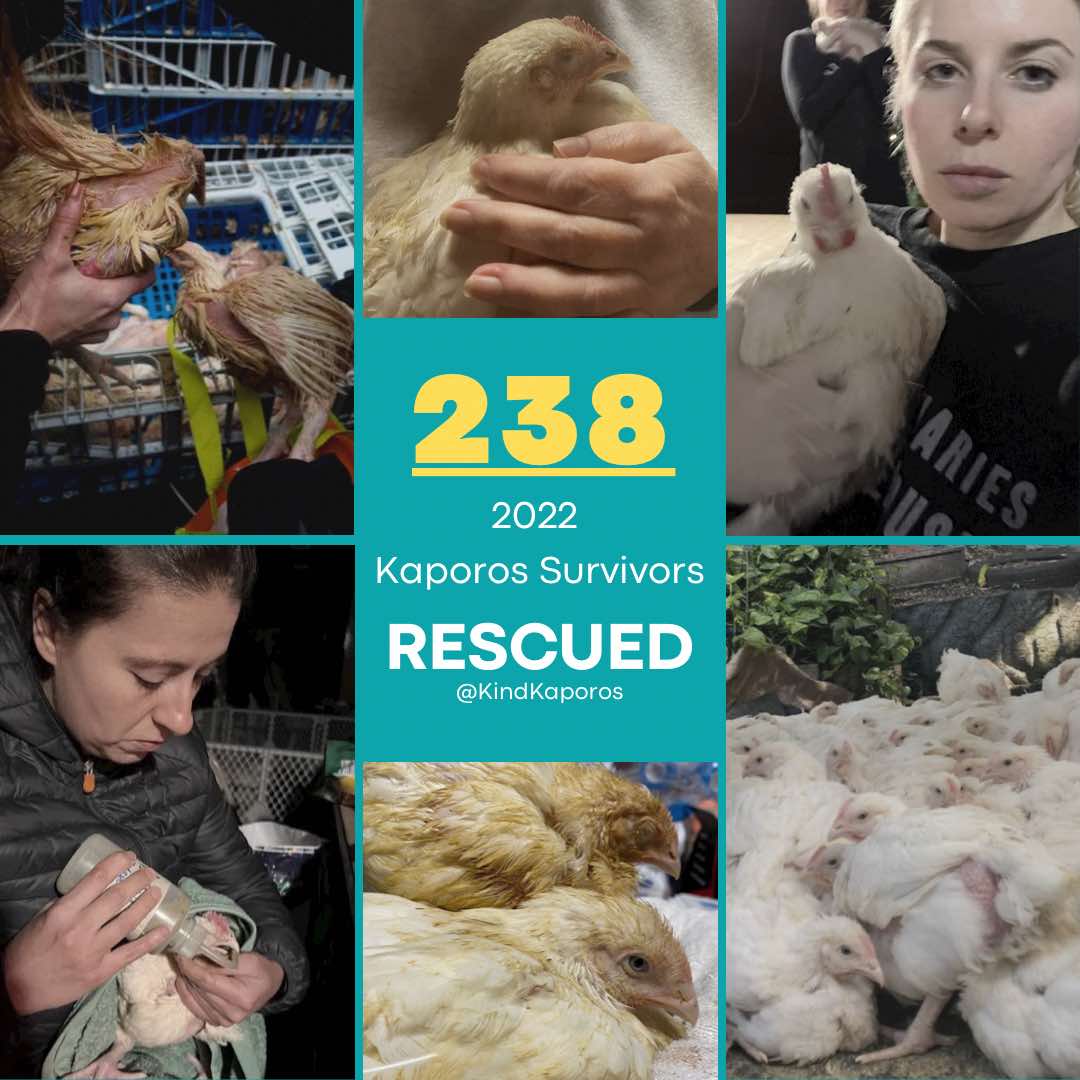
Photo of some of the chickens rescued during Kaporos in 2022

During Kaporos in 2022, animal rights activists in Brooklyn rescued and saved the lives of 238 chickens who would otherwise have died of hypothermia or been slaughtered.

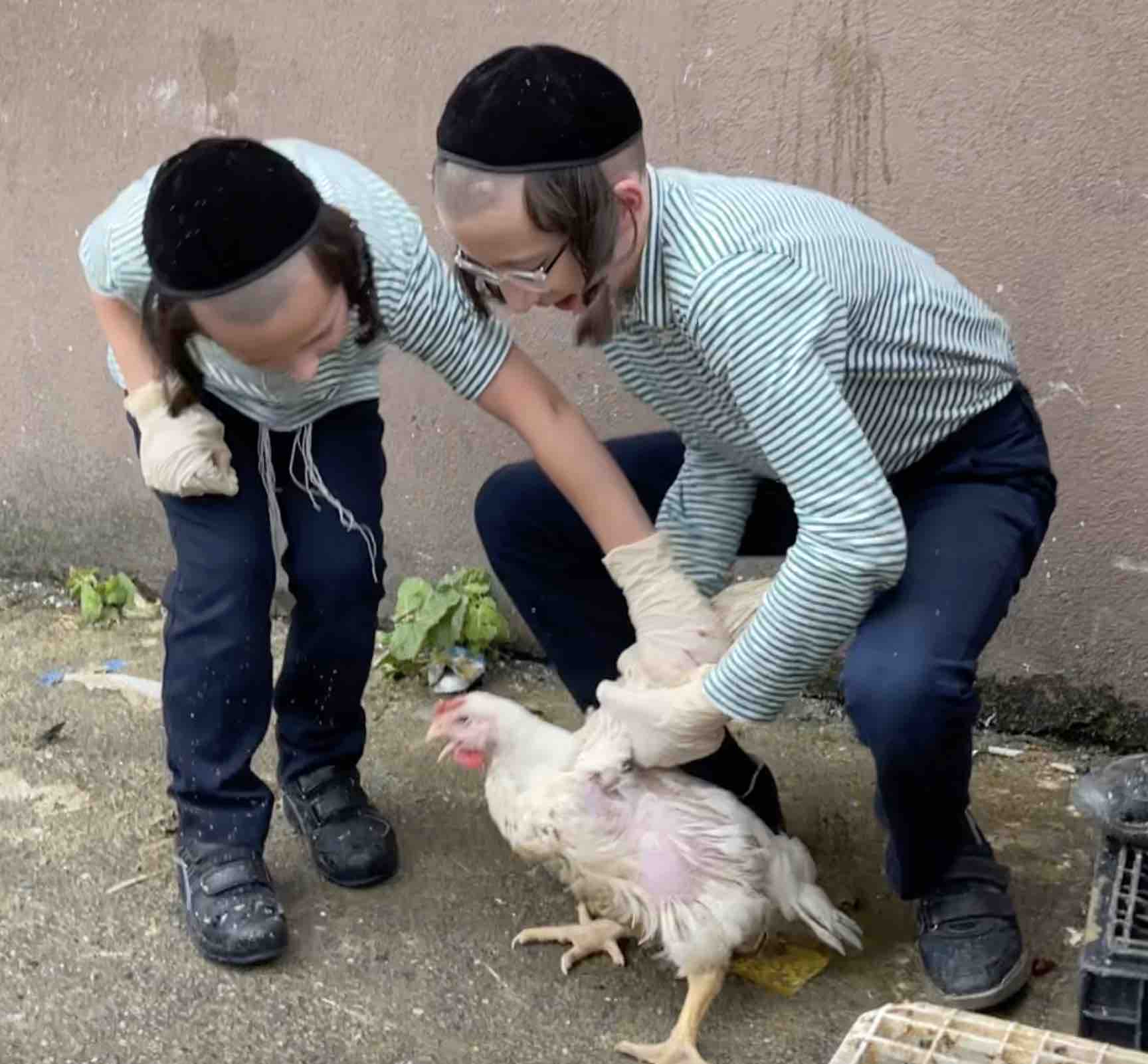
During Kaporos, ultra-Orthodox, or Hasidic, Jews twirl a live chicken around their head while reciting a prayer asking for forgiveness for their sins. After the ritual, the chickens are killed in one of dozens of makeshift slaughterhouses erected on public streets without permits in violation of 15 city and state health and animal cruelty laws.
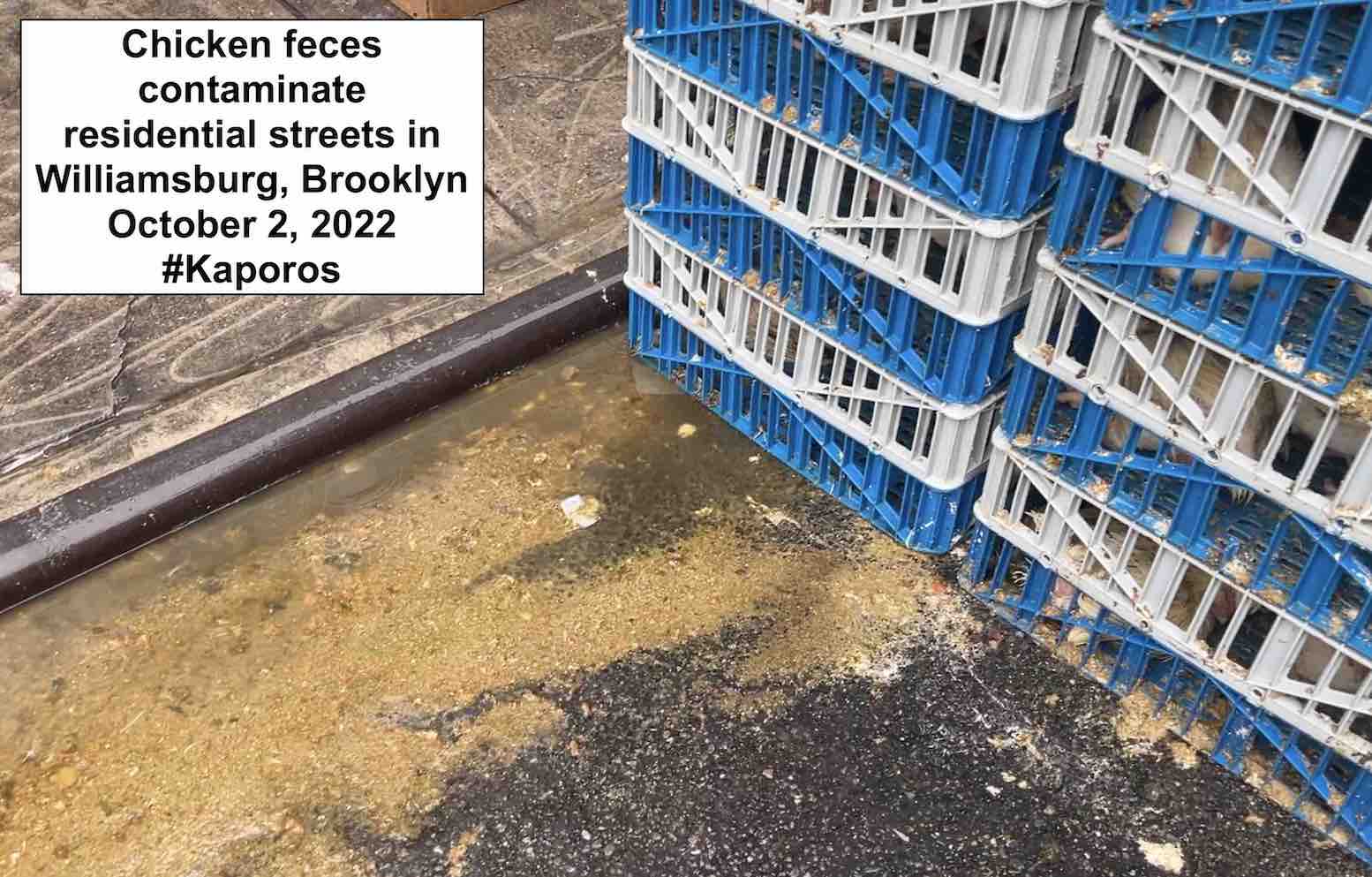
Photo of chicken feces on public streets during Kaporos

During Kaporos, a ritual slaughter of chickens before Yom Kippur, residential streets in several Hasidic neighborhoods in Brooklyn are contaminated with chicken feces in violation of multiple city and state health codes.

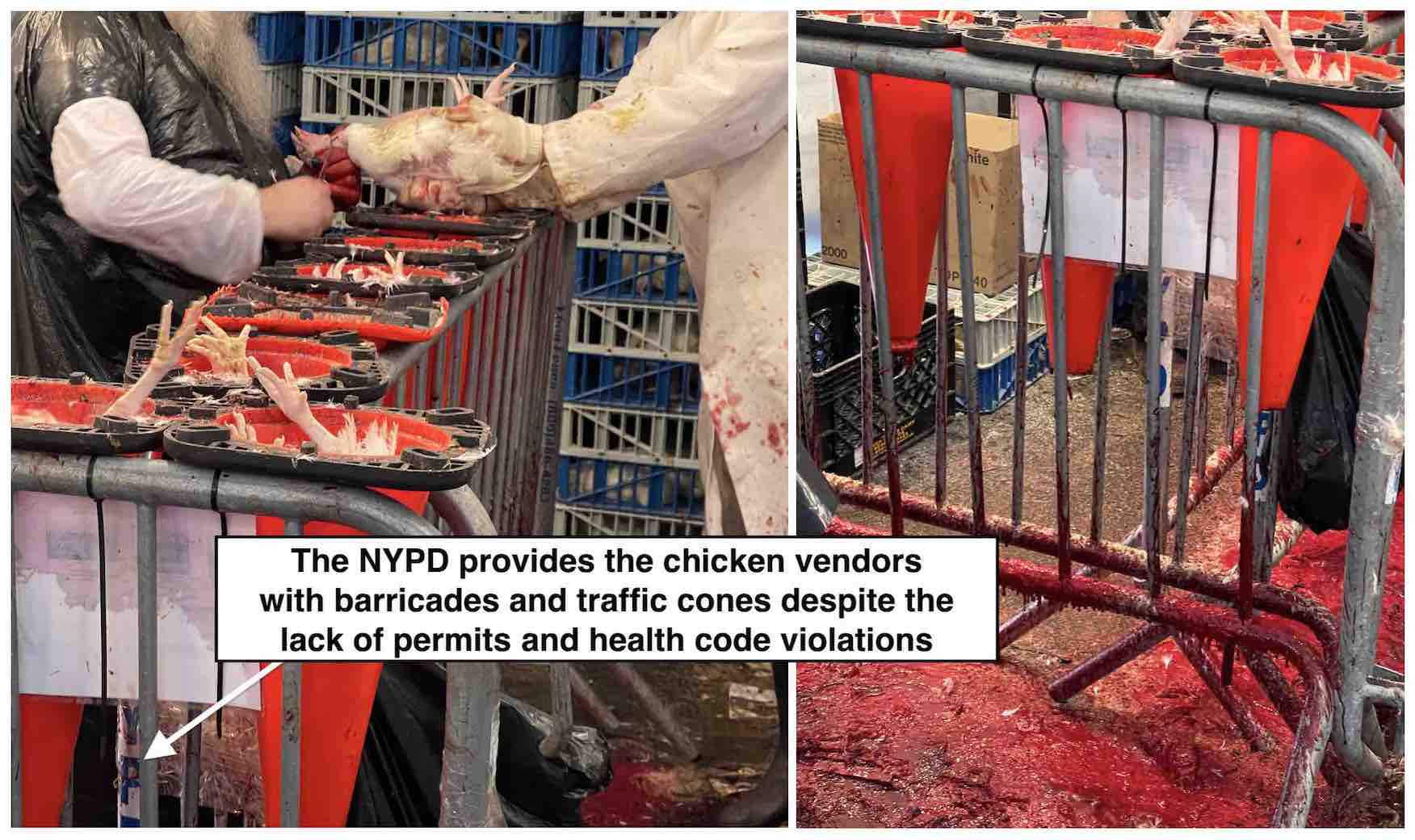
Instead of shutting down the slaughterhouses and issuing fines, the NYPD provides the Kaporos vendors with barricades, floodlights and a police presence to help facilitate the ritual killing. At some of the Kaporos sites, the NYPD closes down entire public streets. Despite the health code and animal cruelty violations and the lack of permits, the city government subsidizes Kaporos because the Hasidic communities in Brooklyn are a powerful voting bloc. 
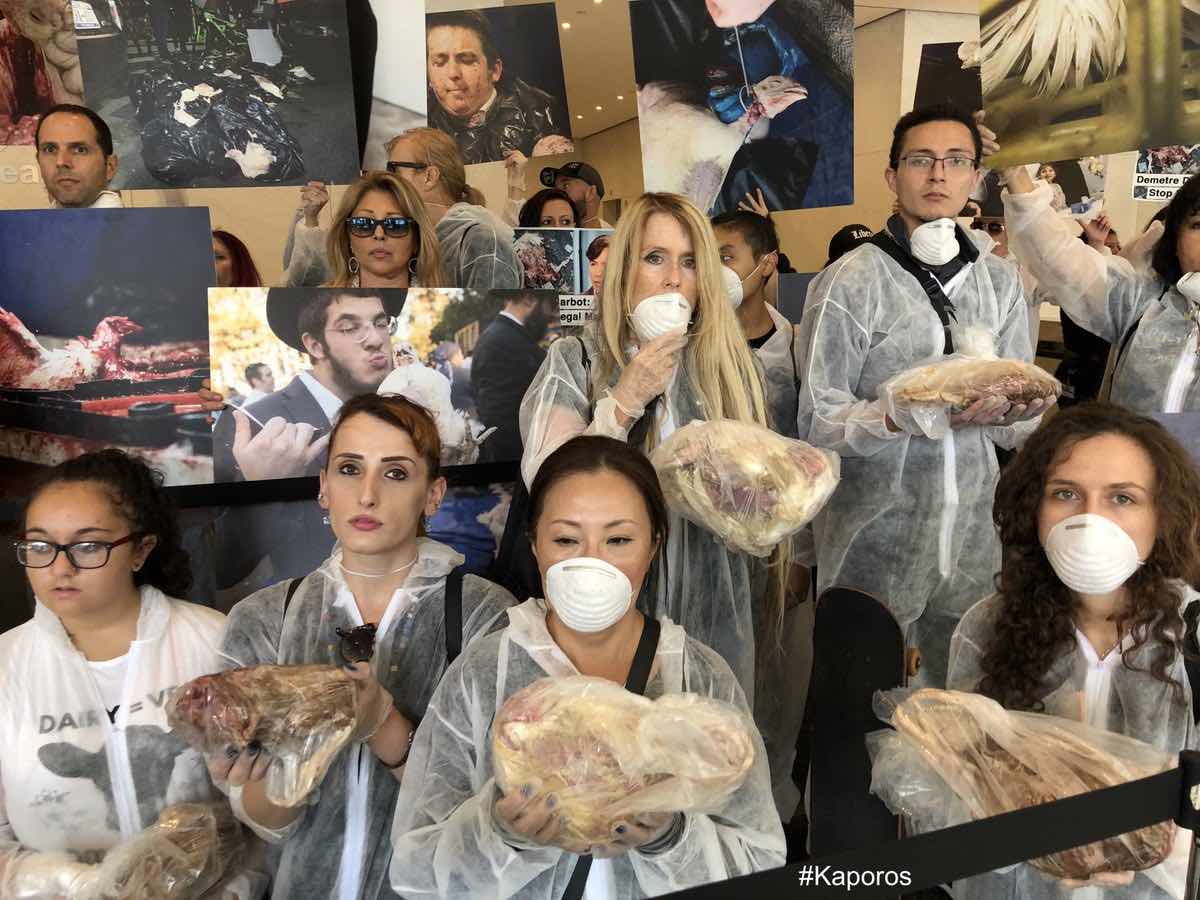
Photos of chickens killed during Kaporos in Brooklyn, NY

In 2018, animal rights activists brought dead Kaporos chickens left on the streets of Brooklyn into the NYC Department of Health.

For many years, animal rights activists with the Alliance to End Chickens as Kaporos protested Kaporos, calling on practitioners to perform the ritual using coins, a commonly used alternative to chickens. Over time, however, the protests, which did not appear to be effecting change, morphed into “chicken care vigils” during which activists provide food and water to the chickens in the crates.

@theirturn

Look how hungry they are. See 5th link in bio. #kaporos #yomkippur #animalcruelty #hasidimofbrooklyn #animalsacrifice @nychealthy

♬ original sound – Donny Moss

In 2017 and 2018, animal rights activists in New York City ran a campaign to compel the Health Commissioner at the time, Dr. Mary Bassett, to enforce the health codes violated during Kaporos. In a meeting with Dr. Bassett and other Health Department officials, the advocates presented her with a toxicology report which concluded that  Kaporos poses a “significant public health hazard” based on fecal and blood samples taken from the streets. Indeed, several advocates who have rescued abandoned and sick chickens have contracted e. Coli and campylobacter. Dr. Bassett refused to curb Kaporos, telling the advocates that “no disease signals” had been associated with the practice.

After being subjected to ten months of increasingly provocative protests during her public appearances, Dr. Bassett resigned from her position as Health Commissioner with over three years left in her term and moved to Boston. In anticipation of a protest during a talk that she was giving at the Boston University School of Public Health, Dr. Bassett attempted to defend her inaction on the grounds that her boss at the time, Mayor Bill de Blasio, would not allow it:  “Those of us who work in government face the reality of the fact that the people who appoint us have to go back to the public and back to the ballot box to be reappointed, so there’s always going to be a need for advocacy from people outside of government. For someone who is passionately committed to many issues embraced by advocates, it can be difficult to acknowledge the role that I play as a political appointee. I can’t always be at the barricades.”
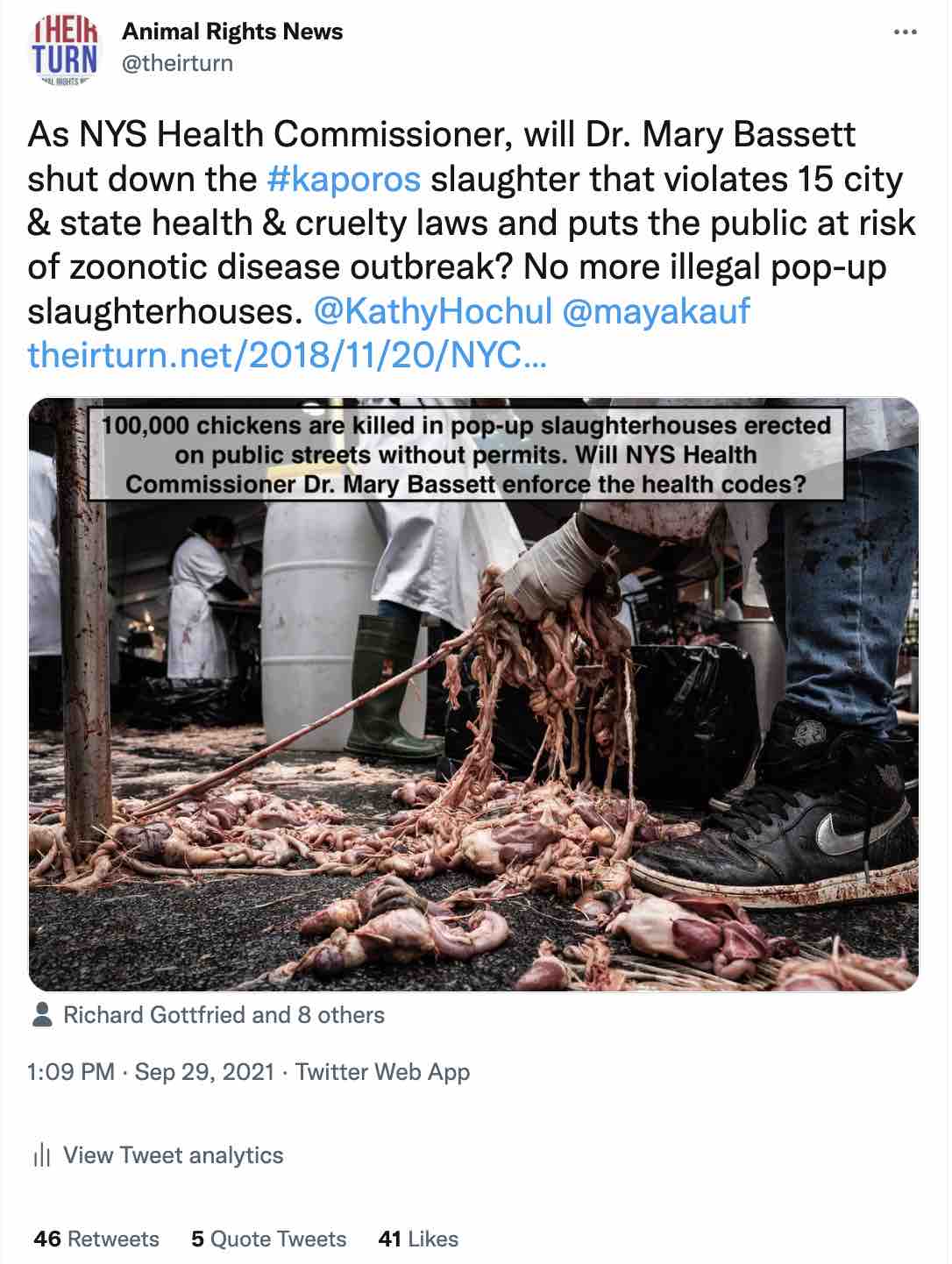
Photo of chicken body parts on the sidewalk

Animal rights activists say that, as NYS Health Commissioner, Dr. Mary Bassett has an obligation to enforce the health codes and protect the public from another zoonotic disease outbreak

After spending three years in Boston, Dr. Bassett returned to New York in 2021, when Governor Kathy Hochul appointed her State Health Commissioner, a position that gives her more power than before to shut down Kaporos. Activists hoped that the COVID pandemic, which is believed to have originated in a live animal market, would compel Dr. Bassett to curb the practice, as tens of thousands of people without PPE physically handle live animals, many of whom are visibly sick and show signs of respiratory distress.
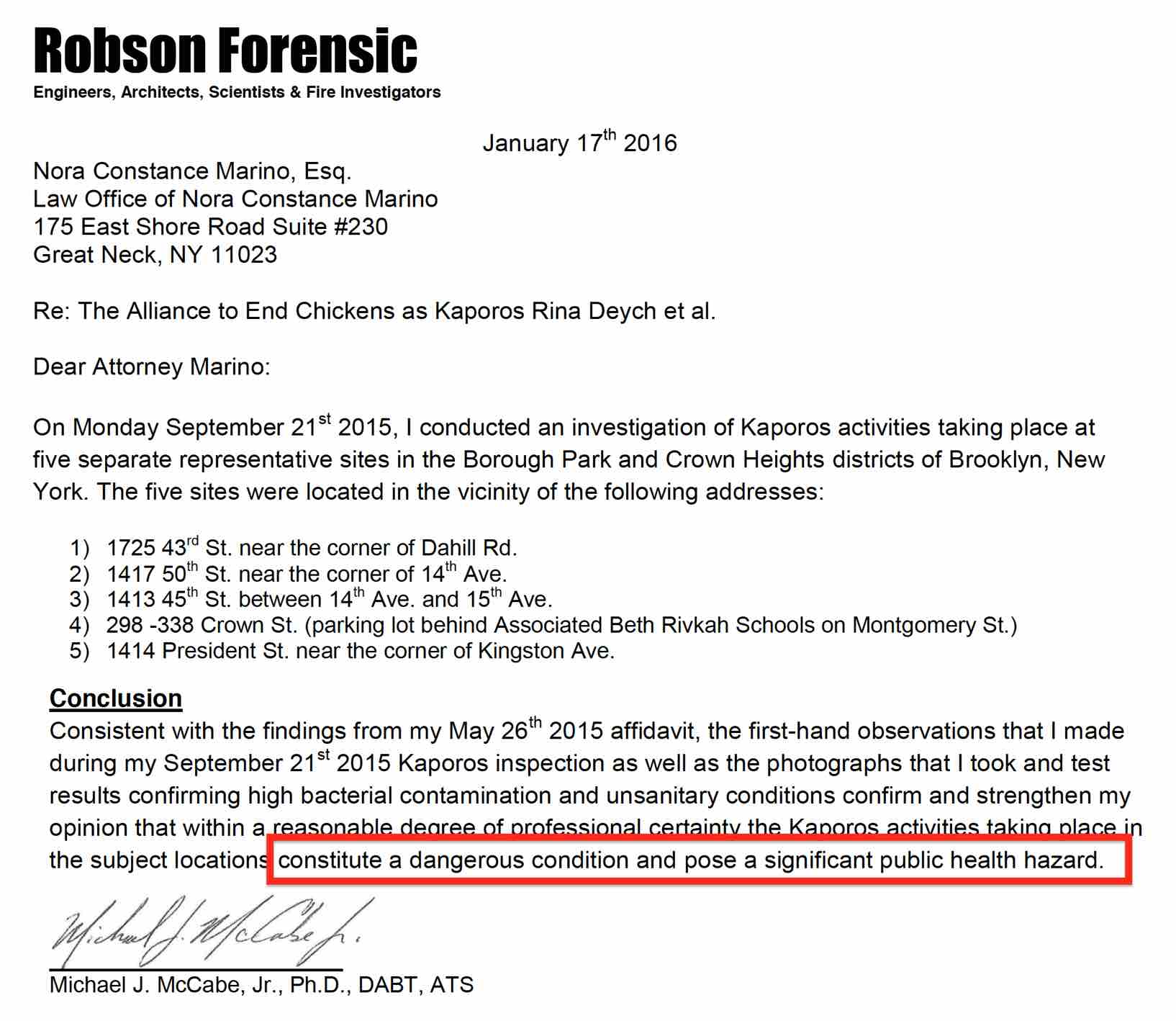
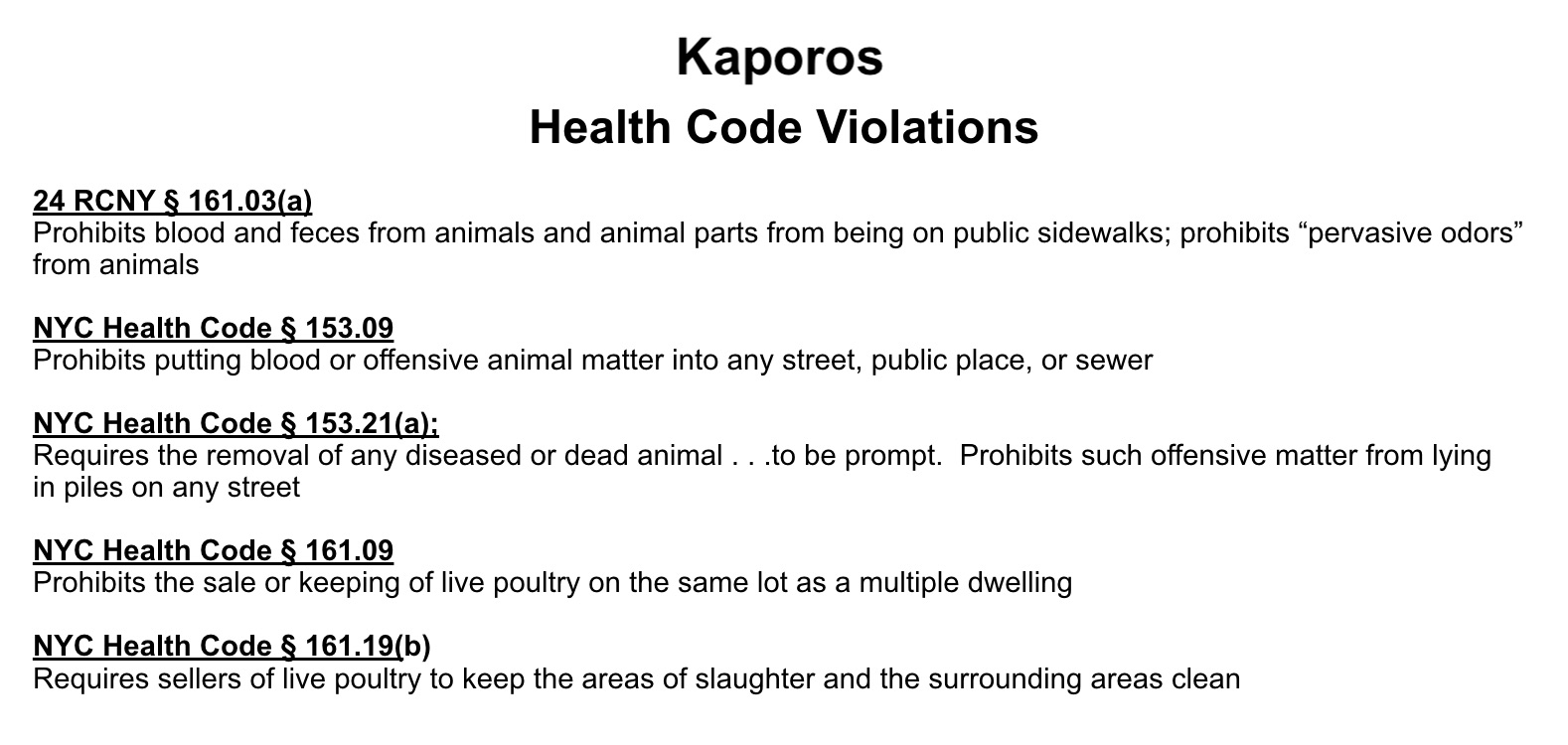
Photos of toxicology report outlining the risks Kaporos poses to the public health

Mayor de Blasio’s Health Commissioners have refused to address a toxicology report that outlines the public health risks posed by the slaughter of over 100,000 chickens on public streets during Kaporos.

In 2015, an advocacy group called the Alliance to End Chickens as Kaporos and 19 NYC residents who live in neighborhoods that are contaminated by the mass slaughter sued the City of New York, the NYC Department of Health and the NYPD for failing to enforce the 15 public health, sanitation and anti-cruelty laws and regulations that are violated during Kaporos. Nora Constance Marino, the attorney for the plaintiffs, called on the court to issue a “Writ of Mandamus,” which would compel city agencies to enforce the laws. After two lower courts ruled against the plaintiffs, Marino argued her case in front of the Court of Appeals, which ruled that city agencies have discretion over which laws to enforce.

Activists estimate that at least 100,000 chickens are slaughtered in the streets of Brooklyn each year during Kaporos.


Filed under: Food
Tagged with: , , ,

UnChainedTV Releases First Ever Animal Rights Reality Show, Pig Little Lies

June 18, 2022 by Leave a Comment


The News

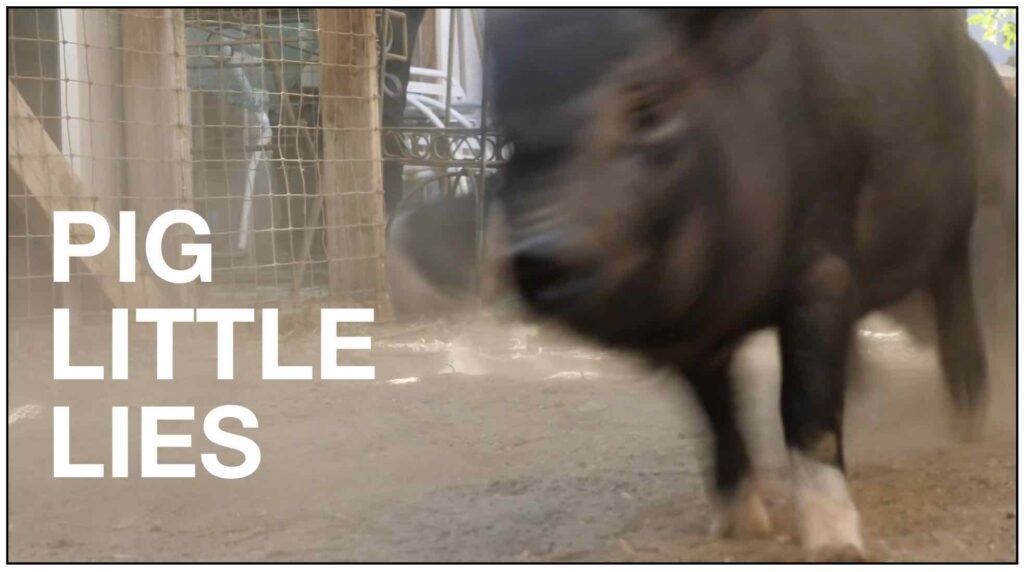
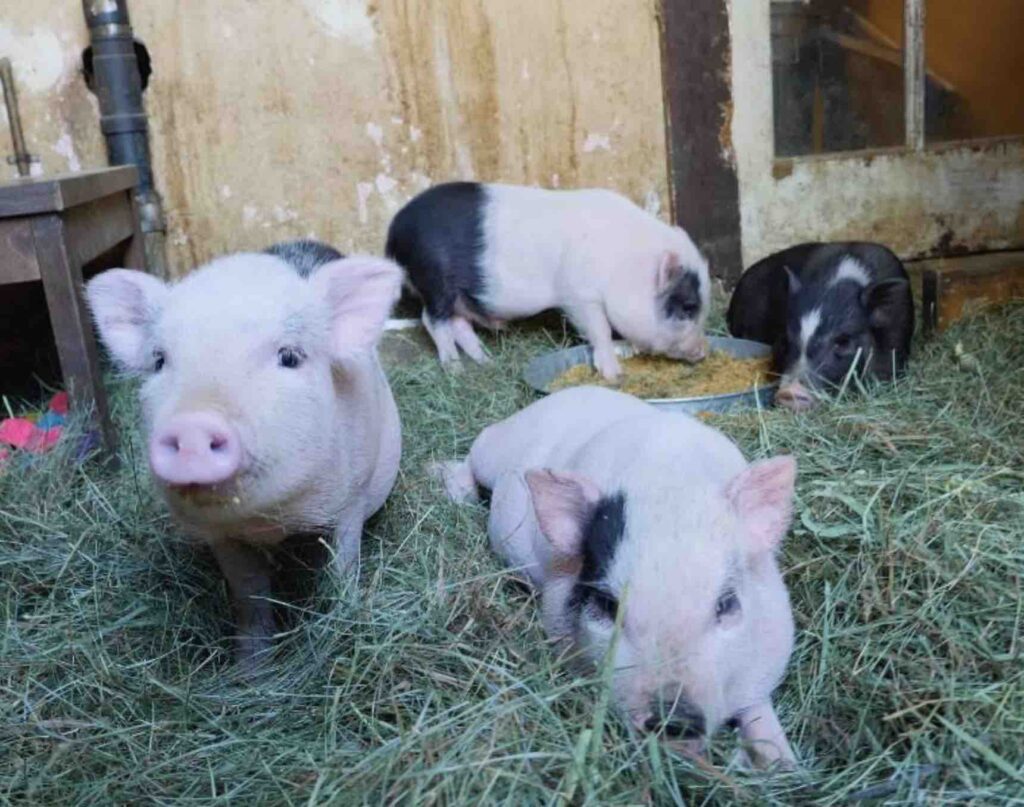
What happens when a country music singer and a TV news journalist receive a phone call about two pigs who will be killed if they’re not rescued within the next 24 hours? Pig Little Lies, a new reality show on UnChainedTV, documents the chaotic – and at times funny – rescue of a bonded pair of potbelly pigs and the bittersweet surprise that transformed the lives of the motley crew of human animals who are caring for them.

Pig Little Lies, a new TV series on UnChainedTV, is the first animal rights themed reality show

Pig Little Lies, a new TV series on UnChainedTV, is the first animal rights themed reality show

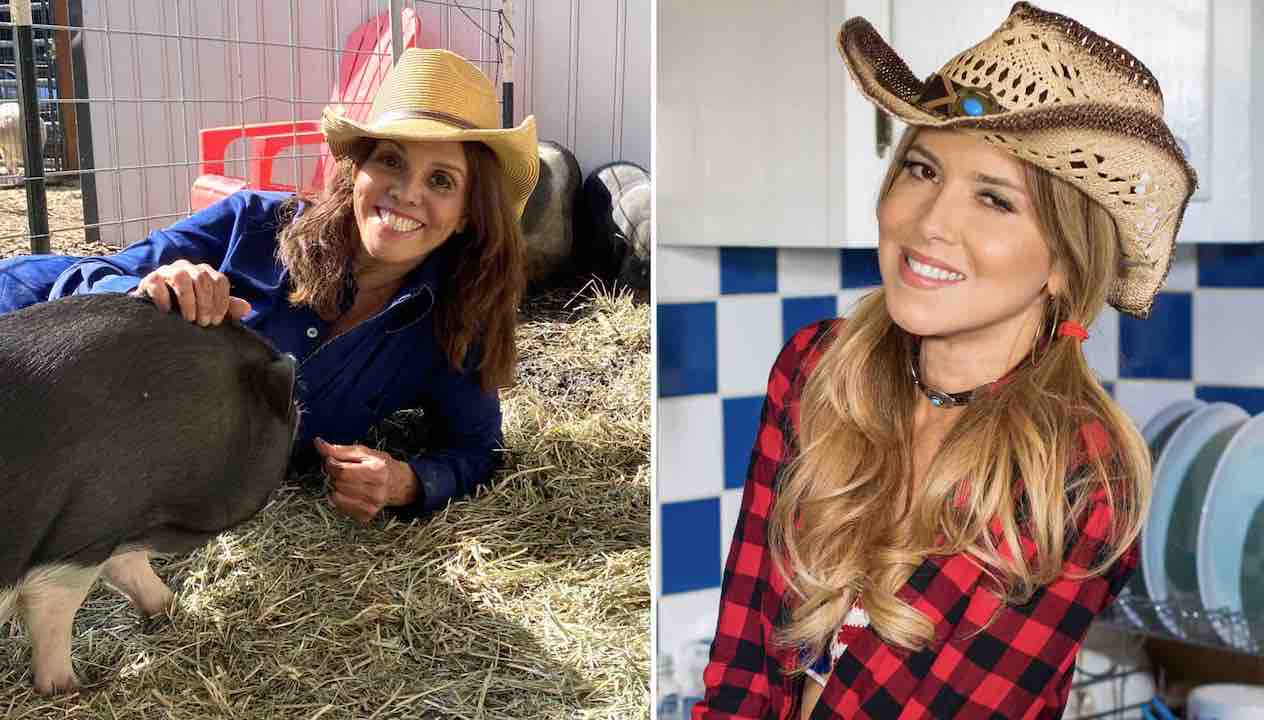
Pig Little Lies, the first animal rights-themed reality TV show, stars Los Angeles-based country singer Simone Reyes, TV journalist Jane Velez-Mitchell, wildlife rehabilitation expert Cindy Brady, and Dante and Beatrice, the two pigs who were abandoned at a high kill animal shelter in Southern California. When Reyes received the fateful call about Dante and Beatrice, Velez-Mitchell, who was with her at the time filming another project, decided to turn her attention – and the camera – to what she knew would be a dramatic rescue.

UnchainedTV is a free network with animal rights and vegan content that can be streamed on smart TVs, smart phones, tablets, Amazon’s Fire Stick, AppleTV and Roku.

Pig Little Lies is first original series produced by UnChainedTV. Launched in 2022, UnChained TV is free streaming platform with hundreds of animal rights and vegan-themed documentaries, cooking shows, travelogues, talk shows and music videos. Velez-Mitchell, who founded the platform, describes it as “a portal to a healthier, more environmentally sustainable, and more compassionate lifestyle.”

Several mainstream media news outlets, including Variety, have reported on UnChainedTV’s release of Pig Little Lies.

Several mainstream media news outlets, including Variety, have reported on the release of Pig Little Lies, the first original series produced by the new streaming network UnChainedTV 

Several mainstream media news outlets, including Variety, have reported on the release of Pig Little Lies, the first original series produced by the new streaming network UnChainedTV

For Velez-Mitchell, Pig Little Lies is the perfect series for her burgeoning network because it uses an entertaining reality show format to provide viewers with life-saving information that they aren’t getting elsewhere. “Heart disease is a leading killer often caused by cholesterol in pork and animal products,” says Velez-Mitchell. “Do doctors inform you of that? Do they tell you that the World Health Organization warns that processed meat, like hot dogs and bacon, cause cancer?” Velez-Mitchell and Reyes are aiming to help the viewers connect the dots between the animal-based foods on their plate and the diseases that are caused by eating them. They are also hoping to help viewers connect the dots between their pork-based meals and the lovable pigs who they get to know in the series. “Pigs are intelligent, social and gentle animals who value their independence and love their families just like us,” said Reyes. “This UnChainedTV series gives Dante and Beatrice an opportunity to showcase their personalities and introduce themselves to people who would normally eat them.”

A few of the stars of UnChainedTV's reality show Pig Little Lies

A few of the stars of UnChainedTV’s reality show Pig Little Lies

UnChained TV is also a platform for filmmakers and animal rights activists to feature their work addressing climate change, filling in a major gap left by the mainstream environmental movement, which has largely avoided addressing the impact of animal agriculture on the planet. “You have a few influential climate activists, like Greta Thunberg, promoting an eco-friendly plant-based diet, but the largest environmental groups have dropped the ball on animal agriculture,” said Velez-Mitchell. “In addition to being one of the largest emitters of greenhouse gases, animal agriculture contributes to habitat destruction, wildlife extinction, world hunger, drought, ocean dead zones and widespread water pollution.”

Jane Velez-Mitchell and Simone Reyes star in UnChained TV's new reality show, Pig Little Lies

Jane Velez-Mitchell and Simone Reyes star in UnChainedTV’s new reality show, Pig Little Lies

Velez-Mitchell hopes that Pig Little Lies will be the first of many original series produced by UnChainedTV.  Next up — a mini-series about a chicken named Hope who lives with a family in Southern California and who rules the house!

The Executive Producers of Pig Little Lies are Jim Greenbaum, Cindy Landon, Dr. Sailesh Rao, Eamonn McCrystal and Jane Velez-Mitchell. The show is directed by Emmy-winning Eamonn McCrystal of Inspired. LLC.

UnchainedTV is a free network that can be streamed on smart TVs, smart phones, tablets, Amazon’s Fire Stick, AppleTV and Roku.


Filed under: Food
Tagged with: , ,

Avian Flu Outbreak Prompts Calls for Suspension of Live Animal Market Operations Near Schools

April 29, 2022 by Leave a Comment


The News

The outbreak of avian flu has prompted parents in New York City to call on the mayor and governor to suspend the operation live animal markets, particularly those near their children’s schools and playgrounds. In a letter shared with the media, the parents argue that the markets, which sell and slaughter multiple species of birds, potentially expose their children to a host of infectious diseases, including e. Coli, campylobacter and the current strain of avian flu, which has infected people in several countries, including the United States.

“The sidewalk in front of the live animal market next to my son’s school is often contaminated with chicken feces and blood,” said Irma Labiosa, one of the public school parents who signed the letter to Mayor Adams and Governor Hochul. “He could be tracking this waste into his classroom, onto the subway and into our home.”

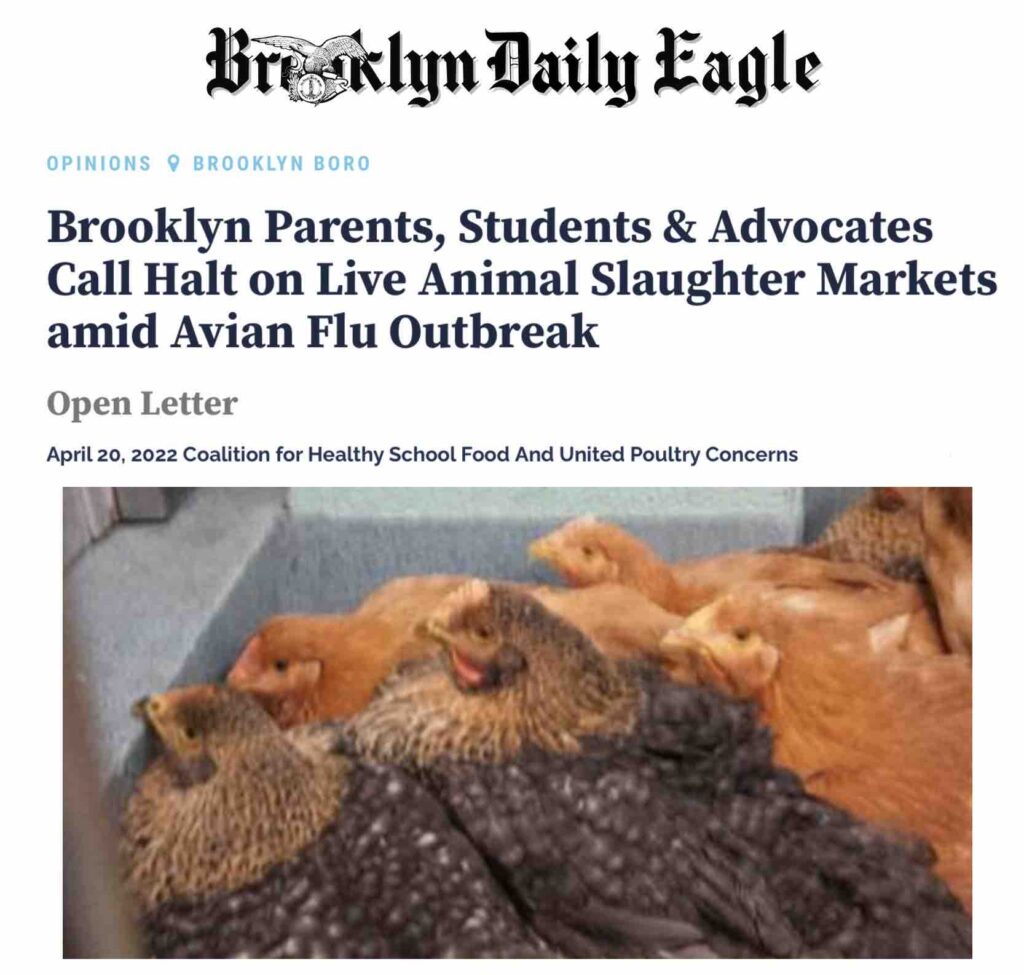
Brooklyn’s leading newspaper, The Brooklyn Eagle, published the letter in full.

The Brooklyn Daily Eagle published a letter sent by parents of NYC schoolchildren calling on Governor Kathy Hochul and Mayor Eric Adams to suspend the operation of live animal markets near schools until an avian flu risk assessment is conducted.

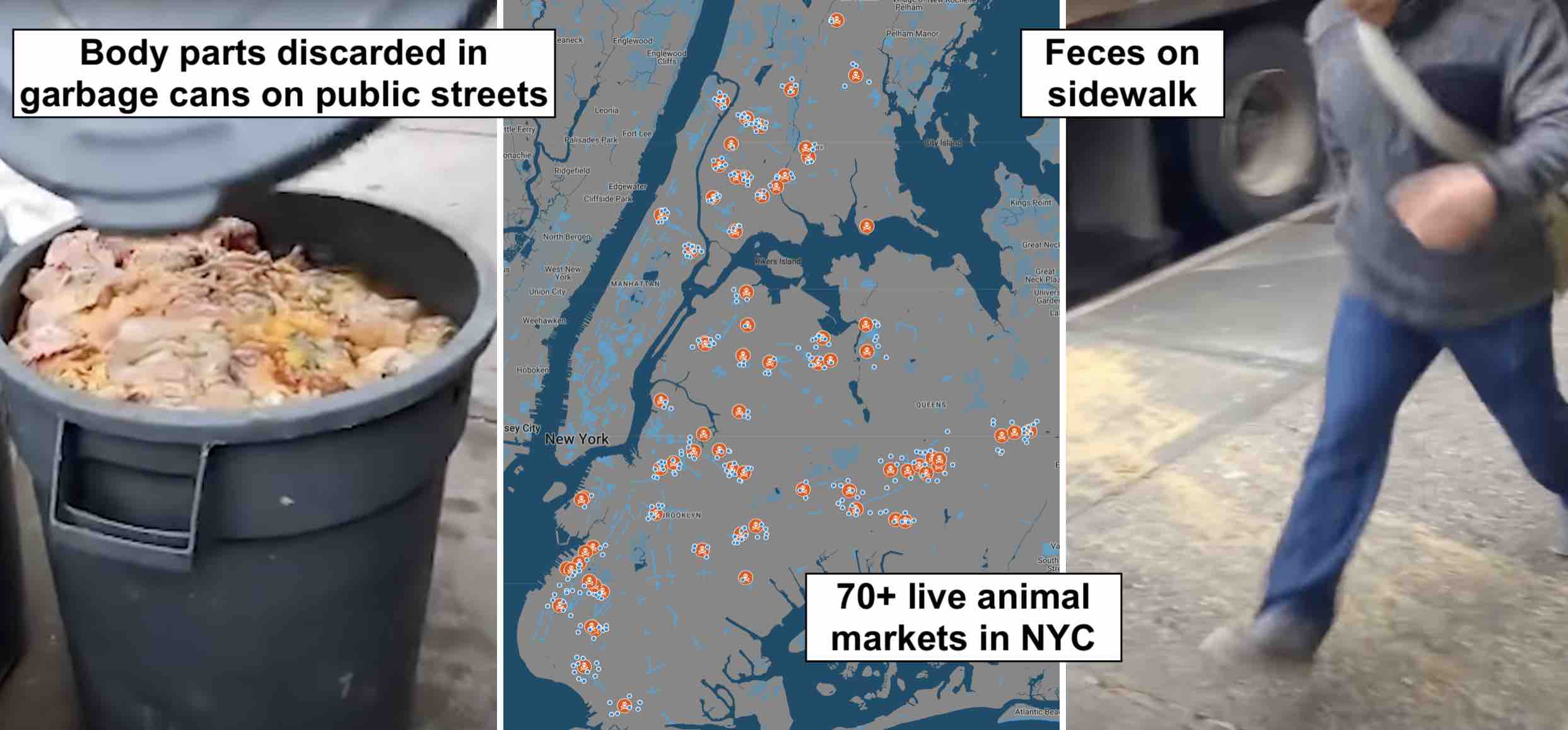
New York City’s 70+ live animal markets, also known as storefront slaughterhouses, are retail businesses that are open to the public. Many operate in densely populated neighborhoods and are located in close proximity to homes, health care facilities, businesses, public transportation, schools and playgrounds. Despite the biohazards, customers are not required to wear PPE to protect themselves and the animals from disease. Among the 10 or more bird species slaughtered in these markets are chickens, turkeys, ducks, geese, pigeons, quails and pheasants. 

“For years, I have been documenting and reporting dead chickens left in open dumpsters and puddles of blood and feces contaminating the sidewalks and streets in front of live animal markets in Queens,” said Edita Birnkrant, the Executive Director of the animal advocacy group NYCLASS. “The filthy sidewalks and putrid odors compromise the quality of life of everyone who lives and works in their vicinity and pose health risks, along with serious animal welfare violations that go ignored. That is why NYCLASS supports passage of state legislation that would prohibit the operation of these neighborhood slaughter markets and create a task force to investigate the public health risks and animal welfare concerns.”

The sidewalks in front of NYC’s live animal slaughter markets, many of which are located near schools and playgrounds, are often contaminated with feces and body parts

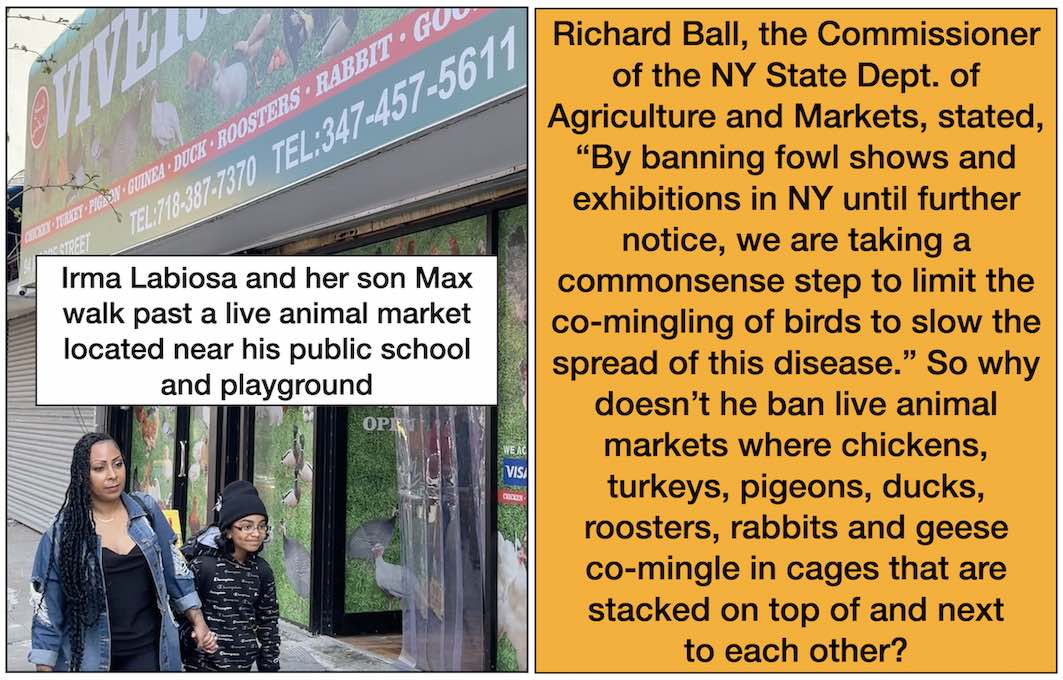
In response to the recent avian flu outbreak in New York in March 2022, the NY State Department of Agriculture and Markets banned the operation of fowl shows, auctions and exhibitions. In his announcement about the ban, Richard Ball, the Commissioner, stated, “By banning fowl shows and exhibitions in New York until further notice, we are taking a commonsense step to limit the co-mingling of birds to slow the spread of this disease.” Labiosa, the school parent, believes this ban should apply to New York’s live markets too. “Given how tightly confined the animals are, avian flu could spread like wildfire if an outbreak occurs in a live animal market,” said Labiosa. “They should not be exempt.” 

Irma Labiosa and her son Max walk by a live animal market located one block away from Max’s public school in New York City

Across the street from the live animal market near her son’s school, Labiosa told TheirTurn that she believes that the presence of live animal markets in lower-income areas is a form of environmental racism. “Wealthy New Yorkers would never allow slaughterhouses to operate in their neighborhoods, but lower income communities don’t have the resources to fight back,” said Labiosa. 

Labiosa’s son, Max, is also disturbed by the live animal market near his school, though, while speaking to TheirTurn, he expressed more concern about the mistreatment of animals than getting sick: “I’ve seen trucks stuffed with chickens, ducks and other birds. It makes me sad to see them treated that way.” Neither Labiosa nor Max eat meat anymore.

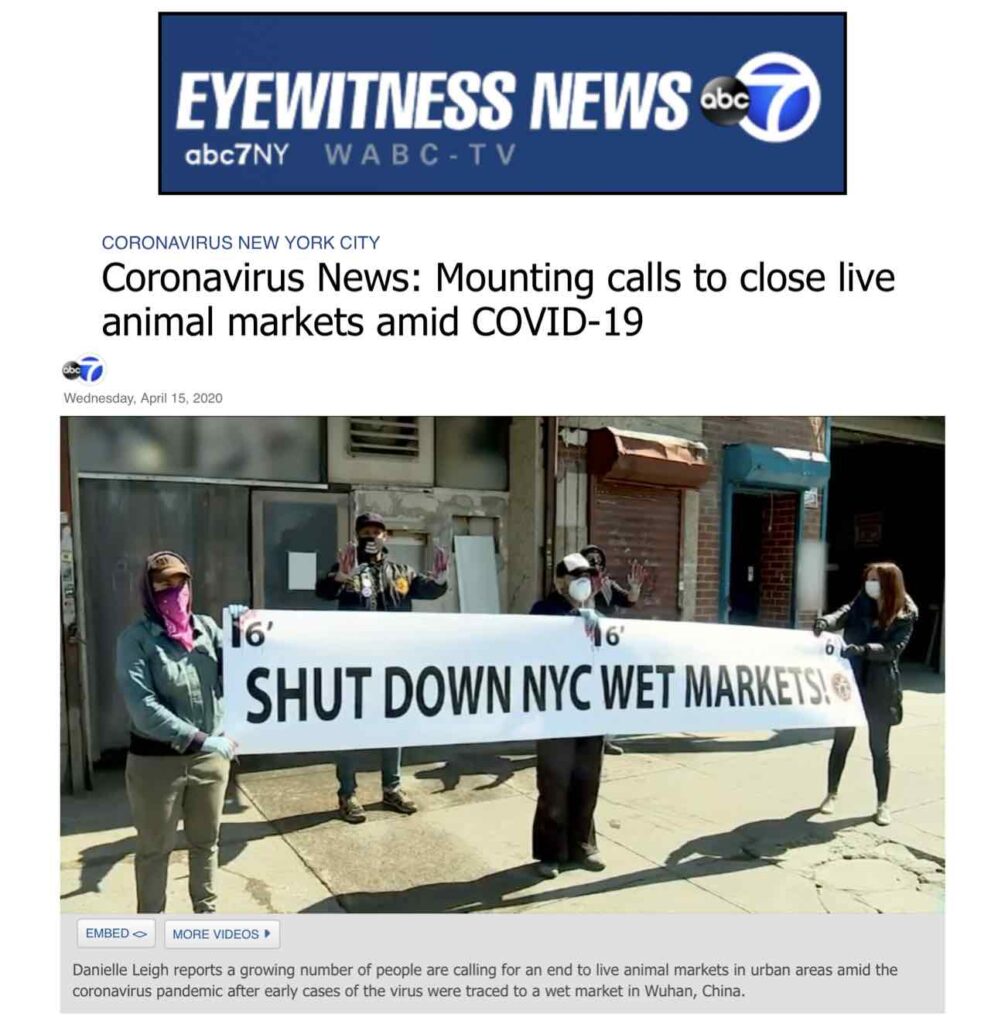
When COVID-19 reached New York, mainstream media outlets reported on the ongoing efforts of the advocacy Slaughter Free NYC to shut down the City’s 70+ live animal markets (click photo to view ABC News story)

Since 2019, Slaughter Free NYC, an advocacy group comprised of public health and animal rights advocates, has been calling on city and state officials to shut down the city’s 70+ live markets until a public health risk assessment is conducted. The group believed that the outbreak of COVID, which is believed to have been transmitted to humans in a live animal market, would trigger them to take its concerns more seriously, but they did not react. In fact, instead of shutting down the live markets, the state designated them as “essential businesses” during the lock down in March 2020.

Despite the government’s decision to ignore the calls of Slaughter Free NYC, the COVID outbreak did generate widespread mainstream media coverage about the risks of live animal markets and the advocacy group’s efforts to shut them down. In July 2020, Now This released a 10 minute documentary film (Here’s What Goes on Inside America’s Wet Markets) that went viral on social media.


Filed under: Food
Tagged with: ,

Kaporos 2021: Chaos, Care and Rescue in Brooklyn, and a New Film

October 25, 2021 by Leave a Comment


The News

From September 7 – 20, 2021, NYC’s animal rights community staged a multi-front effort to help the victims of Kaporos, an annual ritual animal slaughter that takes place in some Orthodox Jewish communities in the days leading up to Yom Kippur, the Jewish day of atonement. In Brooklyn alone, an estimated 100,000 chickens are used in the ritual each year. 

The chickens used in the Kaporos slaughter ritual are held in crates for up to several days with little to no food or water. Each year, activists find hundreds of dead chickens mixed in with the living.

The chickens used in the Kaporos slaughter ritual are held in crates for up to several days with little to no food or water. Each year, activists find hundreds of dead chickens mixed in with the living.

The chickens are trucked into the city from factory farms; stored in crates for up to several days with little to no food or water; swung in the air as practitioners say a prayer; and killed in makeshift slaughterhouses erected on public streets without permits. Despite the lack of permits and multiple health code and animal cruelty violations, the NYPD provides many of the chicken vendors with barricades, floodlights and orange traffic cones in which the chickens are bled out onto the street. In some neighborhoods, the NYPD also cordons off public streets.

In Brooklyn, tens of thousands of Orthodox Jews swing chickens around their heads as part of an annual ritual sacrifice called Kaporos.

In Brooklyn, tens of thousands of Orthodox Jews swing chickens around their heads as part of an annual ritual animal slaughter called Kaporos.

For over 10 years, New York City’s animal rights community has engaged in protest, civil disobedience, litigation, lobbying, educational outreach and animal rescue in an effort to eliminate the practice and help the victims. Despite these efforts, Kaporos continues unabated because the practitioners represent a powerful voting bloc that can help make or break elections in New York.

The city subsidizes Kaporos despite the fact that it violates multiple health code violations that put the public at risk of infectious disease transmission.

The city subsidizes Kaporos despite the fact that it violates multiple health code violations that put the public at risk of a zoonotic disease outbreak.

Making the Switch from Protests to Chicken Care

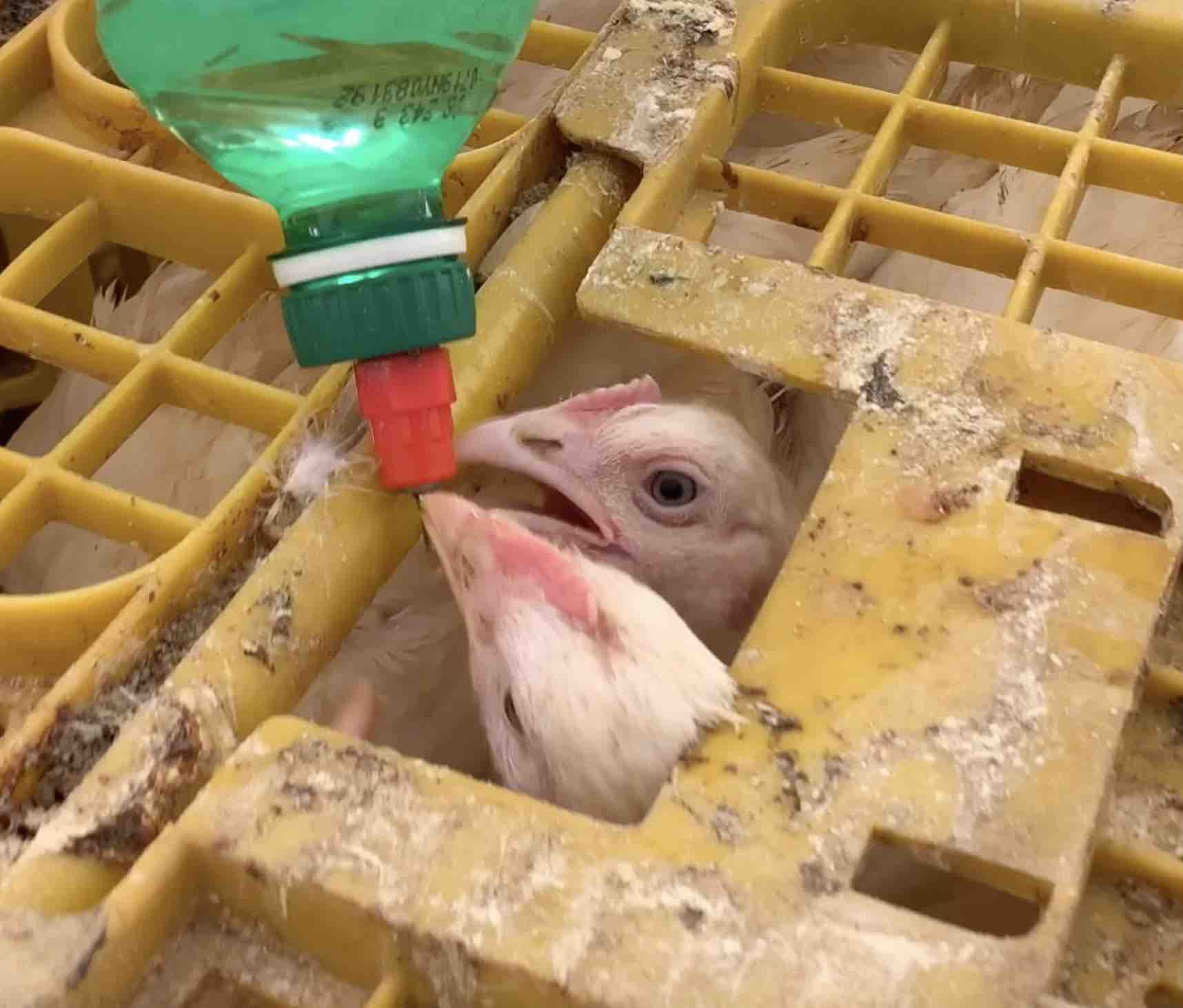
From 2010 to 2017, the Alliance to End Chickens as Kaporos, the organization that has led community efforts, staged protests at the largest Kaporos sites in Brooklyn, but the organization stopped because the practitioners doubled down on the use of chickens. In addition, many taunted activists by handling the chickens more aggressively. In 2018, the Alliance transitioned from protesting to providing the chickens with watermelon and water. The “chicken care” approach provides a bit of relief to the chickens, who would otherwise receive no nourishment, and it demonstrates to the practitioners that the animals are sentient. 

Animal rights activists provide water to some of the chickens who are stacked in crates for up to several days with no nourishment.

Animal rights activists provide water to some of the chickens who are stacked in crates for up to several days with no nourishment.

Putting the Public at Risk of a Zoonotic Disease Outbreak 

The approximately 30 Kaporos sites in Brooklyn are, in effect, unregulated live animal markets where the customers physically handle the chickens, often without protective gear. This close contact could expose them to pathogens harbored by the chickens. Over the years, many activists who have come into physical contact with the chickens have contracted e. Coli and campylobacter. 

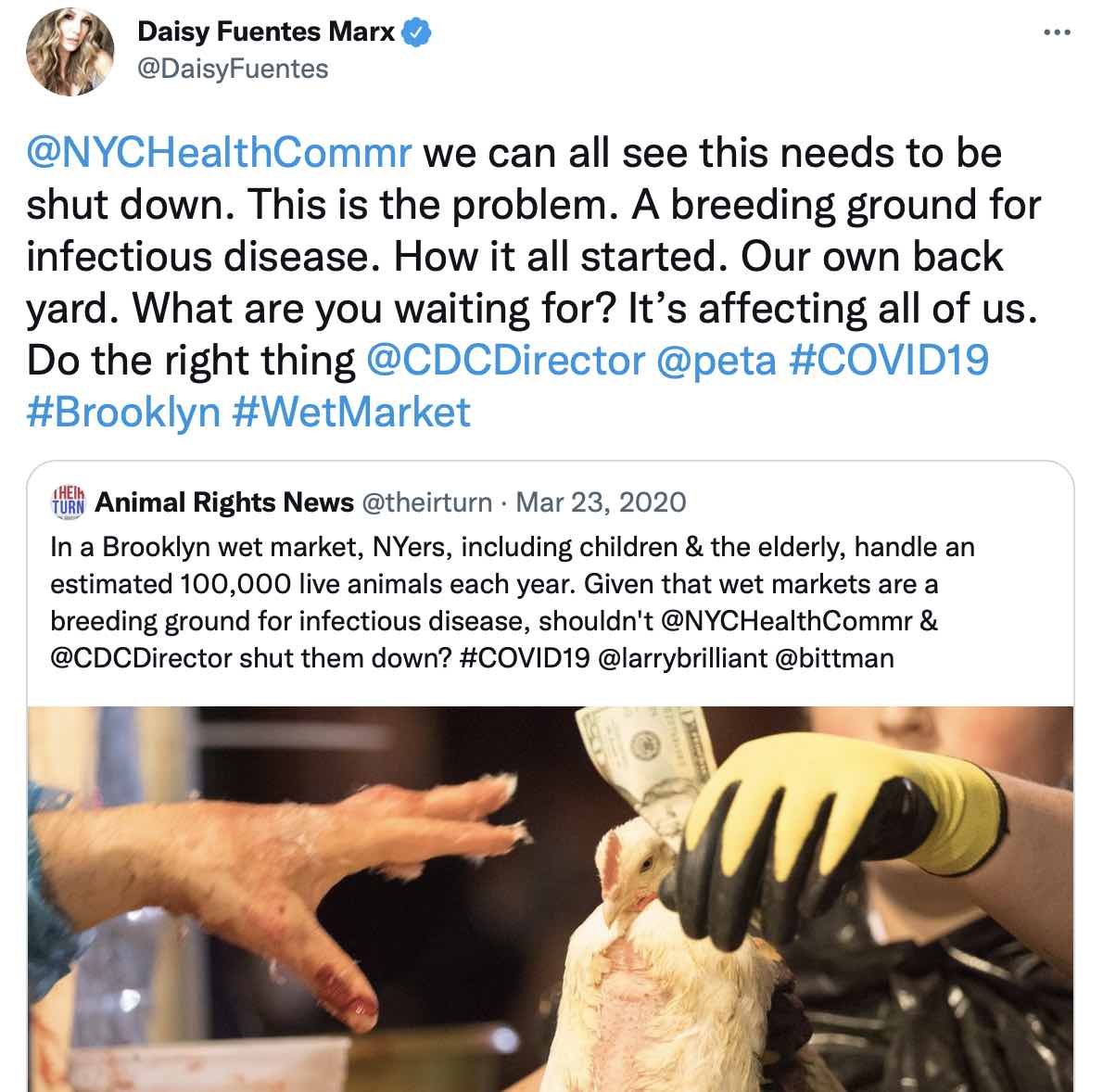
At the height of the COVID-19 pandemic, actress and model Daisy Fuentes Marx tweets about the public health risks associated with Kaporos

At the height of the COVID-19 pandemic, actress and model Daisy Fuentes Marx tweeted about the public health risks associated with Kaporos

According to a toxicologist who studied fecal and blood samples taken from the streets, Kaporos “constitutes a dangerous condition” and “poses a significant public health hazard.” If the living and dead chickens, who are crowded together in crates, harbor viruses that commingle and mutate into a strain that can be transmitted to humans, an avian flu could spread throughout the community and into the general public before it’s even detected.

Dr. Dave Chokshi and the NYC Health Commissioners who preceded him have refused to address a toxicology report that outlines the risk posed by the mass slaughter of over 100,000 animals on public streets during Kaporos.

As part of lawsuit filed against NYC on behalf of Brooklyn residents negatively impacted by the health codes violations, attorney Nora Constance Marino hired a toxicologist to investigate the health risks associated with Kaporos and produce a report. Dr. Dave Chokshi and the NYC Health Commissioners who preceded him have refused to address the toxicology report.

Animal Rescue

During the 2021 Kaporos events, activists in New York City rescued 708 chickens, the most ever. At a triage center in Brooklyn, a rescue crew led by the Alliance to End Chickens as Kaporos and Tamerlaine Sanctuary (a refuge for farm animals in NJ) provided the chickens with wound care, antibiotics and nourishment before loading them into vans that transported them to sanctuaries around the country.

In the days leading up to Yom Kippur, activists with the Alliance to End Chickens as Kaporos rescued 708 chickens and transported them to farm animal sanctuaries around the country.

In the days leading up to Yom Kippur, activists with the Alliance to End Chickens as Kaporos rescued 708 chickens and transported them to farm animal sanctuaries around the country.

The rescuers also brought over 20 chickens to veterinarians for surgical procedures that totaled over $15,000. According to Jill Carnegie, a rescuer with the Alliance to End Chickens as Kaporos, the mortality rate of the rescued chickens who were brought to the triage center was the lowest ever.

The Alliance to End Chickens as Kaporos rescued 708 chickens from slaughter during the 2021 Kaporos events in Brooklyn

The Alliance to End Chickens as Kaporos (a project run by United Poultry Concerns) rescued 708 chickens from slaughter during the 2021 Kaporos events in Brooklyn

A New Documentary Film 

In September, Cavelight Films, a New York-based production company, released a highly-anticipated documentary film about Kaporos, The 12-minute film, Voting Bloc: Slaughter in the Streets of Brooklyn, takes viewers deep inside the insular Orthodox Jewish communities where Kaporos takes place and follows several animal rights activists who document the ritual and rescue animals. 

The Campaign to End the Use of Chickens as Kaporos

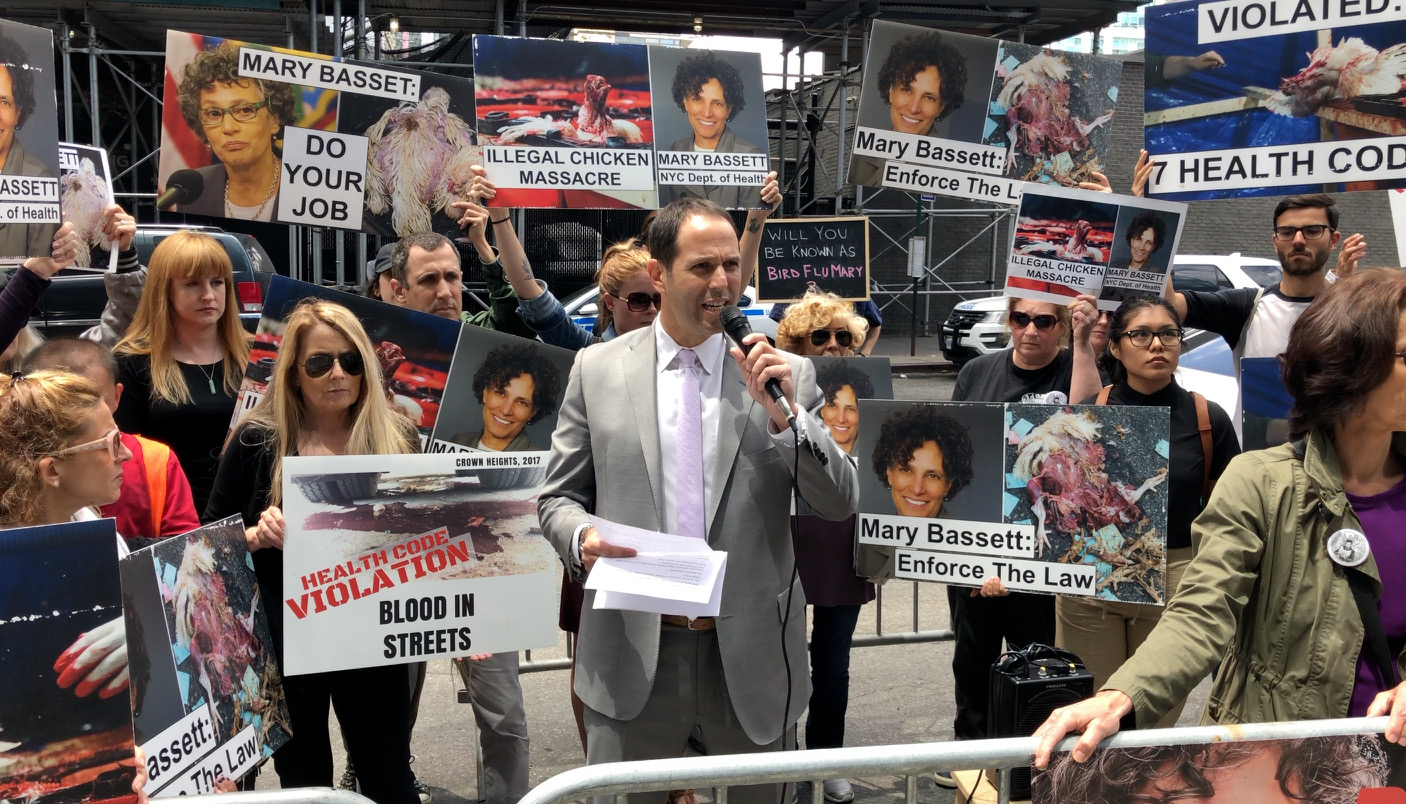
In September 2017, animal rights activists in New York began calling on the New York City Department of Health to enforce the health laws violated during Kaporos, including the slaughter of animals in residential neighborhoods and the contamination of public streets with blood, feces and body parts. They were hopeful that the Health Commissioner, Dr. Mary Bassett, would shut down the mass ritual slaughter not only because of the well documented health risks and violations, but also because she presented herself as a social justice advocate who had regrets about not speaking out against other injustices when she had the platform to do so. When Dr. Bassett dismissed the activists’ concerns, they began protesting  at her public speaking engagements. At several events, including a global public health conference at the New York Hilton, the disruptions forced Dr. Bassett to forfeit her presentation.

In August 2018, after being subjected to 10 months of unrelenting protests, Dr. Bassett resigned as Health Commissioner with three years left in her term and moved to Boston to take a job at Harvard’s T.H. Chan School of Public Health. Her departure was not the outcome that the activists sought, but it did demonstrate the power of protest, civil disobedience and pressure campaigns. Neither she nor the media acknowledged the role that the protests played in her decision to resign.

In 2018, animal advocacy groups in NYC held a press conference at the Department of Health calling on Health Commissioner Dr. Mary Bassett to enforce the city’s health codes that are violated during Kaporos, an annual ritual animal slaughter in which an estimated 100,000 chickens are killed in the streets of Brooklyn’s Orthodox Jewish neighborhoods.

While Dr. Bassett never did acknowledge her refusal to enforce her own health codes, she did publicly admit that she was constrained by politics. In anticipation of a protest during a presentation at the Boston University School of Public Health, she stated, “Those of us who work in government face the reality of the fact that the people who appoint us have to go back to the public and back to the ballot box to be reappointed, so there’s always going to be a need for advocacy from people outside of government. For someone who is passionately committed to many issues embraced by advocates, it can be difficult to acknowledge the role that I play as a political appointee. I can’t always be at the barricades.”

Multiple health codes are violated during Kaporos, a ritual animal sacrifice, but NYC Health Commissioners  turns a blind eye because the practitioners represent a powerful voting bloc.

Multiple health codes are violated during Kaporos, a ritual animal sacrifice, but NYC Health Commissioners  turns a blind eye because the practitioners represent a powerful voting bloc.

While most of the audience members did not know what Dr. Bassett was talking about, the animal rights activists who were present or watching the livestream did. In New York, many elected officials go to great lengths to support of the ultra-Orthodox (Haredi) Jewish communities because they represents a powerful voting bloc. Dr. Bassett’s boss, Mayor Bill de Blasio, undoubtedly forbade her from shutting down Kaporos, despite the fact that it violates so many laws, because it could have cost him future endorsements from that community. To appease her boss, Dr. Bassett prioritized politics ahead of public health.  

In September 2021, New York Governor Kathy Hochul hired Dr. Bassett to serve as the state’s Health Commissioner, a position that once again gives her the authority to enforce health codes and take measures to protect the public health.

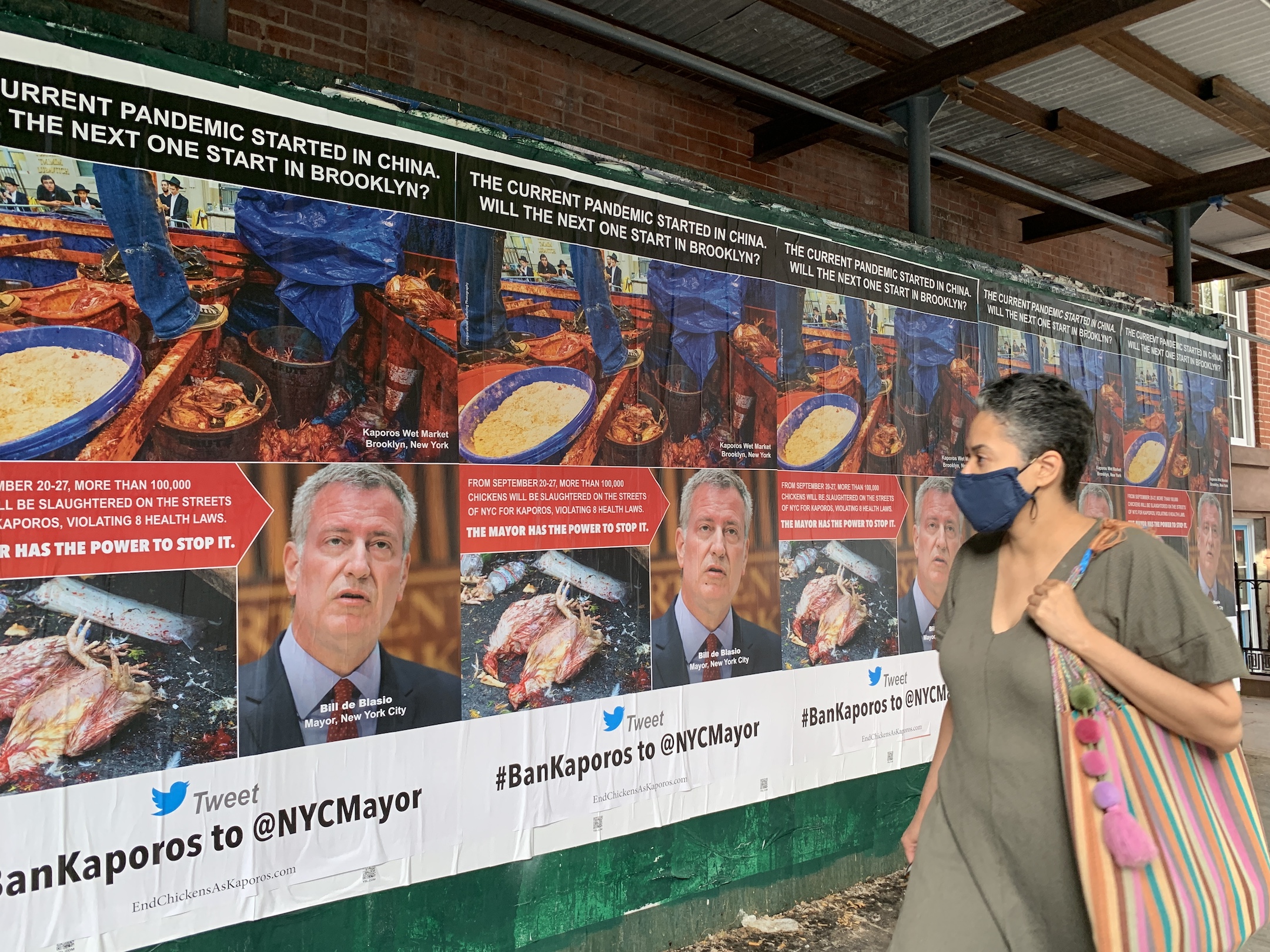
Animal rights activists plaster NYC with posters highlighting the risk of zoonotic disease transmission during Kaporos in 2020

When Dr. Bassett resigned in 2018, the activist community turned its attention to the Deputy Commissioner of Disease Control, Dr. Demetre Daskalakis. He seemed like an appropriate target, given the e. Coli and campylobacter infections and the toxicology report which outlined the public health risks. After he ignored letters requesting a meeting and refused to talk to advocates in the lobby of the Department of Health, activists staged two protests at a spin (cycling) studio he co-owned with his husband. After the second protest, he falsely accused protest organizer Donny Moss of assault and had him arrested. Instead of engaging in a discussion with the activists or simply enforcing the health codes, Dr. Daskalakis used his power as a high-ranking city official to silence and intimidate activists in order to prevent future protests at his spin studio.

Discomfort about Kaporos Among the Practitioners 

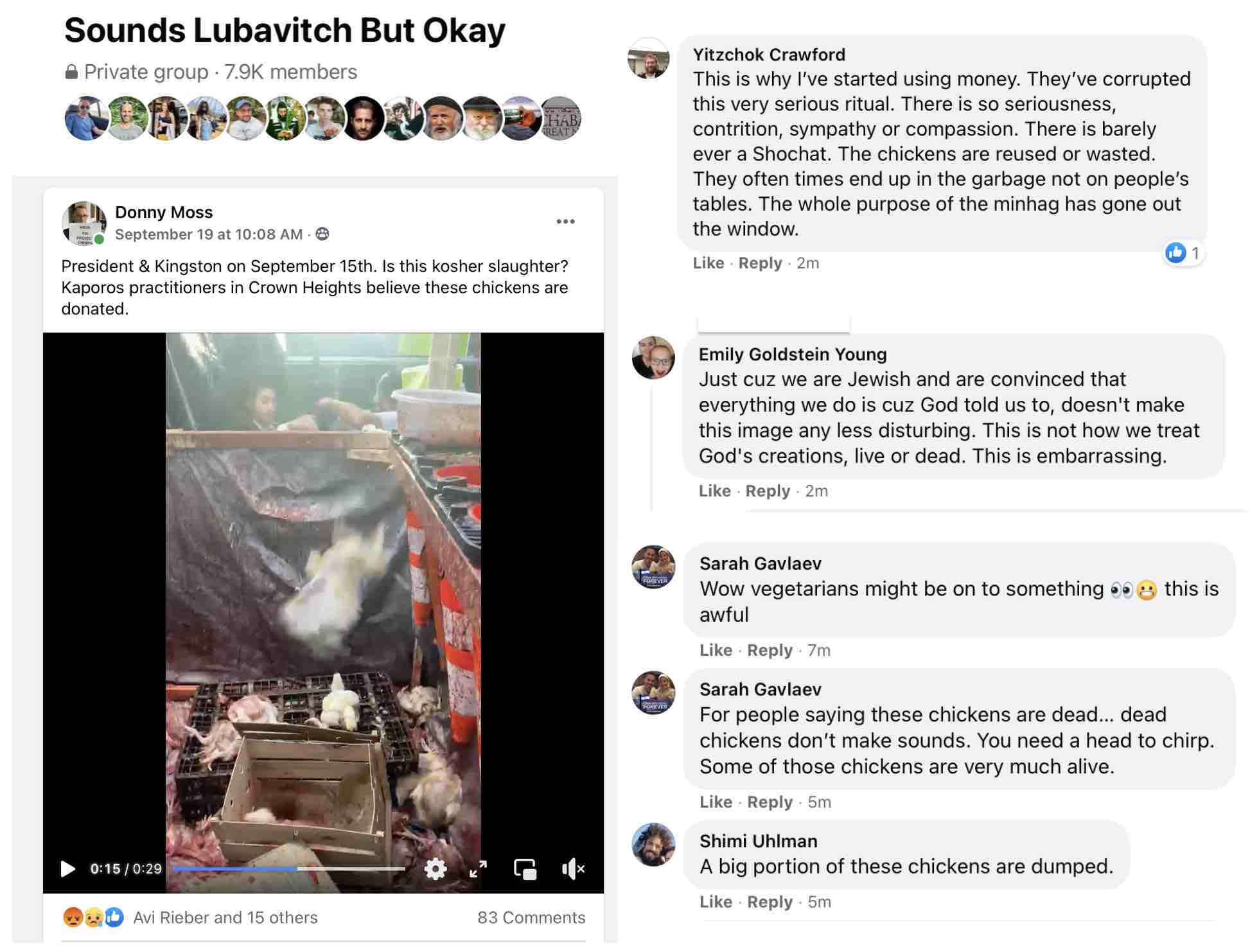
After Yom Kippur, TheirTurn posted a Kaporos video in an Orthodox (Lubavitch) Facebook group with almost 8,000 members. The video, taken in the Crown Heights section of Brooklyn, shows bloody chickens flailing around in great distress after workers at a makeshift slaughterhouse sliced their throats and tossed them into the street. While several Lubavitchers argued that the chickens were dead despite their movements, the majority of people expressed anger about the cruelty and the reckless disregard for “God’s creatures.” Some also expressed concern about the chickens being discarded, as they are told from a young age that the chickens are donated to the poor. 

Video footage of chickens being tossed into the street while still alive after their throats were sliced generated angry responses from Lubavitcher Jews who are told that the chickens are donated to the poor.

Video footage of chickens being tossed into the street while still alive after their throats were sliced generated angry responses from Lubavitcher Jews who are told that the chickens are donated to the poor.

During the 2021 Kaporos, the NYPD took the unprecedented step of shutting down two of the Kaporos sites after dozens of activists filed sanitation, animal cruelty and underage worker complaints with the city. While this enforcement act did nothing to help the chickens, who were transferred to other Kaporos sites, it did offer the activist community a glimmer of hope. Still, after years of protest and other forms of advocacy, many NYC activists have concluded that the mass ritual slaughter will continue until a deadly zoonotic disease outbreak forces city or state officials to shut it down. Until then, the animal rights community will continue to engage in chicken care and rescue to reduce the suffering and save lives.


Filed under: Food
Tagged with: ,

Activists Stage “Eating Animals Causes Pandemics” Rally in NYC

May 2, 2021 by Leave a Comment


The News

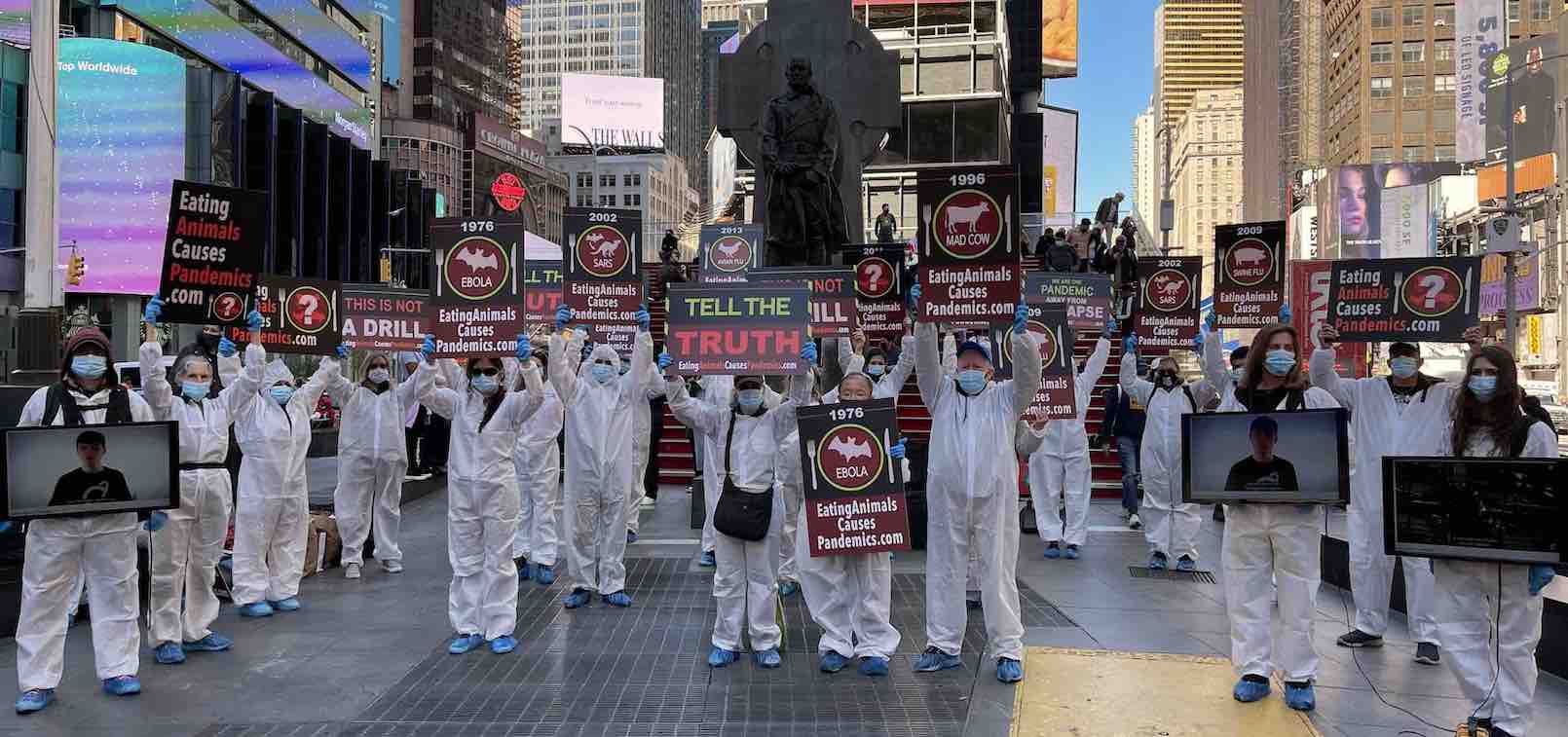
On May 1st, dozens of conservationists and animal rights activists staged a rally in Times Square to help members of the public connect the dots between eating animals and pandemics. Their message was simple: “Eating Animals Causes Pandemics.” The New York City rally was one of approximately 60 that took place in 20 countries around the world in support of International Pandemic Outreach Day.

The Eating Animals Causes Pandemics campaign is a collaboration among animal rights, environmental, conservation and religious organizations. It emerged as a result of the outbreak of COVID-19, which is believed to have jumped to humans in a live animal market in China. Like many of the pandemics that preceded it, including the catastrophic Spanish Flu of 1918, COVID-19 is a zoonotic disease — one that is transmitted to humans from a non-human animal.

On International Pandemic Outreach Day, advocates in New York City spoke to hundreds of pedestrians whose attention they captured with their hazmat suits and posters. Most were not aware that outbreaks of avian flu, swine flu and a human version of mad cow disease are caused by our consumption of chickens, pigs and cows.

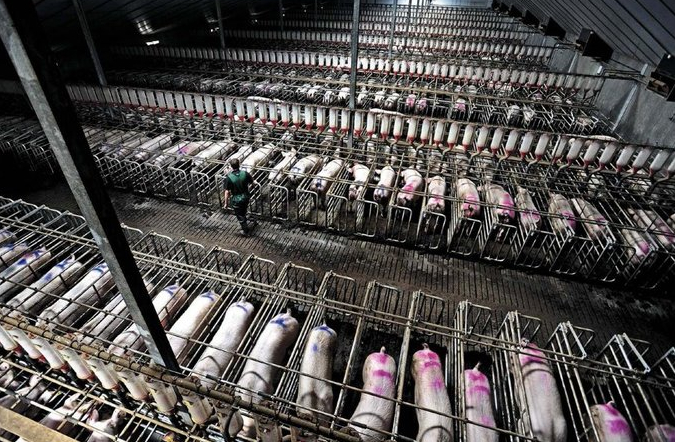
Factory farms are a breeding ground for infectious diseases, which could easily spread among the animals and, if zoonotic, to humans

The COVID-19 pandemic shined a global spotlight on the infectious disease risks associated with live animal markets, but zoonotic diseases can – and do – emerge in factory farms, slaughterhouses and any other setting where animals are intensively confined and/or slaughtered for human consumption. Dr. Michael Gregor, the author of Bird Flu: A Virus of Our Own Hatching (2016) has said, “If you actually want to create pandemics, then build factory farms.”

Conservationists and animal rights activists staged a rally in Times Square to raise awareness about the connection between eating animals and pandemics


Filed under: Food
Tagged with: ,