Their Turn - The Social Justice Movement of Our Time Their Turn - The Social Justice Movement of Our Time

Watch What Happens When Activists Show Earthlings on TV in NYC (VIDEO)

August 30, 2016 by Leave a Comment


The News

Activists with Friends of Animals United (FAUN) screened the documentary Earthlings in Union Square, a public space in New York City with a high concentration of pedestrians. The following video, which was viewed almost 300,000 times in the 24 hours after it was posted on Facebook, shows some of reactions generated by the film:

Phyllis Letthembe, the organizer, told TheirTurn that the activists show Earthlings and distribute information in an effort to open peoples’ eyes to animal cruelty and tap into their empathy.

Pedestrians in NYC stop to watch the documentary film Earthlings

Pedestrians in NYC stop to watch the documentary film Earthlings

During the two hours that Earthlings was screened, hundreds of pedestrians stopped to watch the film and talk to the activists who were standing by to answer questions. “We can tell based on the discussions we are having that people are profoundly affected by the video,” said Letthembe. “We wouldn’t be out in the streets if we didn’t think we were making a difference. After all, it was videos like Earthlings that made me and many of my fellow activists go vegan.”

The next outreach event takes place in the same location on September 15th.

Your Turn

To watch Earthlings, please visit the website for the film.


Filed under: Food
Tagged with: ,

Dozens of Activists Protest Dog Meat Eating Festival At Korean Consulate

July 20, 2016 by Leave a Comment


The News

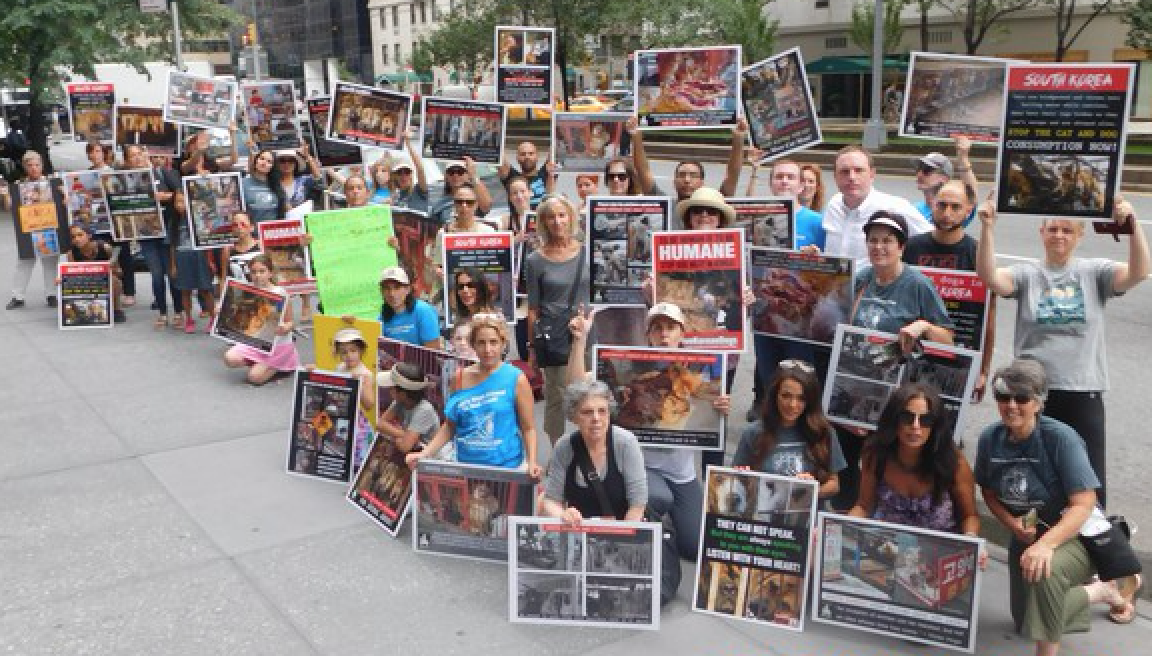
On July 15th, approximately 40 activists staged a protest at the South Korean consulate in New York City to demand that the government ban a dog meat eating festival, Boknal, that takes place every July in Korea. While displaying the posters and chanting “Cultural Justification is No Excuse For Animal Abuse,” the protesters distributed handouts to pedestrians and gathered hundreds of signatures on a petition that will be hand-delivered to Korean diplomats.

Animal rights activists protesting at the Korean embassy.

Animal rights activists protesting at the Korean consulate

“We stand in solidarity with the Korean activists who risk their lives to rescue dogs from hellish farms and who give them the loving homes they deserve,” said Roberto Bonelli of Animals Battalion, the group that organized the protest. “All animal slaughter is wrong, regardless of the species, and, when activists around the world rise up in protest, we will be there to support them.”

Animal rights activists protest at the Korean embassy.

Animal rights activists protesting at the Korean consulate.

One protester, Silva Baker, told TheirTurn about two dogs who she adopted from activists who rescued them from a South Korean dog farm: “I look into Jacks and Gigi eyes every single day, and I can’t believe what would have happened to them. Now I look at these at these pictures, and I think of all the unlucky dogs that are still there.”

Silva Baker adopted two dogs rescued from a South Korean dog farm.

Silva Baker adopted two dogs rescued from a South Korean dog farm.

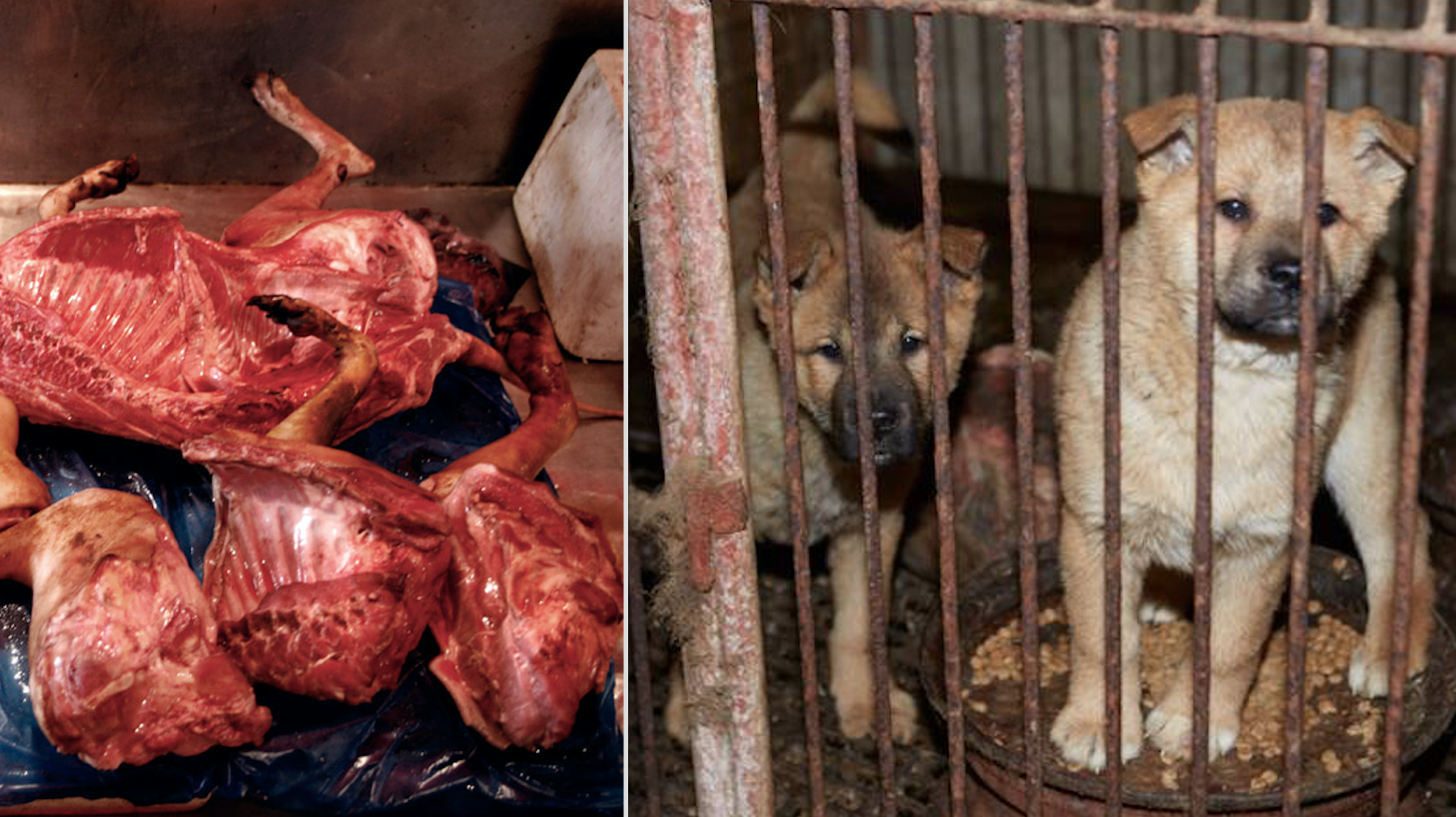
Every year, approximately 2.5 million dogs are slaughtered in South Korea. Some of them are specifically raised for food (on filthy backyard farms); others are kidnapped or were abandoned by their owners. When transported to the slaughterhouse, the dogs are stuffed into crates so small that they cannot move. The methods of slaughter include throat-slitting, bludgeoning with metal poles or hanging. Some dogs are intentionally tortured before being slaughtered because of a superstitious belief that the meat of tortured animals is healthier.

In South Korea, dogs around 2.5 million dogs are killed for their flesh every year.

In South Korea, around 2.5 million dogs are killed for their flesh every year.

Your Turn

To learn more about how you can help end South Korea’s dog meat trade, please visit koreandogs.org.

To find out about future protests regarding South Korea’s dog meat trade, please follow The Animals’ Battalion.


Filed under: Food
Tagged with: , ,

Cheap Third World Labor Fuels Australia’s Notorious Live Export Trade

July 19, 2016 by Leave a Comment


The News

Harrowing footage of Australian cattle being slaughtered in Vietnam has shined a global spotlight on Australia’s notorious “live export” trade. The footage, released by Animals Australia, shows restrained cows being bludgeoned with sledgehammers as they frantically attempt to avoid the blows meant to smash their skulls. The footage has triggered a public discussion and debate about the rationale for exporting live animals instead refrigerated meat from animals slaughtered in Australia.

https://youtu.be/2SH_t3KAGD0

Live export companies claim that  animals must be exported live because refrigeration in the countries to which they are shipped is inadequate. According to advocates, however, that rationale is dubious. A Cambodian company called SLN Meat Supplies, which recently imported almost 3,000 Australian cattle, stated that it plans to store and eventually export the meat of those animals to China, Vietnam and Japan. According to SLN, refrigeration will be used in the process. SLN is one of many companies that imports live animals, slaughters them and then exports the refrigerated meat to other countries.
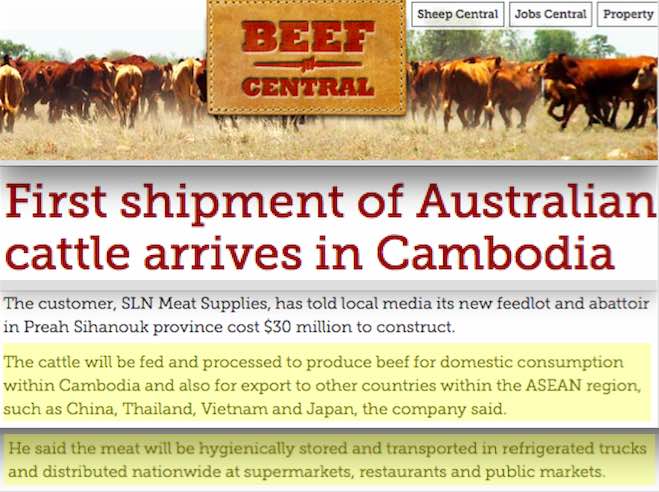
Live export companies claim that live exports are necessary due to lack of refrigeration in the importing companies despite those countries refrigerating the meat and exporting it.

Live export companies falsely claim that exporting animals while they are alive is  necessary due to lack of refrigeration in the importing companies.

Simon Whitehouse of Live Export – GlobalVoice4Animals has a different theory about why Australian companies export live animals instead of slaughtering them locally:  “large profits [made] through the exploitation of grossly underpaid, third world labor.”  Cheap third world labor fuels the live export trade in many ways.

Slaughterhouse workers in poor countries are paid much less than those in more wealthy countries. A Cambodian slaughterhouse worker, for instance, receives about 1/200 the salary of an Australian worker. Since the wholesale price of beef in poor countries is about the same as it is in wealthy countries, the lower wages lead to a greater profit margin for the companies that import live animals. In some cases, live export companies partially or fully own the importing companies, so slaughtering the animals where labor is cheaper increases their profit margins. When live export companies earn higher profits, they offer ranchers more money for their animals. Cheap third world labor therefore affects the live export trade at virtually every step in the supply chain. “Without that cheap labor source, there would be no live export trade” says Mr. Whitehouse.
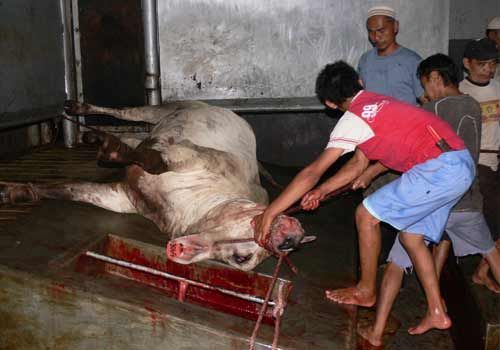
Exported Australian cow being slaughtered.

Exported Australian cow being slaughtered.

 Each year, Australia ships millions of live sheep, cattle and goats to countries in the Middle East and Asia where they are slaughtered for meat. Footage taken during more than 30 investigations conducted by Animals Australia demonstrates that many of these animals endure “routine abuse” and “brutal slaughter” in countries that have few, if any, protections in place. In addition, millions of animals have died on the ships during the treacherous overseas journeys during which are intensively confined and deprived of their basic needs.
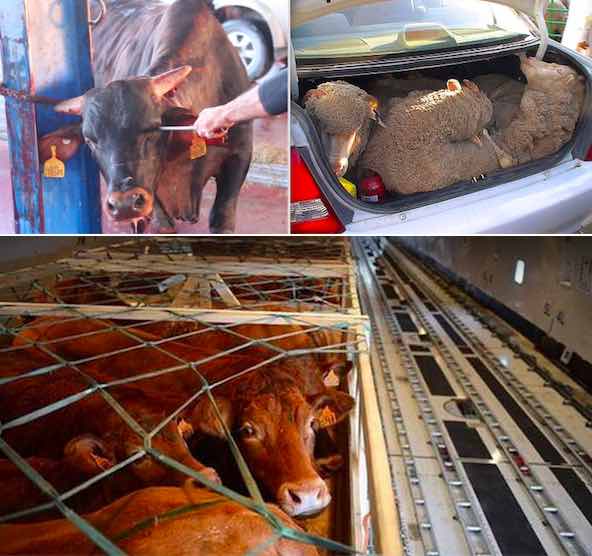
Live exports are notorious for animal cruelty.

Australia’s notorious live export industry

Your Turn

Please visit Animals Australia’s Ban Live Export initiative to learn more about live exports and find out how you can help.


Filed under: Food
Tagged with: , , , ,

Gas Chambers – The “Humane” Alternative?

July 12, 2016 by Leave a Comment


The News

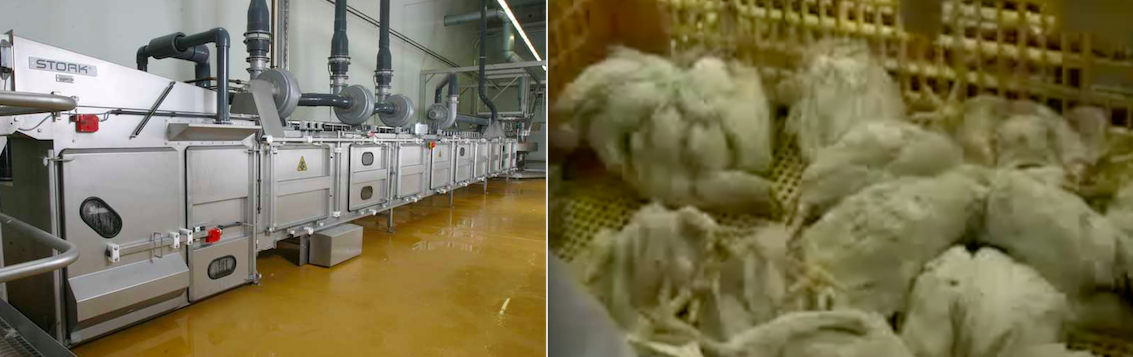
Following numerous undercover investigations revealing shocking cruelty in slaughterhouses, U.S. meat and egg companies are slowly shifting towards a method of killing regarded by many as being less inhumane: gas chambers.

Euphemistically referred to as Controlled Atmosphere Killing (CAK), gas chambers are widely used in Australia and some European Union countries to slaughter pigs, chickens and other animals.

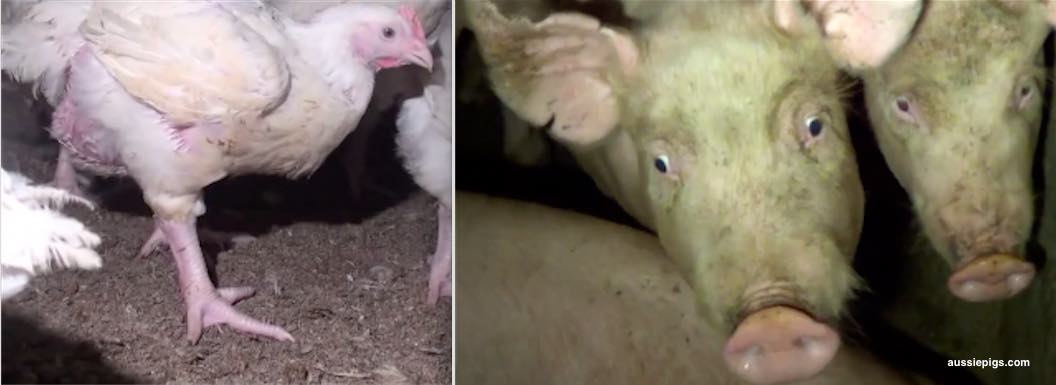
In several countries, pigs and chickens are commonly killed using gas chambers.

In several countries, pigs and chickens are commonly killed using gas chambers.

PIGS

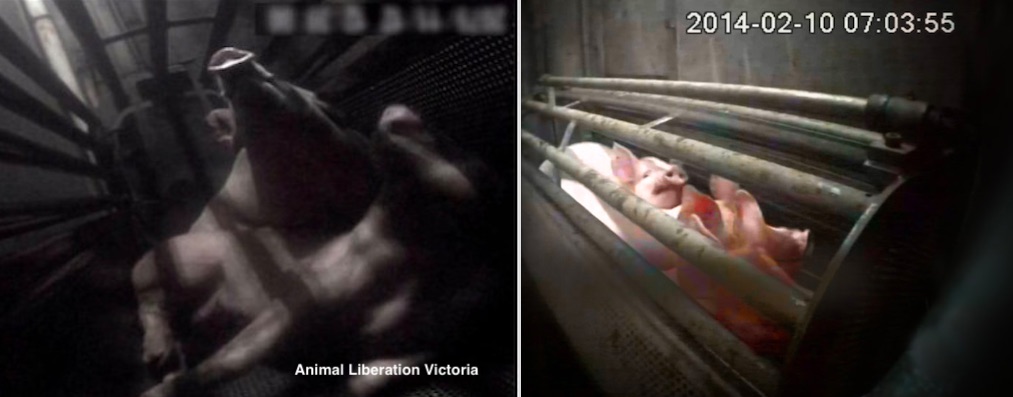
In order to gas pigs, slaughterhouse workers use electric prods to force them into small steel cages which are lowered into carbon dioxide filled chambers. Undercover footage shows pigs screaming, thrashing and gasping for air in their final moments. An Australian activist conducting an undercover investigation described what he saw: “In their last minutes, these pigs are burning from the inside out.”

Pigs being suffocated in gas chambers.

Pigs being suffocated in gas chambers.

BROILER CHICKENS

The travelling crates that contain chickens are typically unloaded from a truck onto a conveyor belt which carries them into a gas chamber. According to an eyewitness from Canadians for the Ethical Treatment of Food Animals, “Aversive behavior in the form of gasping, shaking of heads and stretching of necks to breathe could be seen beginning in window two [of the gas chamber] and, by window three, all were exhibiting strong convulsions. The birds’ movements eventually became still and by the time they emerged from the CO2 chambers they were completely lifeless…”

Gas chambers are used trendier broiler chickens unconscious before they are bled to death.

Gas chambers are used to render broiler chickens unconscious before they are bled to death.

EGG-LAYING HENS

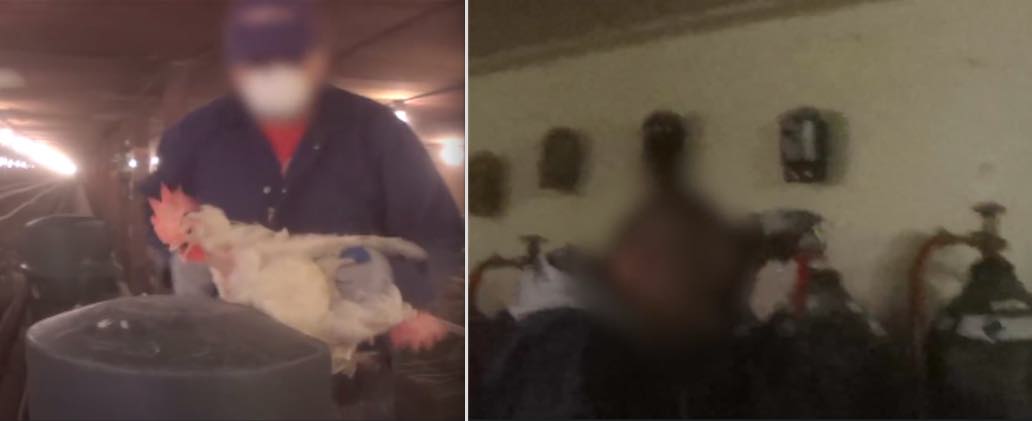
Workers aggressively grab spent layer hens birds out of their cages and toss them into mobile metal gas chambers.  On some factory farms, the hens are simply stuffed into trash cans where they are gassed. According to a former worker at a supplier to Eggland’s Best: “It’s absolutely chilling to hear these birds scrambling and fighting for air in these gas chambers.”

At worst spent hens are killed by being thrown into trash cans which are than filled with gas.

At worst spent hens are killed by being thrown into trash cans which are than filled with gas.

Several animal advocacy groups are pressuring companies to transition to using CAK as their primary method of slaughter because it has been shown to be, in many ways, less painful and stressful than conventional methods.

Your Turn

To learn more about the use of gas chambers to kill pigs, please visit aussieabattoirs.com

To watch the investigation that revealed the use of gas chambers to kill spent hens, please visit Mercy For Animals

To learn more about animal cruelty in the food industry, please watch Farm to Fridge and Earthlings

To order a free vegan starter kit, please visit PETA


Filed under: Food
Tagged with: , , , , , , ,

Jenny’s Aha Moment

June 29, 2016 by Leave a Comment


The News

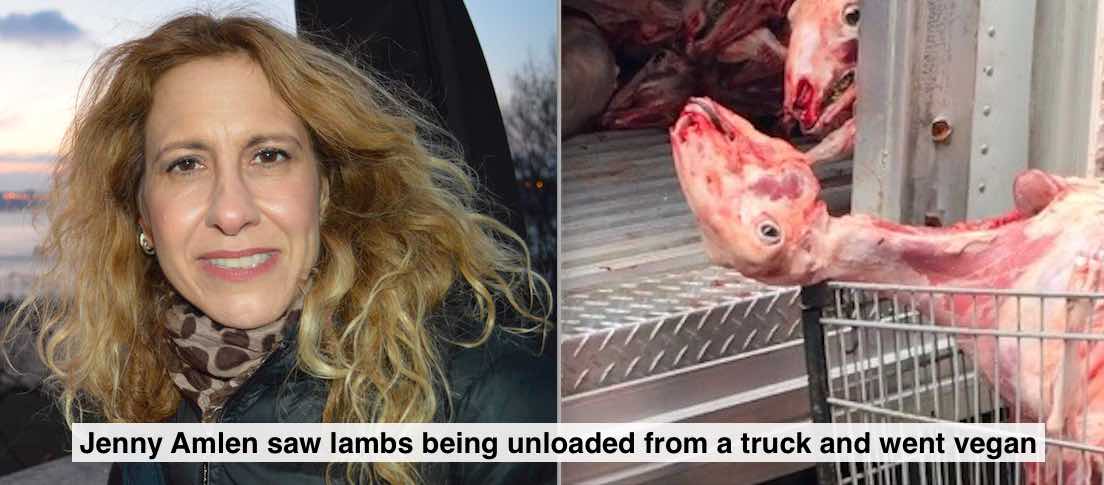
While eating in a restaurant in Brooklyn, Jenny Amlen saw skinned lambs being unloaded from a nearby truck. At that moment, she made the connection between the burger on her plate and the animal who was killed for it.

“I saw almost 100 slaughtered lambs being thrown into a shopping cart in broad daylight. I saw their eyes, and it was devastating, shocking and heartbreaking. I thought then that they were mothers, fathers, sisters, brothers just like us,” said Jenny Amlen. “Honestly, it reminded me of the Holocaust. It was just lambs instead of humans.”

Jenny sent the video footage to TheirTurn and said that the incident prompted her to go vegan.

Jenny Amlen saw skinned lambs being unloaded from a truck and decided to go vegan.

Jenny Amlen saw skinned lambs being unloaded from a truck and decided to go vegan.

Your Turn

To order a free vegan starter kit please visit PETA


Filed under: Food
Tagged with: , , ,