The meat and dairy industries continue to attack veganism through its paid supporters in the government and media. As demonstrated by the closure of vegan restaurants and the drop in sales of plant-based foods, their large-scale propaganda campaign is working. Their attacks have consequences not only for vegan businesses, but also for human health, the planet and the animals.
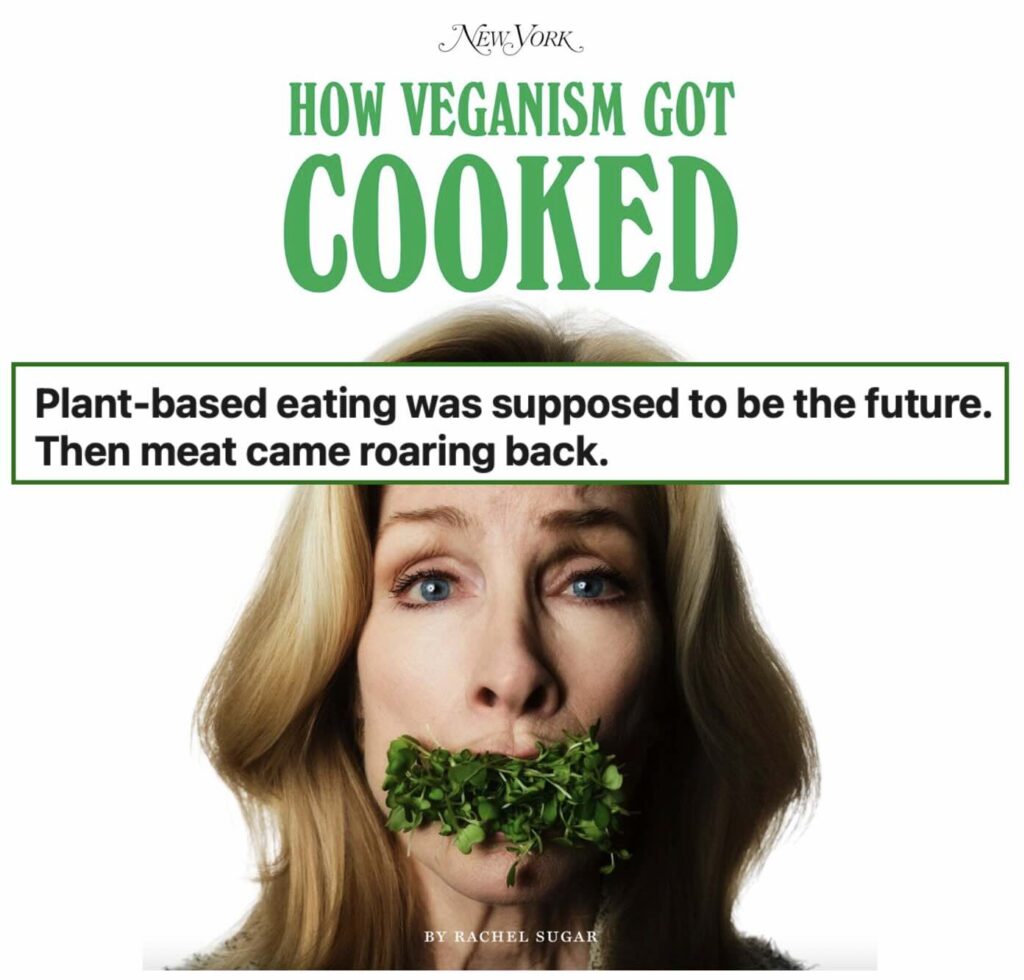
The meat and dairy industries’ attacks on veganism and plant-based eating are taking a toll.
In an effort to minimize the damage and protect the progress made in recent years, TheirTurn has shifted its attention to VegMediaWatch, a watchdog group that combats anti-vegan bias. On its six social media platforms, @VegMediaWatch has been working to hold journalists accountable for publishing stories that contain biased, misleading or false information about plant-based diets and veganism.
VegMediaWatch has made it easy for supporters to help. If you sign up Rapid Response Team on the VegMediaWatch website, you will receive a weekly action alert that provides clear guidance on how you can help in just a minute or two. Please note that, if you receive emails from TheirTurn, you will not automatically receive emails from VegMediaWatch, so please do subscribe here.
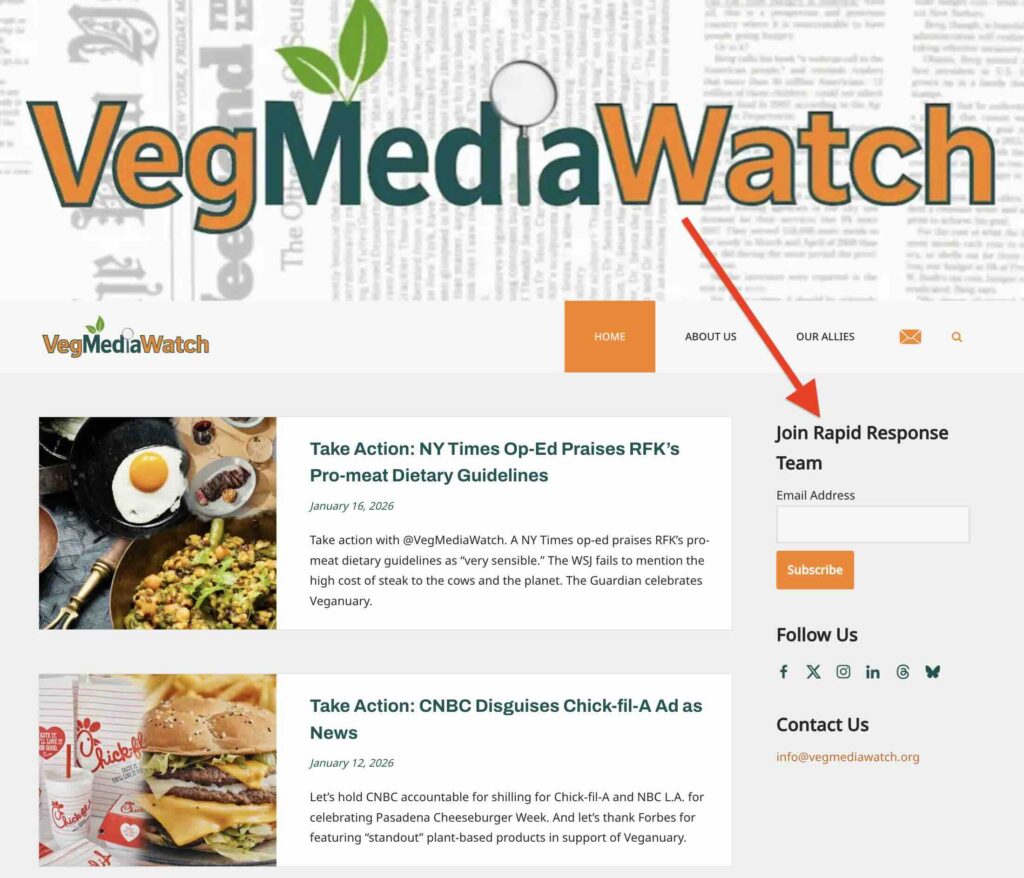
Please sign up for VegMediaWatch’s Rapid Response Team to receive a weekly action alert
VegMediaWatch doesn’t just critique. It also acknowledges and amplifies journalists who portray veganism fairly and accurately and who report honestly on the impacts of animal agriculture. Responsible journalism deserves recognition, and positive reinforcement could influence future reporting.
Unlike social media influencers, who are largely unaccountable, journalists in the mainstream are sensitive to accusations of bias. Indeed, several have responded to VegMediaWatch posts. Some have been defensive; others supportive. Either way, their responses demonstrate that they are paying attention and that the posts are impacting on them.
While the vegan and animal rights communities do not have the financial resources of the meat and dairy industries, we do have the truth on our side and a determination to promote cruelty-free living. If we want veganism to be represented truthfully in the media, then we must use our social media platforms to speak out.
A watchdog group, VegMediaWatch, has launched to combat the growing wave of anti-vegan propaganda in the mainstream media. The initiative aims to hold journalists and news outlets accountable for publishing biased stories that misrepresent veganism and plant-based foods.
Each year, the meat and dairy industries spend millions of dollars on public relations to shape public opinion. Their efforts to vilify plant-based foods as “ultra-processed” while promoting meat and dairy as “natural” and “environmentally friendly” are paying off. As consumers embrace the misinformation, they are making food choices that are worse for their health, the planet, the animals and vegan businesses.
VegMediaWatch was created to reverse this trend. Through respectful, fact-based social media posts, @VegMediaWatch calls out journalists and media outlets that publish anti-vegan propaganda.
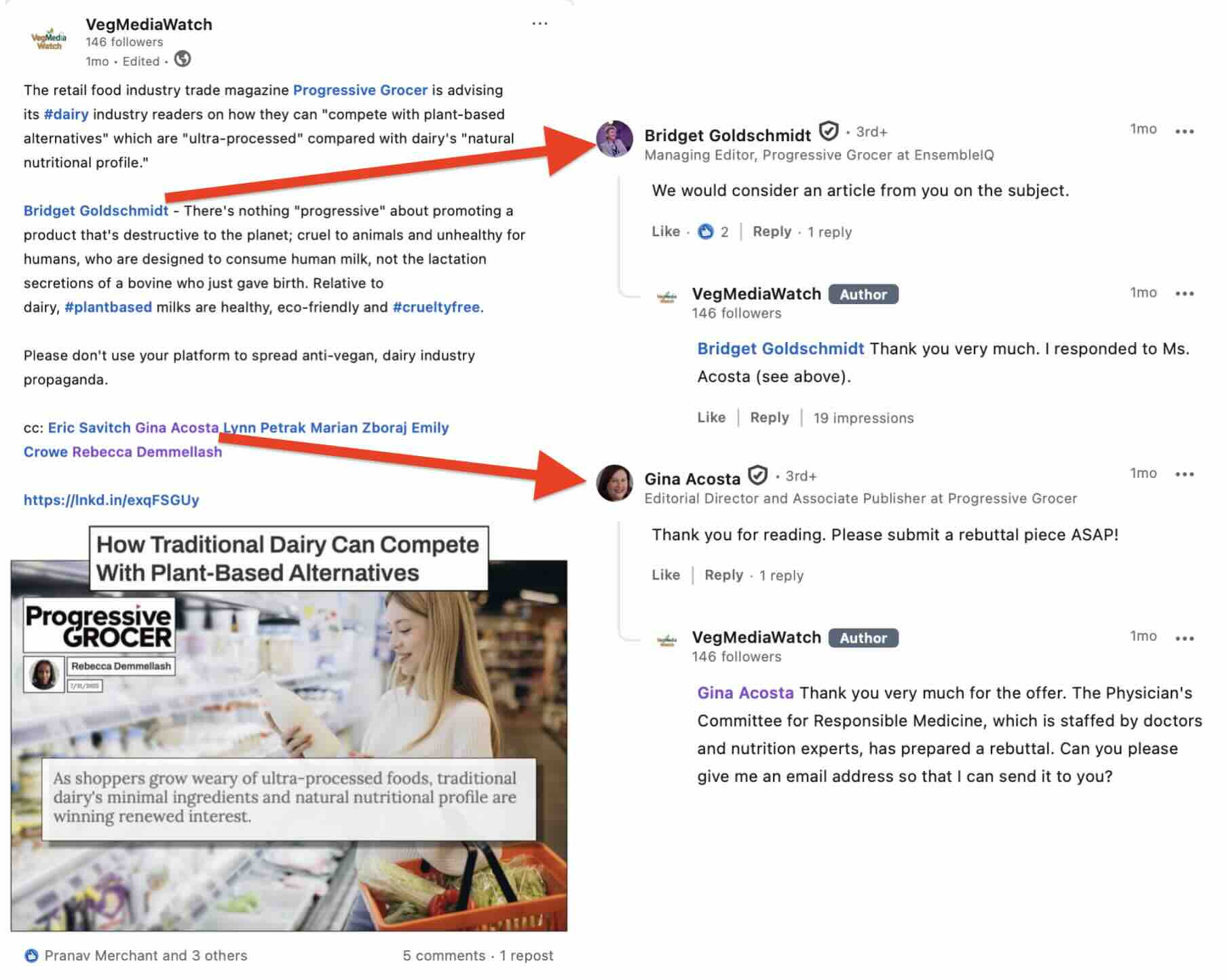
Journalists targeted in post invite VegMediaWatch to submit an op-ed
The mainstream media often uses their news pages to promote the products of their meat and dairy advertisers and to quash their competition” said Jane Velez-Mitchell of UnchainedTV. “VegMediaWatch is here to to hold the culprits accountable by shining a spotlight on the bias and propaganda.”
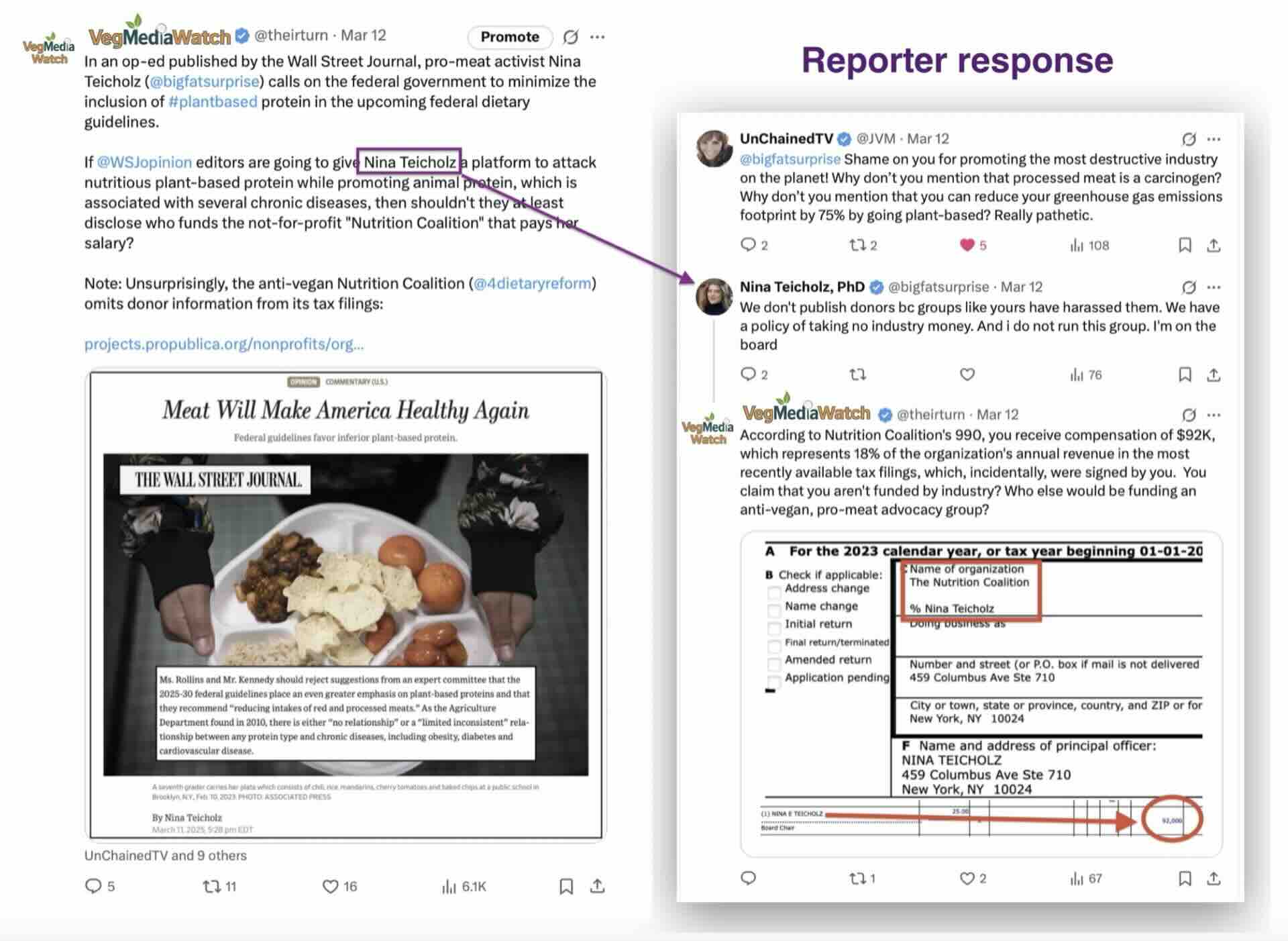
VegMediaWatch exposes anti-vegan bias in the Wall Street Journal and the writer’s conflict of interest
In addition to exposing false narratives, VegMediaWatch celebrates and amplifies stories in the mainstream media that fairly and accurately portray plant-based foods and veganism.
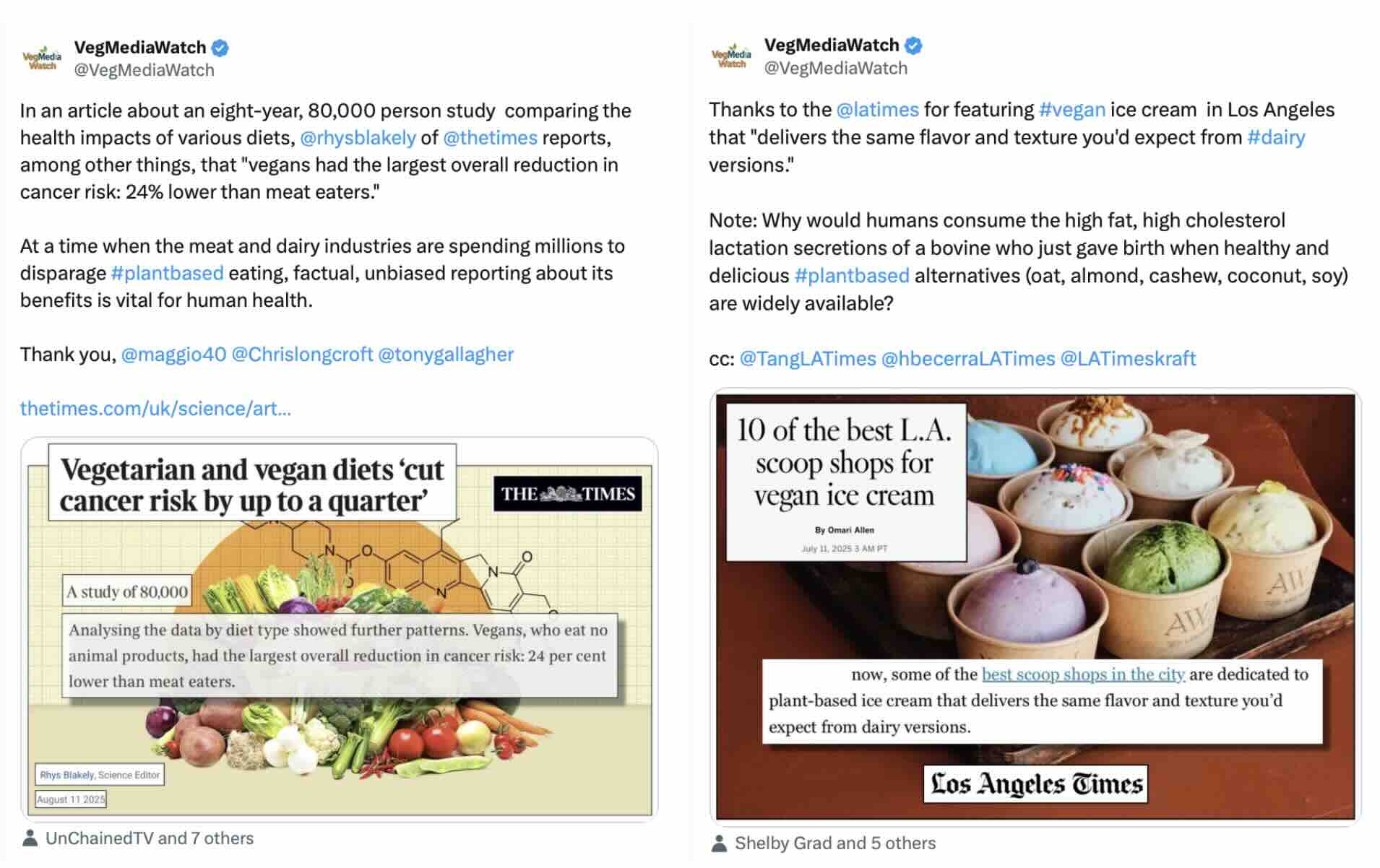
VegMediaWatch amplifies stories in the mainstream media that positively portray plant-based foods and veganism
“Together, we can shift the conversation around plant-based food—demanding fairness in reporting and empowering consumers to make informed and ethical choices that are better our health, the planet and the animals,” said Velez-Mitchell.
VegMediaWatch encourages members of the public to support its efforts by signing up for the Rapid Response Team in order to receive a weekly action alert and by sharing and engaging with @VegMediaWatch content on social media.
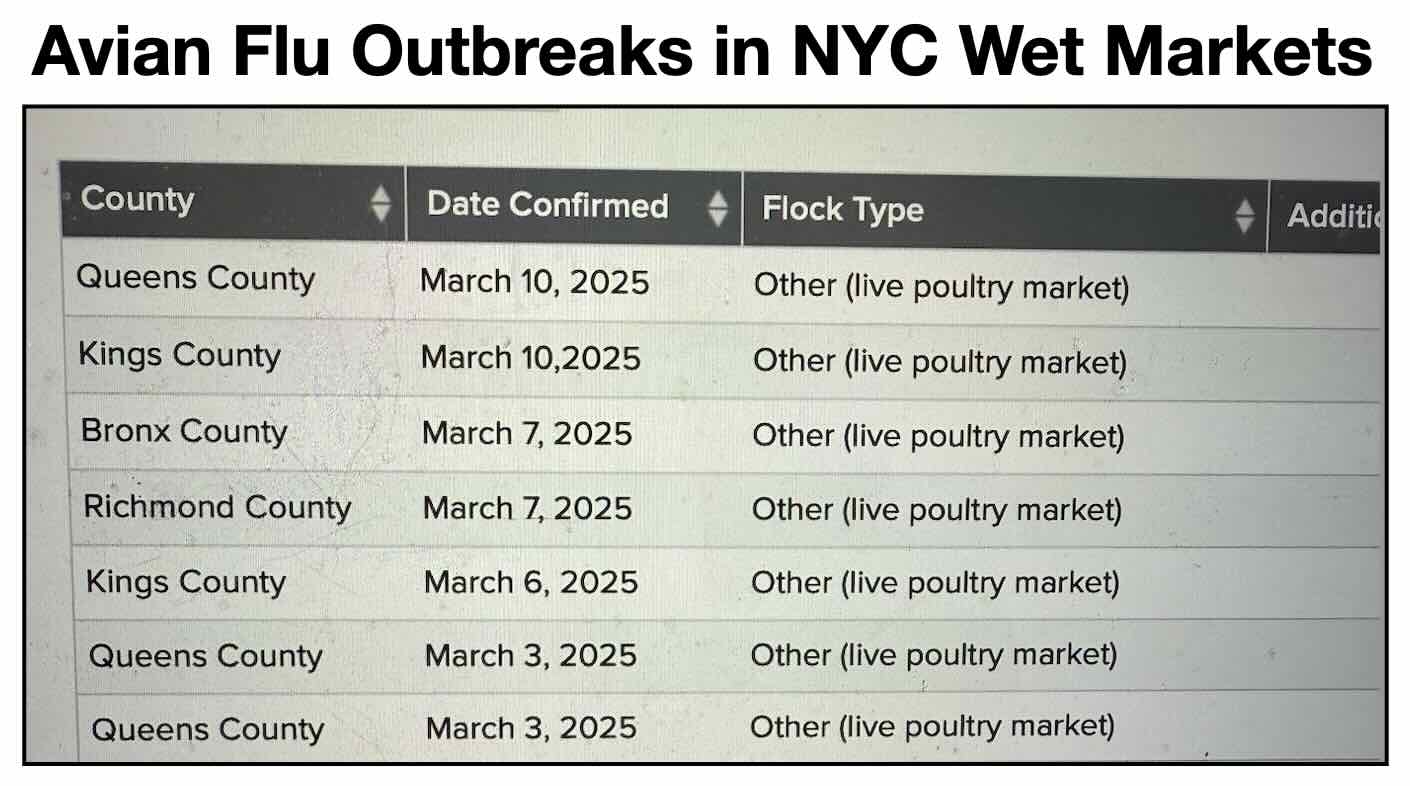
Just three weeks after New York’s 80+ live animal markets re-opened following a five day mandatory closure due to avian flu outbreaks, the New York State Department of Ag & Markets reported seven new outbreaks affecting thousands of birds in four of the city’s five boroughs. In response to media inquiries about the new outbreaks, a spokesperson for the agency said that the state would “order another shutdown if clear evidence persists that bird flu is spreading in the live poultry business.” Public health advocates and animal rights groups are asserting that temporary closures won’t stop the spread of avian flu and other infectious diseases and that their operation in NYC poses an ongoing risk to the public health.
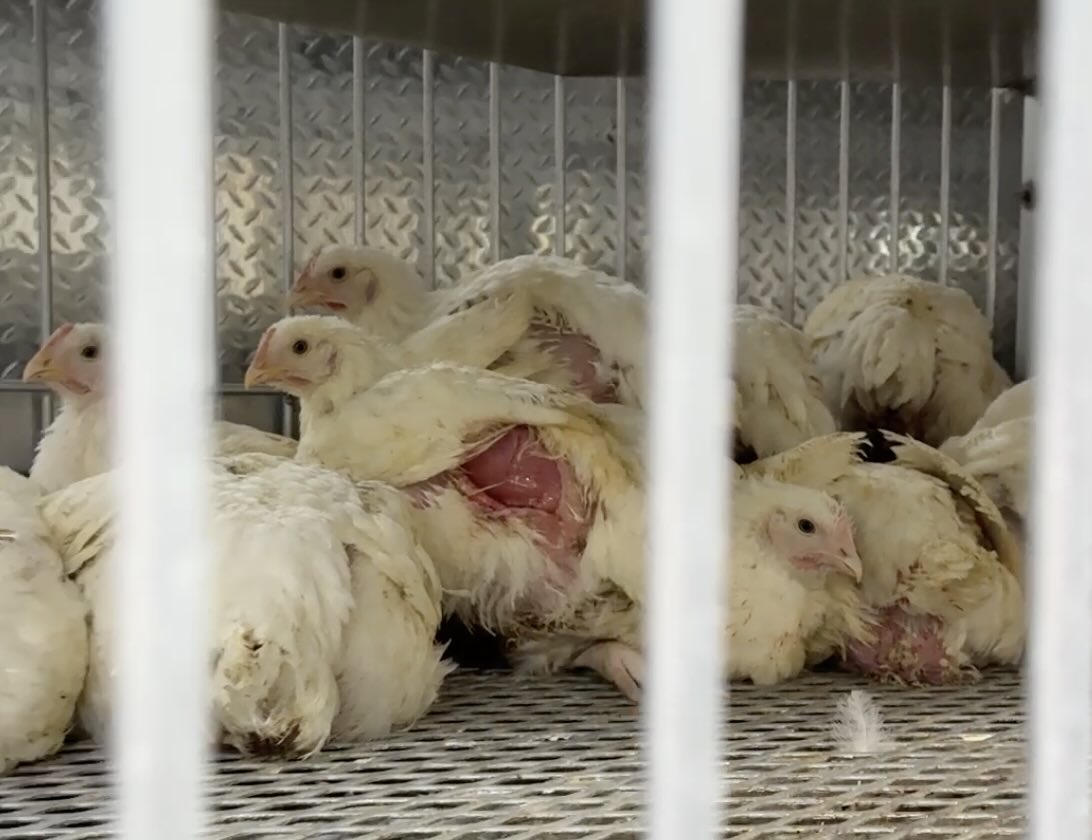
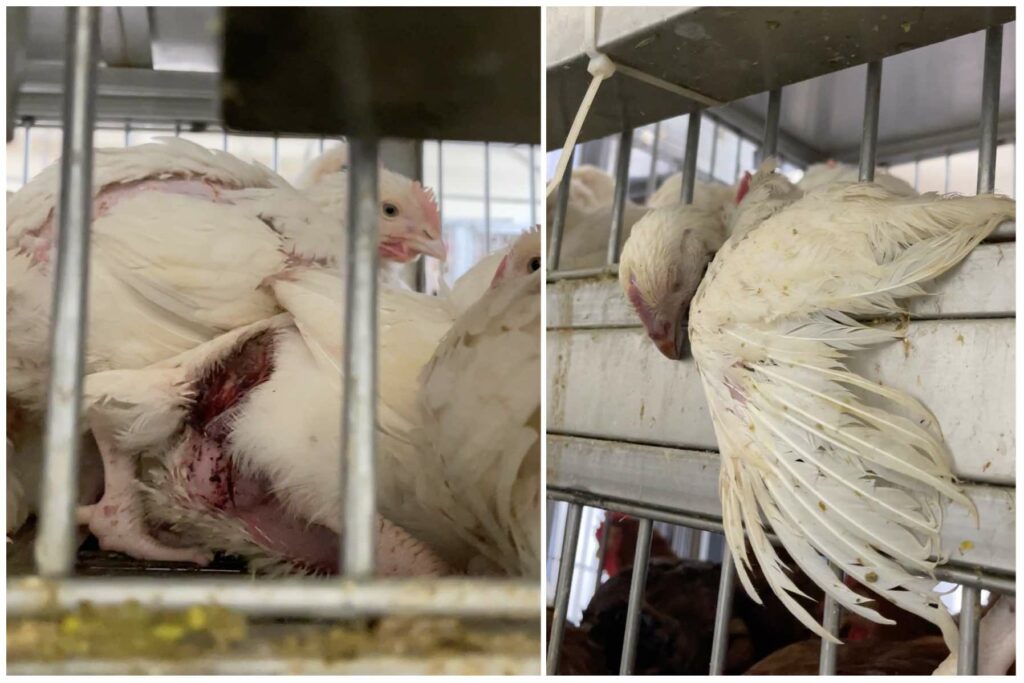
Since early February, when the live markets re-opened, Edita Birnkrant, the Executive Director of the animal advocacy group NYCLASS, and anthrozooligist John DiLeonardo, Executive Director of the bird rescue and animal advocacy group Humane Long Island, have paid several visits. “Our investigation showed the same dangerous conditions that existed when Governor Hochul shut down the markets the first time,” said Birnkrant. “They continue to confine multiple species of birds and other animals, many of whom are visibly sick, in crowded cages as members of the public walk in and out with no restrictions or safety measures in place.”
Avian flu outbreaks that have occurred since NYC’s live animal markets reopened following a five day closure in February.
DiLeonardo, who has rescued more than 100 animals from NYC’s live animal markets, says all of them were sick with coccidiosis, aspergillus, staph infection, respiratory infection, or infectious diseases. Avian influenza, however, is the scariest, according to DiLeonardo because, if it mutates into a strain that can be transmitted among humans, it would be 100 times more deadly than COVID-19.”
Chicken with open wound at an NYC live animal market during avian flu outbreak
In early March, Guardian Angels founder and 2025 NYC Mayoral candidate Curtis Sliwa made two unannounced visits to several wet markets in Brooklyn and Queens. Appalled by what he witnessed, he is now calling on elected officials and public health authorities to shut them down. “The wet markets are life-sized petri dish filled with thousands of animals who are visibly sick and suffering from illness and intensive confinement. New York should not allow wet markets to operate anywhere, especially in the densely populated residential neighborhoods where most of them are located. The unsafe and inhumane conditions in these storefront slaughterhouses are unfixable.”
Just three weeks after New York’s 80+ live animal markets re-opened following a five day closure due to multiple #avianflu outbreaks, @nyagandmarkets has reported seven new outbreaks affecting thousands of birds in four of NYC’s five boroughs.
In May 2020, NY State Assembly Member Linda Rosenthal and NY State Senator Luis Sepulveda introduced legislation to shut down New York’s live animal markets “to help prevent the spread of zoonotic diseases.” The legislation, if passed into law, would convene a “Task Force on Slaughterhouse Public Health and Safety and Animal Welfare” comprised of experts in epidemiology, veterinary science, and animal welfare to determine whether any amount of regulation can make the slaughterhouses safe enough to operate.
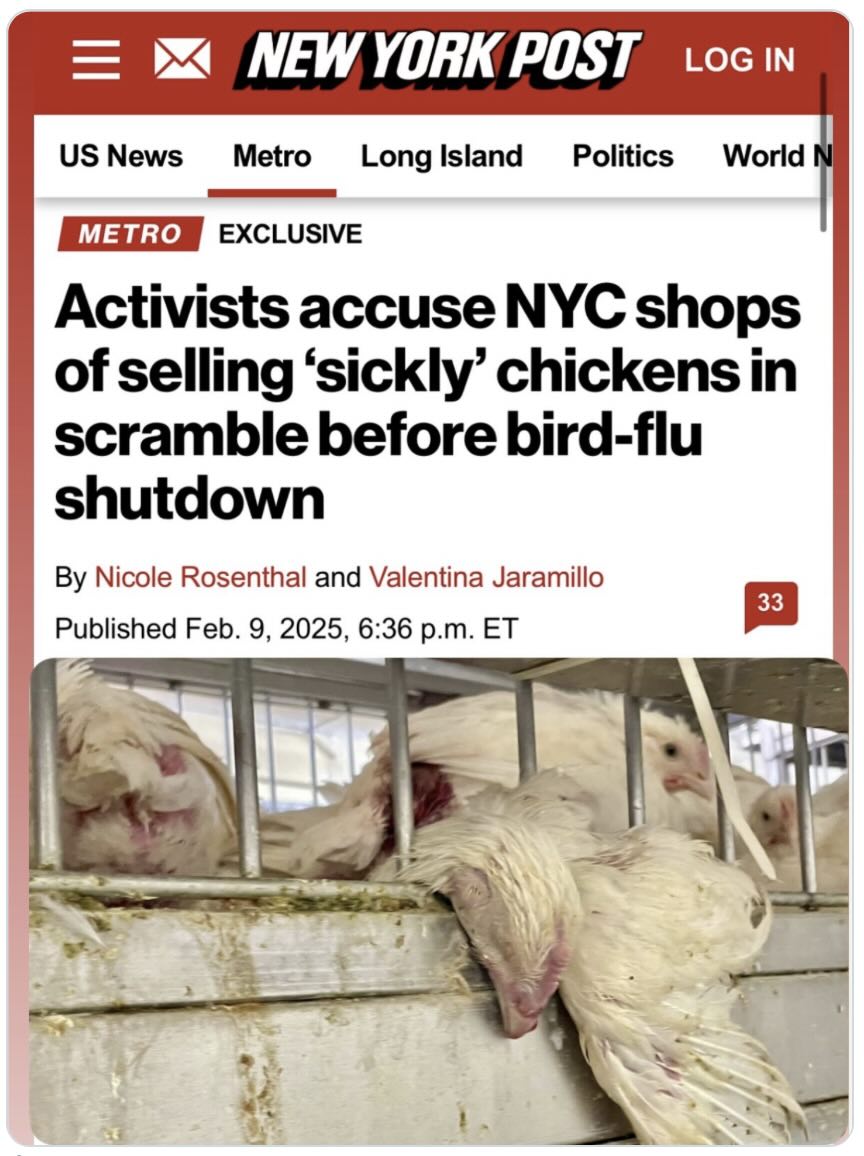
Media coverage of avian flu outbreaks in NYC’s live animal markets
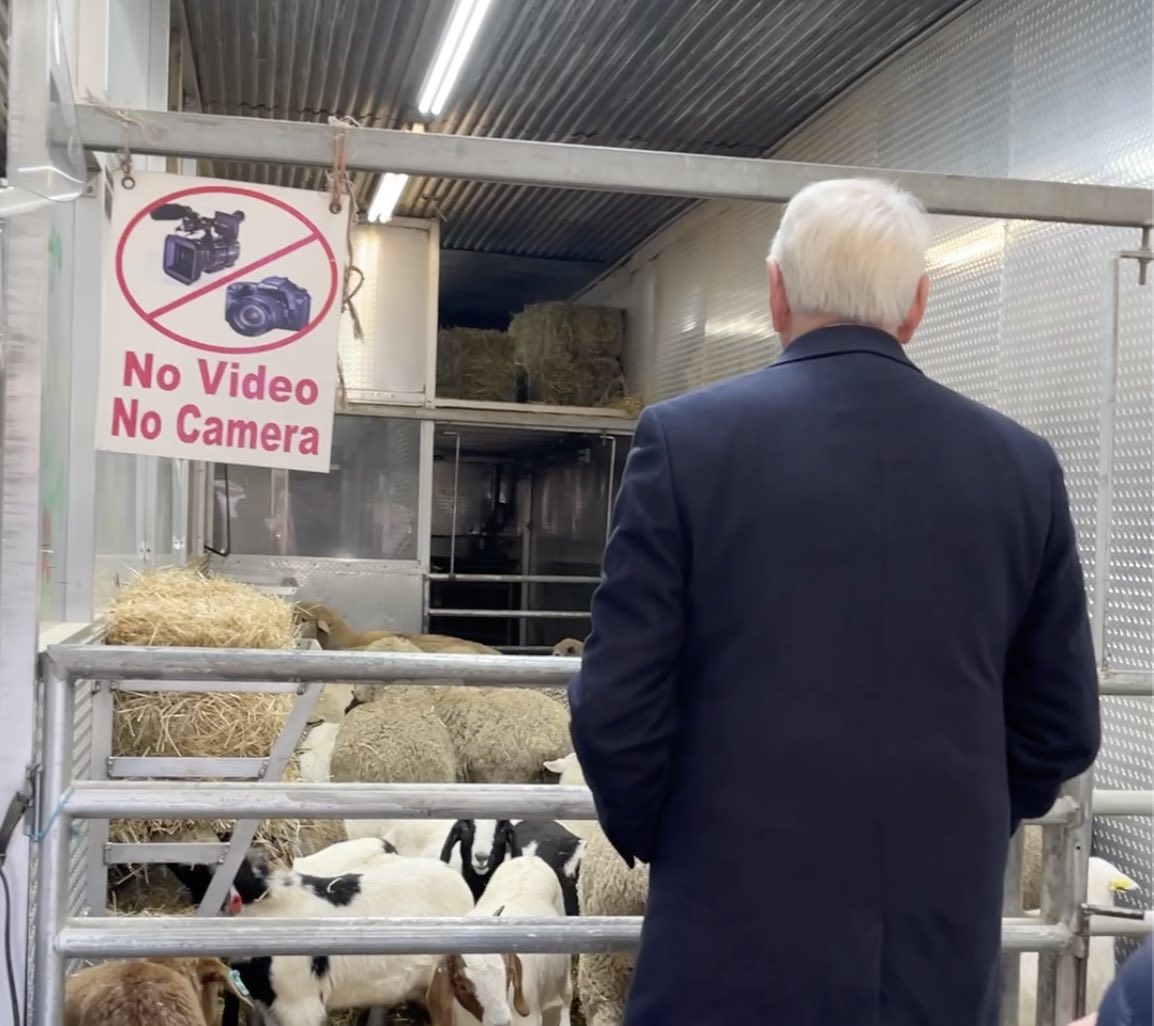
After receiving multiple complaints from constituents, New York City Council Member Bob Holden visited live animal markets in Queens and Brooklyn. In these storefront slaughterhouses, also called viveros, customers select the animals who they want to eat, and workers kill them on premises. Among the approximately 12 species sold in NYC’s 70 live markets are chickens, ducks, guinea fowl, turkeys, quails, rabbits, goats, sheep and cows. The large mammals are held in pens, and the rabbits and birds are stored in cages.
After touring the markets in Queens and Brooklyn, Council Member Holden, said he was “appalled” by what he found inside: “The conditions are horrendous and barbaric. The animals are packed in. We saw birds with open sores, and we saw sick and dead birds in the cages. I don’t know how anyone can buy these birds. We’re going to do some investigation to find out how this is allowed, and we’re going to try to put a stop to it. It’s unconscionable.”
During an unannounced visit to a live animal market in Brooklyn, NYC Council Member Bob Holden encounters chickens with wounds and dead chickens mixed in with the living.
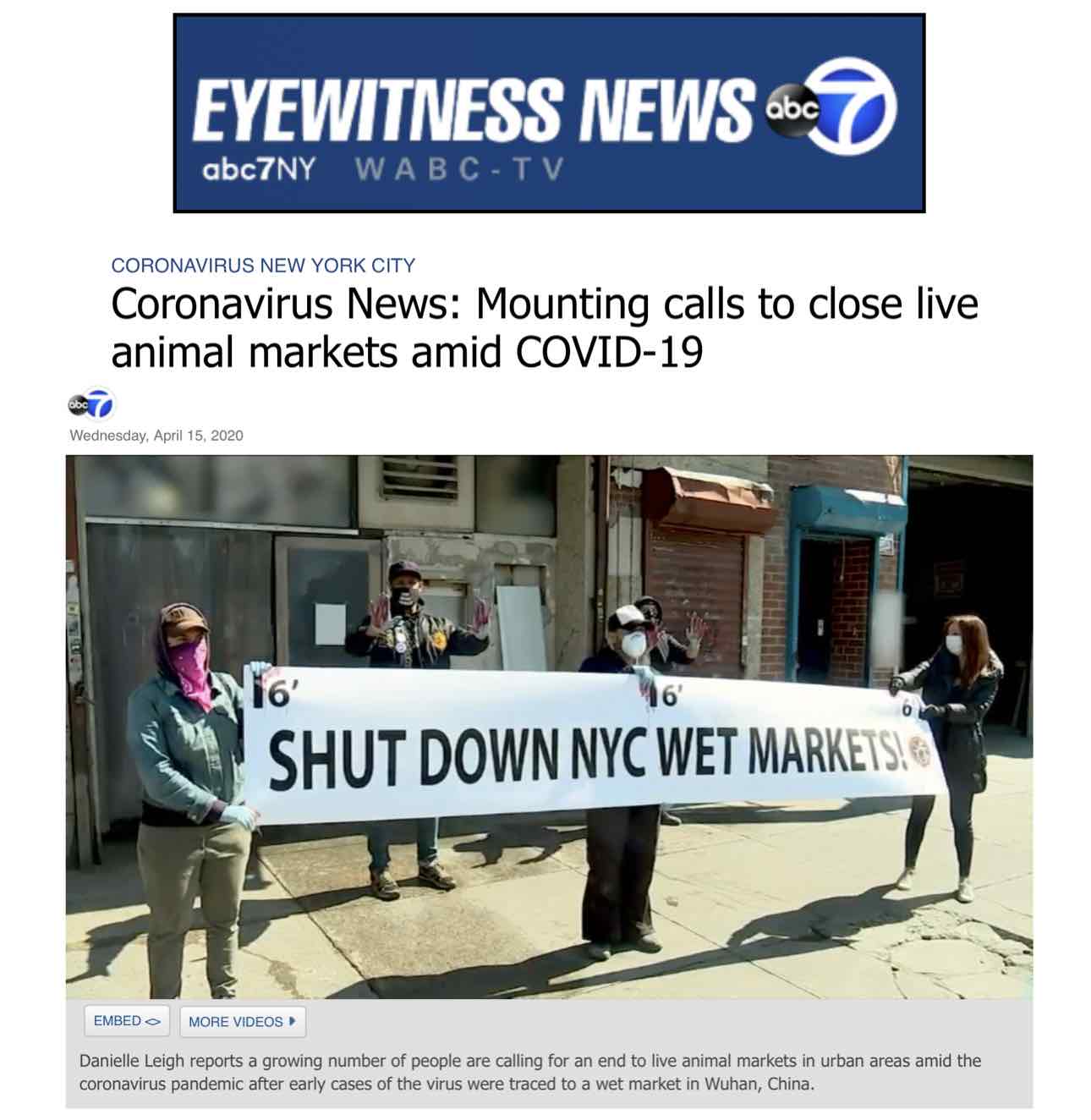
The city’s live animal markets were thrust into the national spotlight in early 2020 when the media reported that COVID was likely transmitted from animals to humans in a similar market in Wuhan, China. Despite this revelation, then Governor Andrew Cuomo deemed the state’s live markets “essential businesses.” Astonished by this designation, public health and animal welfare advocates staged protests in front of several of NYC’s markets to raise awareness of the public health risks.
During the first few months of the pandemic, media outlets reported on the ongoing efforts of advocacy groups to shut down the City’s 70 live animal markets
At the start of the pandemic lockdown, Dr. James Desmond, a veterinarian and infectious disease researcher based in Liberia, told TheirTurn, “Wet markets that sell live animals house different species in close proximity to each other and to humans. If different strains of influenza in any of these species combine to create a new flu strain, then a more lethal outbreak could occur, similar to the H2N2 pandemic of 1957.”
In response to constituent complaints, NYC Council Member Bob Holden visits a live animal market in his Queens district.
In 2021, Dr. Anthony Fauci, who was serving as the Director of National Institute of Allergy and Infectious Diseases, called for the closure of live animal markets in Asia, perhaps unaware of their presence in the United States. “I think they should shut down those things right away. It boggles my mind how, when we have so many diseases that emanate out of that unusual human/animal interface, that we don’t just shut it down.”
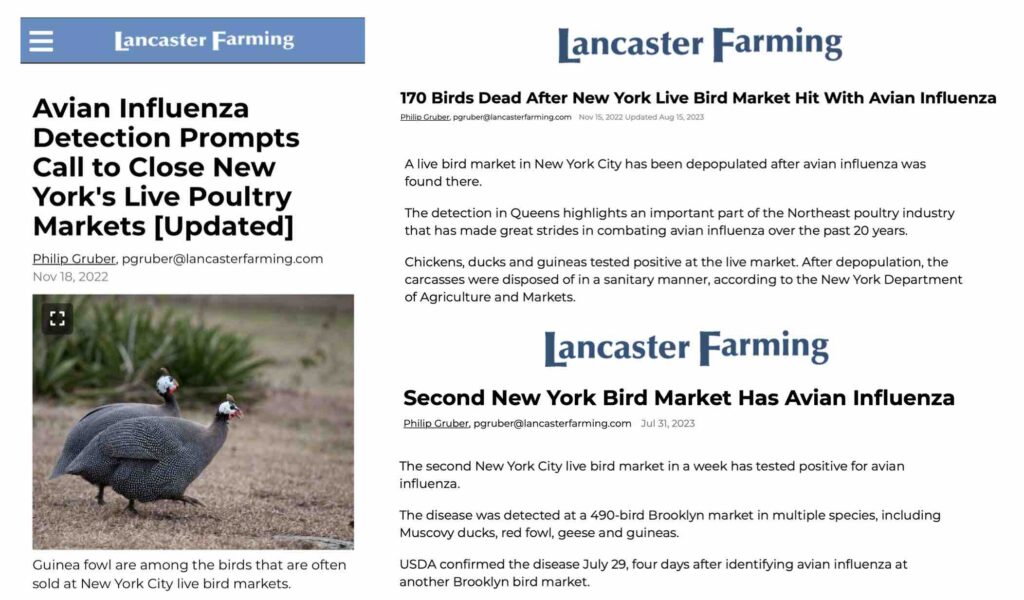
In 2022 and 2023, avian flu was detected in several live animal markets in New York City. Hundreds of birds were culled in an effort to contain the spread.
News coverage of avian flu outbreaks in live animal markets in NYC in 2022 and 2023
New York City’s live animal markets are regulated by the New York State Department of Agriculture & Markets. Based on the findings in Freedom of Information Act (FOIA) requests, the agency rarely cites the markets for violations of the city and state’s health and sanitation codes. It also rarely shuts down or suspends operations of the markets do have violations. Neighbors say that the lack of enforcement enables the owners to keep animals in squalid conditions and leave feces, urine and blood on the public sidewalks in front of the stores.
Two advocacy groups in NYC, Slaughter Free NYC and NYCLASS, have been campaigning to shut down the city’s live animal markets for several years. The Executive Director of NYCLASS, Edita Birnkrant, points to several reasons why they don’t belong. “In addition to violating health, sanitation and cruelty codes, many of the markets are likely violating zoning laws. Research conducted by The NYC Bar Association Animal Law Committee concluded that ‘many of the live animal markets are operating either without a certificate of occupancy or in potential violation of the uses permitted in the subject zoning district.’”
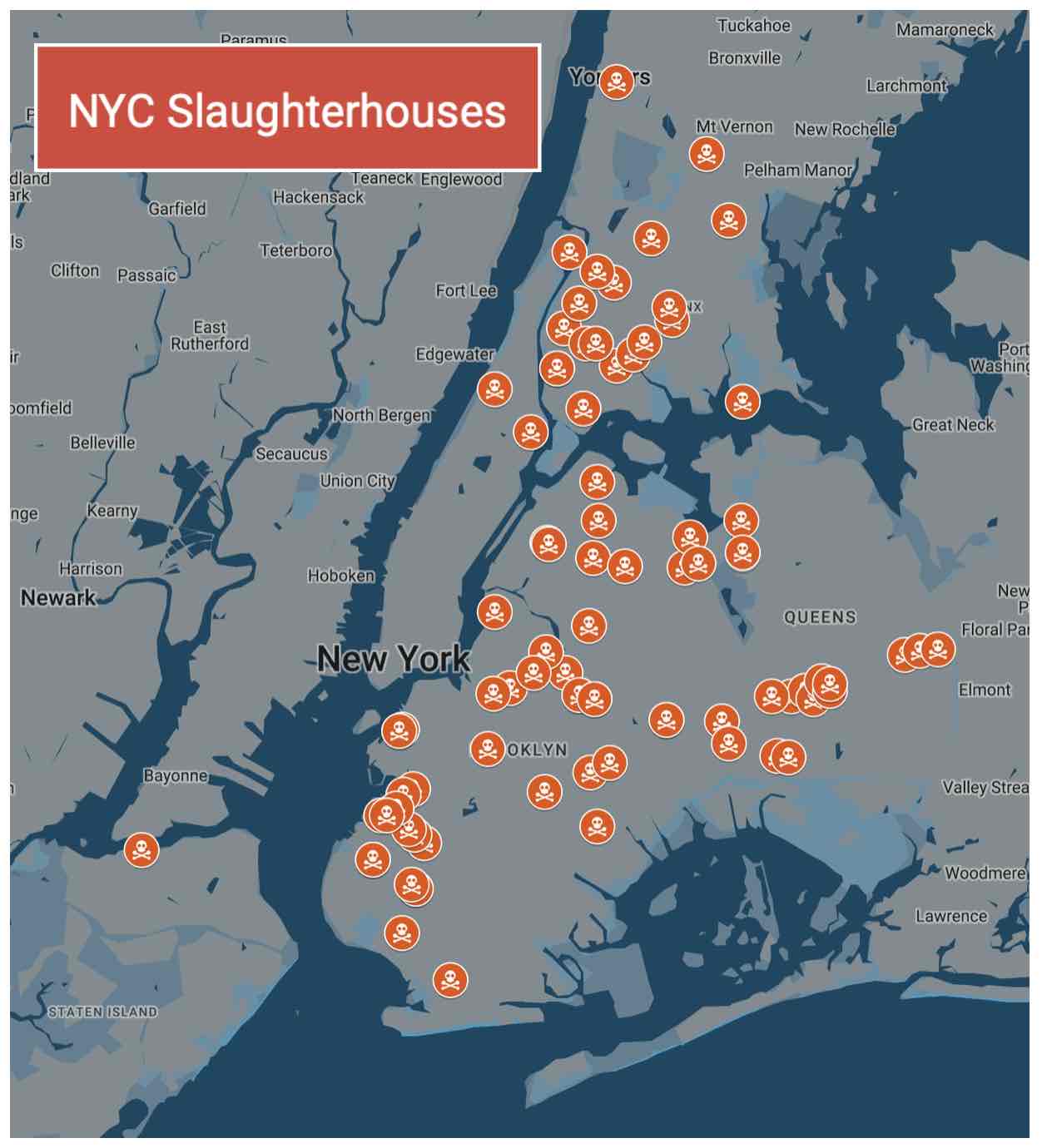
Map of live animal markets, or storefront slaughterhouses, in NYC created by the advocacy group Slaughter Free NYC
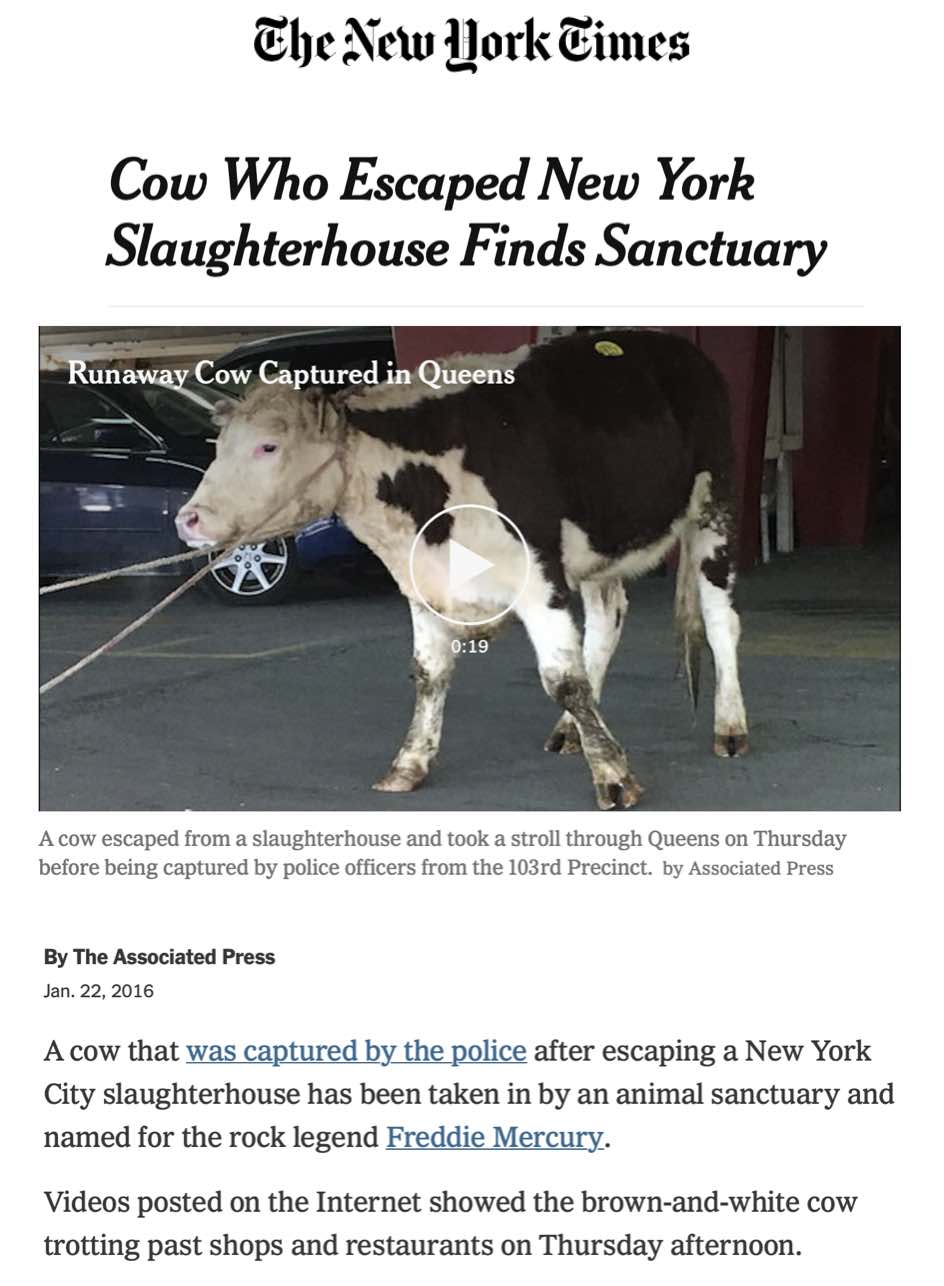
In recent years, several cows have escaped live animal markets and fled through congested city streets. In two cases, New Jersey-based Skylands Animal Sanctuary rescued the cows and gave them a forever home.
New York Times coverage of Freddie’s escape from a New York City storefront slaughterhouse
In posts on social media, many people credited their switch to a plant-based diet on the mainstream media coverage of the dramatic escapes and rescues. “I didn’t want to know about cows [being slaughtered] because I was addicted to cow ice cream,” said New York City resident Martha Mooney Waltien.” Then one day, Freddie ran from the slaughterhouse, and I saw his face. He was so scared, and he wanted to live. And I thought, ‘No more cheeseburgers.’”
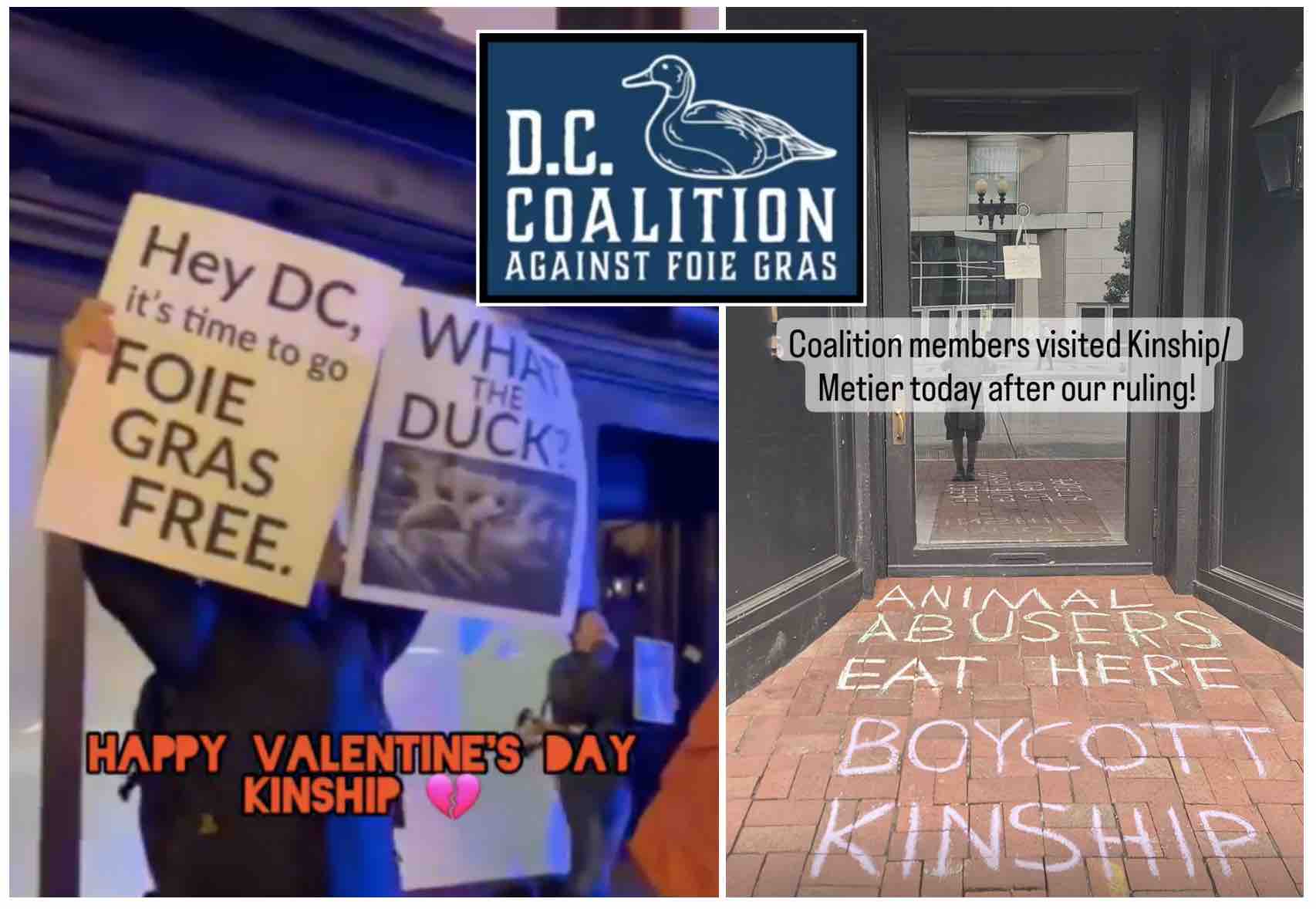
The Washington, D.C. Superior Court has ruled in favor of three animal rights activists sued for stalking by a restaurant owner attempting to curb their anti-foie gras protests and online speech. The activists, members of the D.C. Coalition Against Foie Gras, are calling on Eric Ziebold to stop selling the fatty liver product at his restaurants, Kinship and Métier.
Washington D.C. restauranteur Eric Ziebold sued animal rights activists with the the D.C. Coalition Against Foie Gras in an effort to stifle their protests and online activity
The defendants’ lawyers, Matthew Strugar, Nigel Barrella and Chris Carraway from the University of Denver Animal Activist Defense Project, won the case by filing Anti-SLAPP (Strategic Lawsuit Against Public Participation) motions. The motions argued that Ziebold was attempting to silence the activists by burdening them with legal costs. The Superior Court granted the anti-SLAPP motions and dismissed Ziebold’s case. In addition to paying his own legal bills, Ziebold is obligated to pay those of the defendants.
Lead anti-SLAPP attorney Matthew Strugar stated, “Belligerent rich people like Eric Ziebold think they can shut down their critics through costly litigation. Anti-SLAPP laws are essential to protect free speech and punish bullies like Ziebold who try to weaponize the legal system to escape accountability.”
Upon hearing the verdict, defendant Lauren Melchionda made the following statement on behalf of the D.C. Coalition Against Foie Gras: “Our silence cannot be bought or won in court. We began this campaign to end the sale of foie gras in D.C due its immense cruelty. We will not capitulate what amounts to a tantrum from Eric Ziebold and once again urge him to take the pledge.”
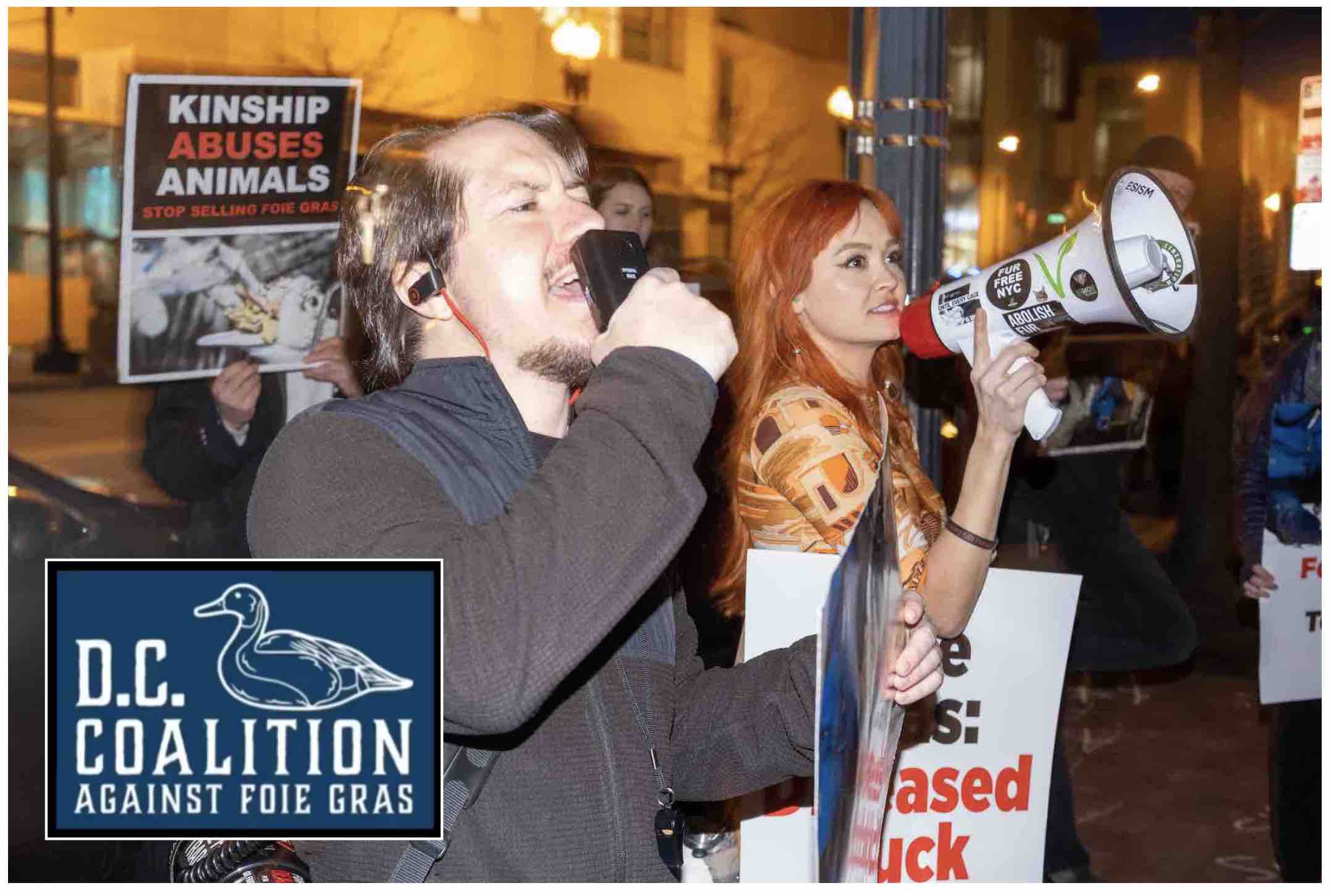
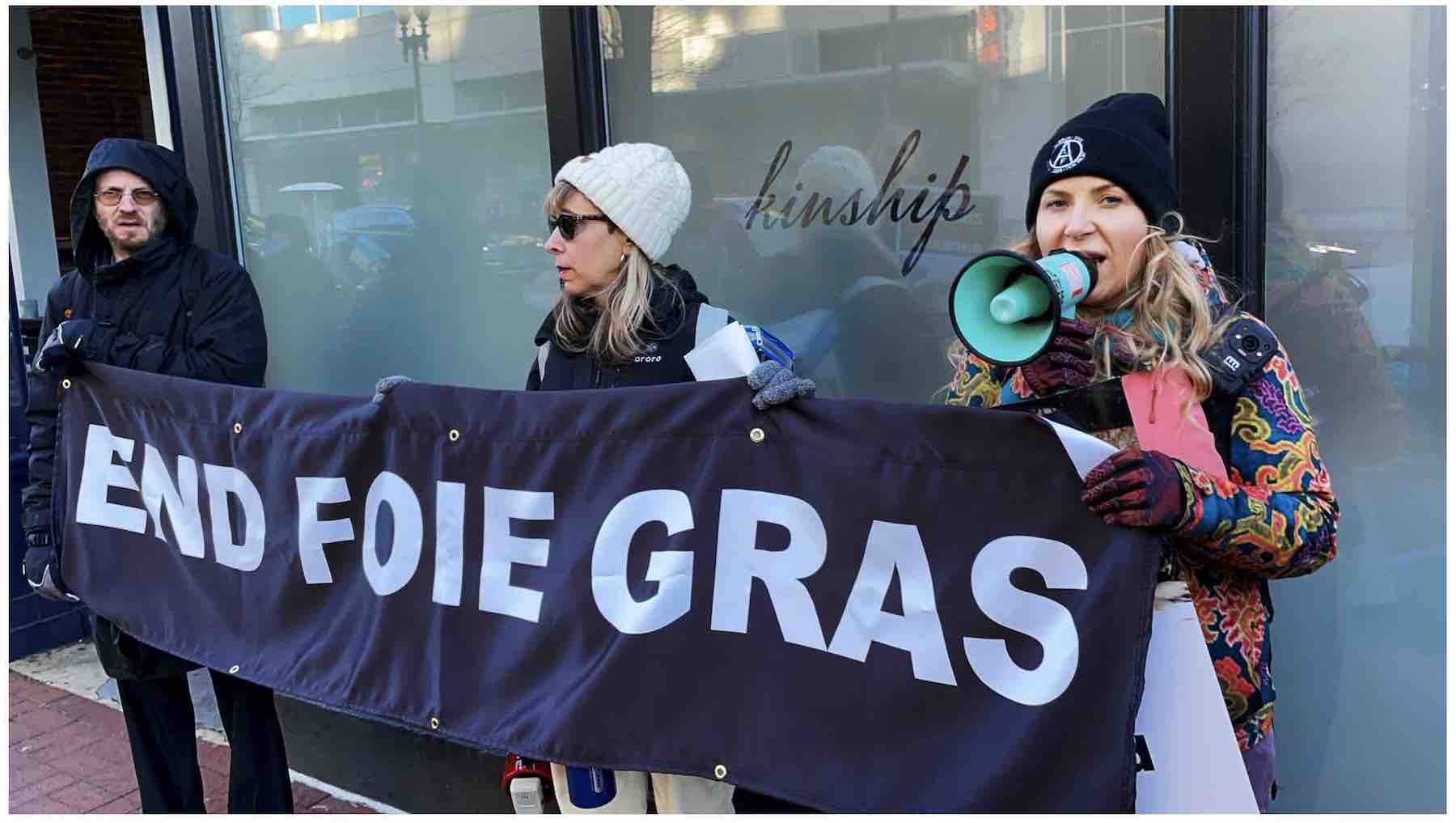
Animal rights activists with the D.C. Coalition Against Foie Gras protest at the restaurant Kinship, which sells the fatty liver product
Co-defendant Jenn Werth added, “Eric Ziebold wants to continue operating restaurants like it’s the 80s. Meanwhile, the world around him is evolving. Foie gras has been banned in several developed countries, and D.C.’s progressive community doesn’t want to eat food that is a product of cruelty.”
According to the defendants, Ziebold grew increasingly agitated by the protests over the course of two months. On one occasion, he locked activists inside of the restaurant until police arrived and forced Ziebold to let the activists out. According to the police, forcing them to stay inside was tantamount to kidnapping.
The D.C. Coalition Against Foie Gras calls on Eric Ziebold to stop selling foie gras in his restaurants
Despite claiming that the suit was not about the protests or free speech, Ziebold’s lawyers asked the court to curb the protesters’ online activity and to prohibit future protests within 100 yards of Kinship. A magistrate judge initially approved of these restrictions, but the Superior Court Judge removed them weeks before dissolving the injunction altogether. The court found that the stalking lawsuits were meritless because Ziebold sued the activists over their speech and protest activity, and Ziebold could not show he was likely to win his cases.
Co-counsel Chris Carraway said, “This victory reaffirms you cannot weaponize an anti-stalking measure, designed to protect actual victims of stalking, to silence criticism against the inhumane treatment inherent in serving foie gras.”
Foie gras is the diseased liver of a force-fed duck or goose. Undercover investigations of the country’s largest foie gras producer, Hudson Valley Foie Gras, have repeatedly found ducks dying from their injuries or choking to death as a result of the force-feedings. “Ducks on foie gras farms have been found with broken beaks, punctured esophaguses, choking to death on their own vomit,” said Mark Schellhase, the third defendant. “It is the height of animal cruelty.”
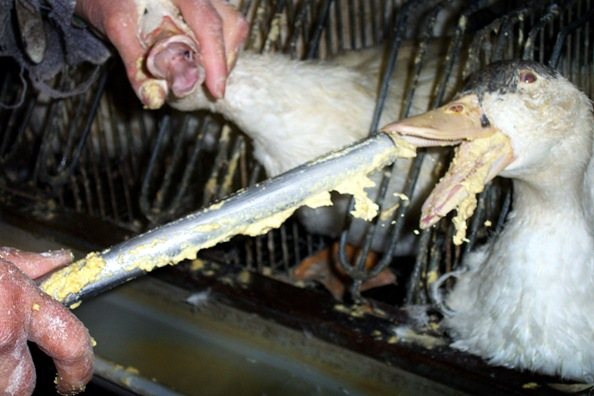
Gavage, the process by which the livers of ducks and geese are fattened, is French for force feeding.
Foie gras is banned in California, Italy, Germany, the UK, and several other countries due to the cruelty associate with force-feeding.
The D.C. Coalition Against Foie Gras says it will continue protesting at Kinship and other Washington, D.C.-based restaurants until the city is foie-gras free.
Follow Their Turn