


Their Turn - The Social Justice Movement of Our Time Their Turn - The Social Justice Movement of Our Time

Activism 2.0 – Entering, Agitating & Disrupting

January 11, 2015 by 4 comments


Opinion

All ethical vegans fighting for animal rights want the same thing — total animal liberation — but our paths to achieving it take us in different directions. In the past two years, a new and confrontational approach has gone mainstream in the U.S. and is spreading globally. Does the approach reflect the natural evolution of all social justice movements? Does it stem from the desire to expedite change for animals? Did it emerge to help activists stand out in an era of information overload? Whatever the motive, the approach is breathing new life into the animal rights movement, jolting  consumers where they least expect it; capturing the attention of the media; and triggering activists to exit their comfort zones on behalf of animals.

DxE protests Chipotle's for marketing animal farming & slaughter as humane.

DxE protests Chipotle’s for marketing animal farming & slaughter as humane. (Photo: DxE)

The big change, propagated by the global organization Direct Action Everywhere (DxE) and embraced by NYC-based Collectively Free, is taking the protests inside of businesses that exploit animals. Let’s face it: many people pay no attention to activists demonstrating on a sidewalk, but they are a captive audience when seated in a restaurant or waiting in line at the grocery store. It’s an approach that, on the surface, appears ineffective or even counterproductive to some people. But in a compelling article about the approach, DxE’s founder, Wayne Hsiung, explains why disrupting and agitating inside are key ingredients in any successful social justice movement.

In his blog, Hsiung writes that Naomi Wolf, the pioneering feminist who studied dissent and protest in America, argues that, throughout history, activists have succeeded only when they disrupted “business as usual” and that today’s protests have become so “bureaucratized, institutionalized, and integrated into the fabric of ordinary life” that they are no longer disruptive.

Rosa Parks agitated by illegally sitting at the front of this bus, which is now a symbol of the Civil Rights movement.

Rosa Parks agitated by illegally sitting at the front of this bus, which is now a symbol of the Civil Rights movement.

Following are a few short excerpts from Hsiung’s blog:

“Dissent is vital to achieving social change, and that dissent is only effective if it is powerful, confident, and . . . disruptive.”

“Passersby, customers, and even multinational corporations can easily dismiss and write us off, if we do not push our message in the places where it is most unwelcome. But when we transform a space where violence has been normalized into a space of dissent, we can jolt, not just individual people, but our entire society into change.”
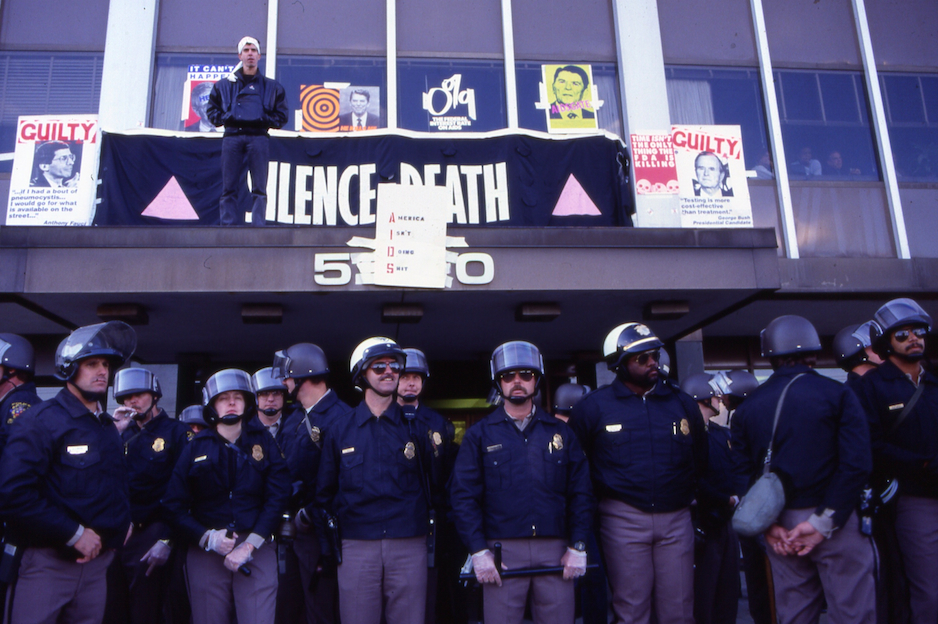
The AIDS activist group ACT-UP, which was comprised mostly of gay men in the 1990s, would have been ignored if they didn't stop traffic, chain themselves to fences and climb onto rooftops.

ACT-UP, an AIDS activist group, would have been ignored in the 1990s if they didn’t stop traffic, chain themselves to fences and climb onto rooftops. (pictured at the NIH)

“Because we have expressed that our cause is important enough to violate a powerful social norm [dining], we leave a mark on people: “Wow, what the heck was that! They’re so outraged by something that they felt the need to come into the store to register their complaint.”
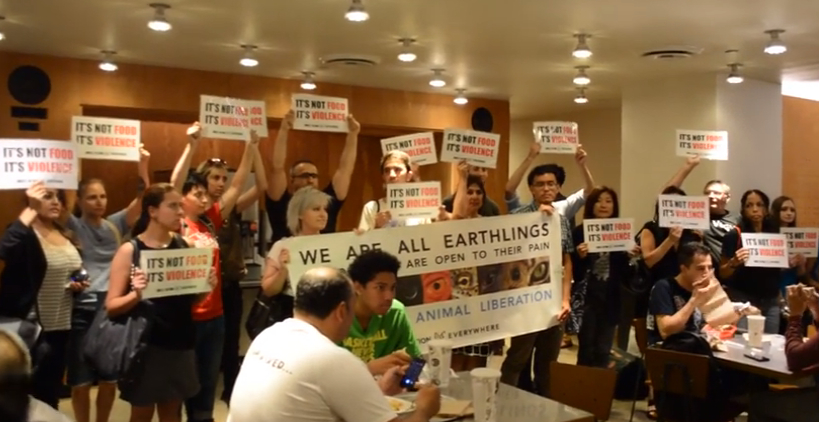
animal rights protest at Chipotle

DxE breaks with the tradition of letting customers dine in peace.

“Speaking loudly and proudly in defiance of social convention . . . inspires others to do the same. And that is why we encourage our activists to step outside of their comfort zones . . . and into the stores that are selling the dead bodies of our friends.”

Your Turn

Please visit Direct Action Everywhere and Collectively Free to learn about, support and/or join their provocative campaigns to expose the truth about animal farming and promote a cruelty-free lifestyle.

Secret Investigation at Whole Foods’ Egg Supplier Reveals Horrors of “Certified Humane” Farming

January 9, 2015 by 7 comments


The News

Direct Action Everywhere (DxE), a California-based animal rights group that stages dramatic in-store protests around the world, conducted a year-long investigation of a “certified humane” farm, and what they found was so compelling that the New York Times ran a lengthy (though slanted) story about it, exposing the mainstream public to the myth of “humane” animal agriculture.

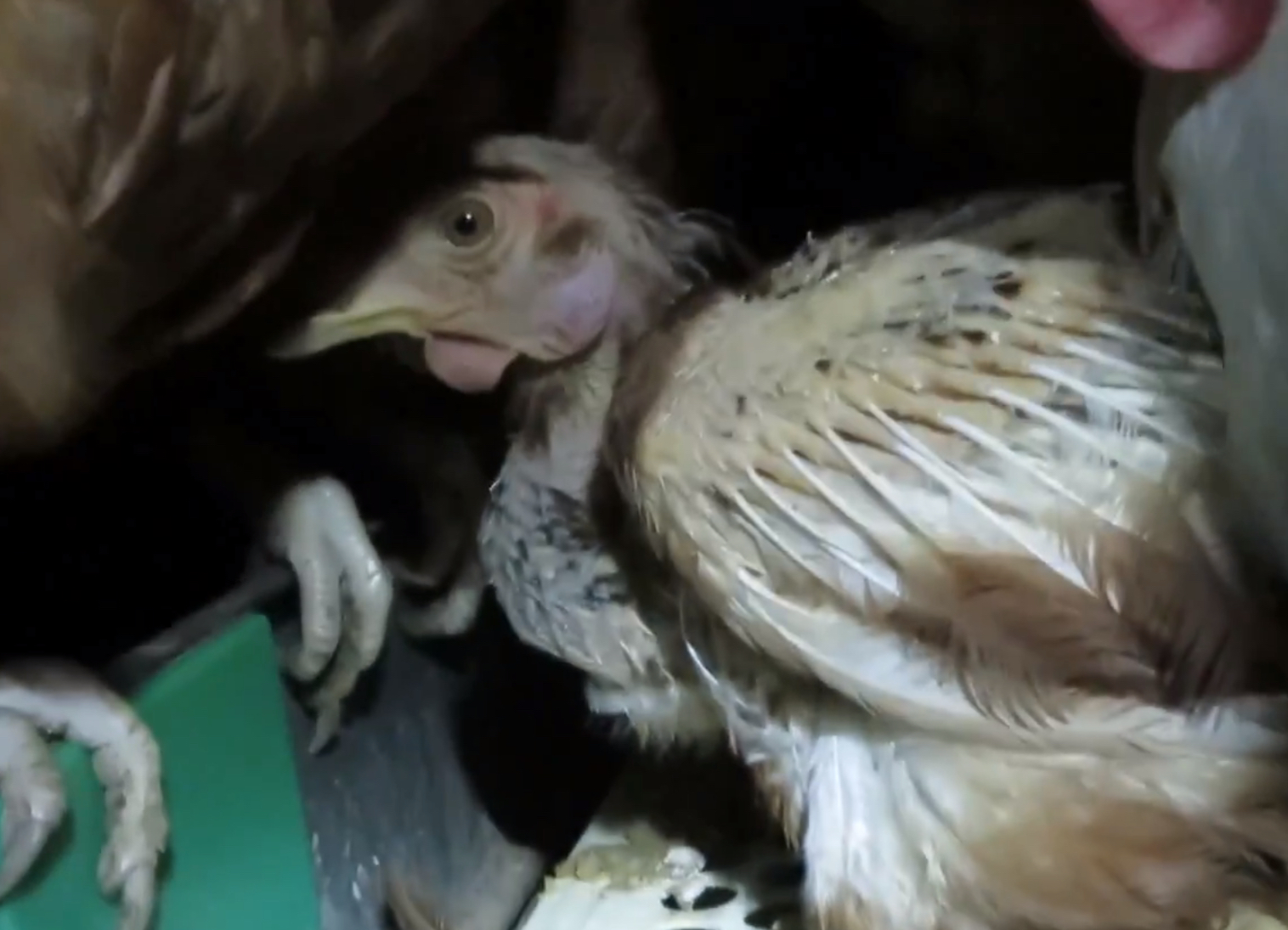
Certified humane?

Certified humane?

During approximately 10 visits to Petaluma Farms, a Whole Foods egg supplier in California, DxE took video footage of the horrific conditions in which the “humanely raised” hens are living. In addition to documenting the typical aspects of “life” on factory farms, such as disease, stress and overcrowding, they encountered birds languishing in manure pits; struggling to breath and already dead. One of the worst conditions, the “overwhelming” smell, could not be captured on camera.

In this extraordinary video, DxE uses video footage from its investigation to demonstrate that, even in the “best” of circumstances – on a farm that is “certified humane” – animals are abused, neglected and deprived of the chance to do anything that comes naturally to them.

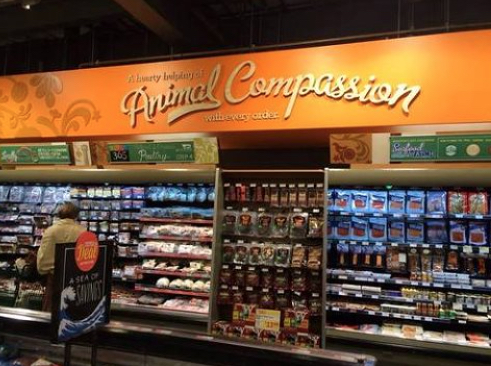
Because Whole Foods is spending tens of millions of dollars to duplicitously market animal abuse as “humane” and slaughter as an “act of compassion,” DxE is launching an international campaign against the grocery store chain – with protests planned in 50 cities – demonstrating that there is no humane way to slice off hens’ beaks, castrate baby pigs, suffocate animals in gas chambers and slit their throats. Whole Foods, they argue, has built a “house of lies” around a “dark and violent reality,” where their “farms are prisons, and every inmate is on death row.”

Whole Foods markets slaughter as "compassion."

Whole Foods markets slaughter as “compassion.”

Your Turn

Please visit Direct Action Everywhere to learn about, support and/or join their provocative campaigns to expose the truth about animal farming and promote a cruelty-free lifestyle.

Video Captures Dozens Attacking Injured Bull

January 7, 2015 by 3 comments


The News

Dozens of people in Southern Colombia attacked and killed a bull who was lying injured on the ground in a arena during the annual “corraleja,” an amateur bullfighting festival held each year in several towns in Colombia. During corralejas, spectators are invited into the arena to fight the bull.

Two shots of spectators jumping onto the bull

Two shots of spectators jumping onto the bull

Video of the incident, which shows dozens of people kicking, stoning and slashing the helpless bull, has generated outrage in Colombia. In response to the outcry, the country’s Ministry of Culture issued a statement describing the ritual as “barbaric” and calling for the attackers to be punished. He has also called for a public debate about whether the festival should be allowed to continue.

The Mayor of Turbaco, the town in which the incident was filmed, defended the attack: “In ‘corraleja’ festivals, there are always injuries, there are always animals beaten and horses killed. These are the kinds of incidents that form part of the traditions and customs of such festivals.”

As more and more people become exposed to the barbarity of bullfights, governments are being pressured to curb the tradition. In Bogota, Colombia’s capital, the Mayor banned bullfighting in 2012, declaring that the city’s arena is for “activities of life, not death.” Bullfight supporters are fighting back in the courts and in the streets.

Hundreds attend pro-bullfight rally in Bogota, Colombia

Hundreds attend pro-bullfight rally in Bogota, Colombia

Barcelona banned bullfighting in 2012. Over the border in France, however, the bloodsport is still legal. In 2014, dozens of animal rights activists stormed a bullfight arena in Southwest France and were dragged away one by one by police officers. In an unexpected development, bullfight fans violently attacked the protesters.

bullfight

Bullfight protesters in France


Philanthropist Rescues 1,300 Monkeys from Imminent Torture

January 6, 2015 by 4 comments


The News

Ady Gil, a Los Angeles-based philanthropist and animal rights activist, has spent $2 million to purchase 1,300 monkeys on the verge of being sold to laboratories around the world. The long-tailed macaques were the last of monkeys at Mazor Farms, a primate breeding facility that supplies monkeys for experiments. Several hundred of Mazor’s monkeys were snatched from the jungle in Mauritius, an island off the coast of Africa, and shipped in crates to Israel. The remainder were bred in captivity.

Journalist Jane Velez-Mitchell spoke to Mr. Gil about his historic purchase:

According to activists with Behind Closed Doors, who have been fighting for 20 years to shut down Mazor Farms, infant monkeys born at the facility are kidnapped from their mothers and held in separate enclosures so that they can be bred as quickly as possible. The separation is traumatic for the infants and their mothers, who cry out for them. Those who survive are tattooed, sold for $3,000 each, stuffed into crates and shipped to labs for toxicology studies or invasive brain studies, which, according to the Israeli activists, is “a fate worse than death.”

Photo: Alon Ron, Haaretz

Photo: Alon Ron, Haaretz

Mazor Farms has been the target of Israeli animal rights activists for 20 years. In recent years, they have had some success with curbing Mazor’s operations. In 2010, the Israeli airline El-Al agreed to stop transporting animals for experimentation after video emerged of monkeys suffering in crates. In 2011, the Israeli government banned the importation of wild caught monkeys. In 2012, activists took to the streets of Tel Aviv in a dramatic protest to shine a spotlight on the atrocities committed at Mazor Farms and the labs where their monkeys are shipped:

Thanks to the generosity and vision of Ady Gil, Mazor Farms is closed for good. The monkeys will be sent to sanctuaries in Israel that are being expanded to meet the demand.

Your Turn

Ady Gil spent a stunning $2 million to free the monkeys, but his foundation will need help paying to expand an existing sanctuary and for lifelong care of these monkeys. Please visit Ady Gil World Conservation to see how you can help give these monkeys a second chance.


Breaking News: First-Ever Footage of Hen Slaughterhouse Shows Egregious Violations

January 5, 2015 by 5 comments


The News

Eggs. Billions upon billions of eggs are consumed in the United States each year. Most consumers buys eggs by the dozen and crack them open without giving a second thought to where they come from, much less what happens to the hens when they can no longer lay them.

Today, the Humane Society of the United States (HSUS) released the first-ever footage from a slaughterhouse for spent hens. The footage was taken by an undercover investigator who spent 57 days documenting what happens to the 85,000 hens killed each day at just one slaughterhouse – Butterfield Foods in the state of Minnesota.

The most egregious abuse uncovered was scalding hens while they were still alive. Hens are supposed to be dropped into an electrified water trough to render them unconscious before having their throats slit and being dropped into scalding tanks for feather removal, but that doesn’t always happen. In a thirty minute period, the HSUS investigator counted approximately 45 birds who were drowned alive in the scalding tanks. It’s the most grisly end possible for animals who spent their entire caged lives in a space smaller than a sheet of paper.

battery cage hens

Hens in battery cages

Even though chickens and turkeys represent 9 out of 10 animals who are slaughtered in the U.S., the federal Humane Methods of Slaughter Act exempts them. Nonetheless, HSUS invoked Minnesota’s anti-cruelty code to file a complaint with the state. The organization also filed a complaint with the USDA’s Food Safety Inspection Service on the grounds that Butterfield is violating the Poultry Products Inspection Act.

The hens slaughtered at Butterfield are transported in crates from factory farms all over the country. During their long journey, the hens, who are already battered after spending their lives in battery cages, are deprived of food, water, space to move and protection from the weather. The investigator documented birds who arrived dead; with broken bones; and covered in feces.

When the trucks arrive at Butterfield, workers grab the frantic hens out of the crates with a metal hook, shackle them upside down, and send them on a conveyer belt from an electrified water trough to a neck cutting station to a scalding tank. The investigator witnessed hens attempting to right themselves; hens who missed the electrified trough; and hens who had their necks sliced while fully conscious. Some hens arrived alive and bleeding at the scalding tank where they were boiled.

Butterfield Foods

Butterfield Foods

Who eats spent hens? Their bodies, which were bred to lay eggs, have very little meat. In addition, hens often have broken bones which splinter into the flesh. Paul Shapiro, HSUS’ VP for Farm Animal Protection, says that most this low-grade meat, valued at 2 cents/bird, is used for farm animals and pet food. At Butterfield, however, the meat is canned for human consumption and sold to discount stores.

butterfield chicken

Hens can live for over a decade, but, on factory farms, they are sent to the slaughterhouse at 12 – 18 months, which is when they stop laying eggs.

Your Turn

The best way to prevent this cruelty is to stop eating chickens and their eggs.  But you can also help by urging the United States Secretary of Agriculture  at the USDA to include poultry under the Humane Methods of Slaughter Act.