

Their Turn - The Social Justice Movement of Our Time Their Turn - The Social Justice Movement of Our Time

Updates on Campaign to Help Animals Being Warehoused at Humane Society of NY

July 6, 2023 by 6 comments


The News

Background

In July 2021, whistleblowers at the Humane Society of New York (HSNY) contacted animal advocates to sound the alarm about the warehousing of dogs and cats at the large and prominent shelter in midtown Manhattan. They said that adoptions had come to a virtual standstill 15 months earlier and that the building was closed to the public under false pretenses. The whistleblowers wrote that, despite claiming to be closed due to COVID, the HSNY could not reopen its doors to the public until they made the building wheelchair accessible under Americans with Disabilities Act (ADA) guidelines.
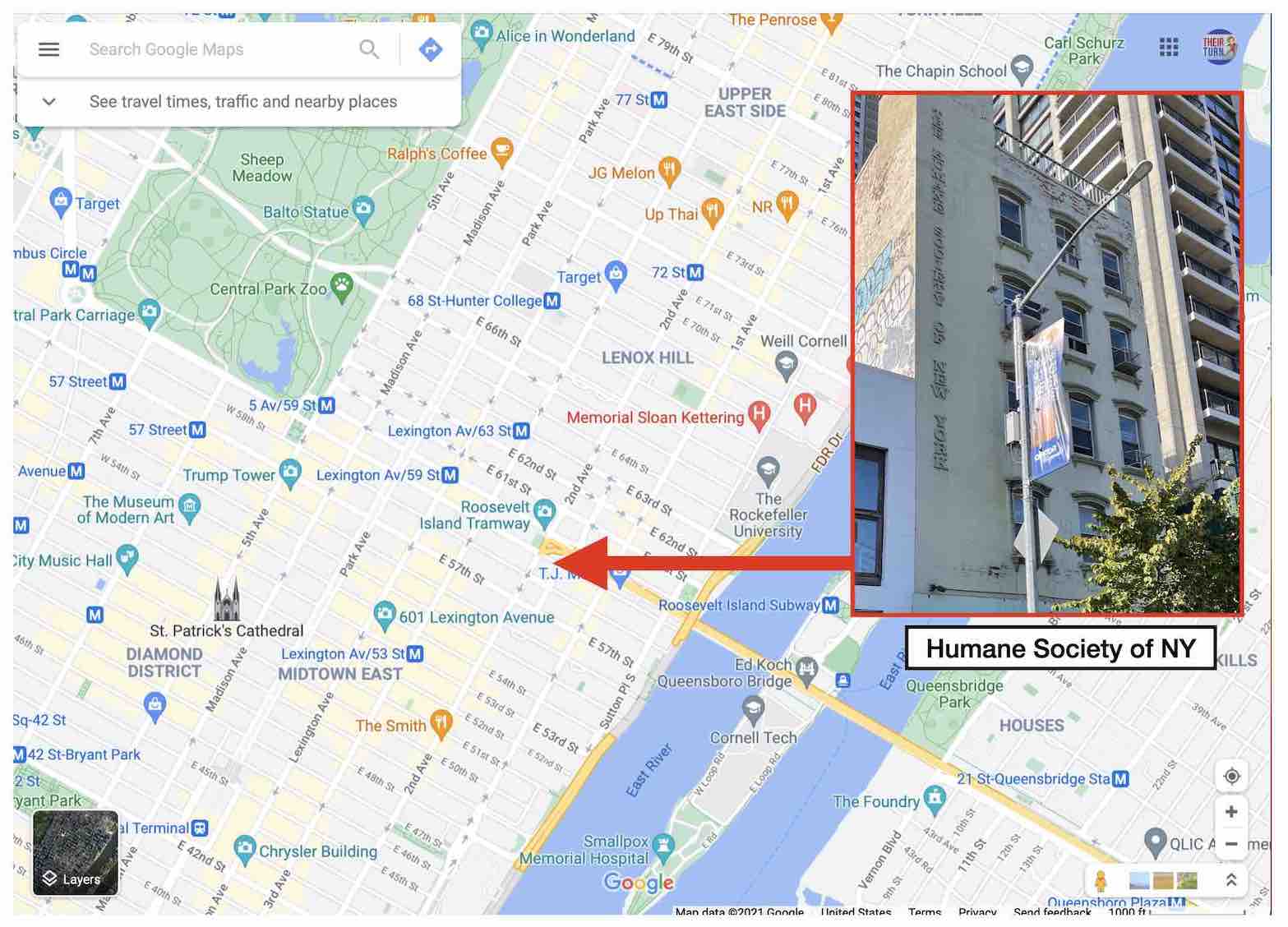
Photo of Humane Society of New York

The Humane Society of New York is centrally located in a heavily populated residential neighborhood in Manhattan, but members of the public have not been able to enter the building to meet the homeless animals

In the ensuing months, advocates learned that the Executive Director, Sandra DeFeo, planned to keep the building closed to the public indefinitely. Insiders said she did not want to make the renovations and was content to keep members of the public, including adopters and clients of their vet clinic, out of the building, even if that meant that prospective adopters had no way of meeting the animals.
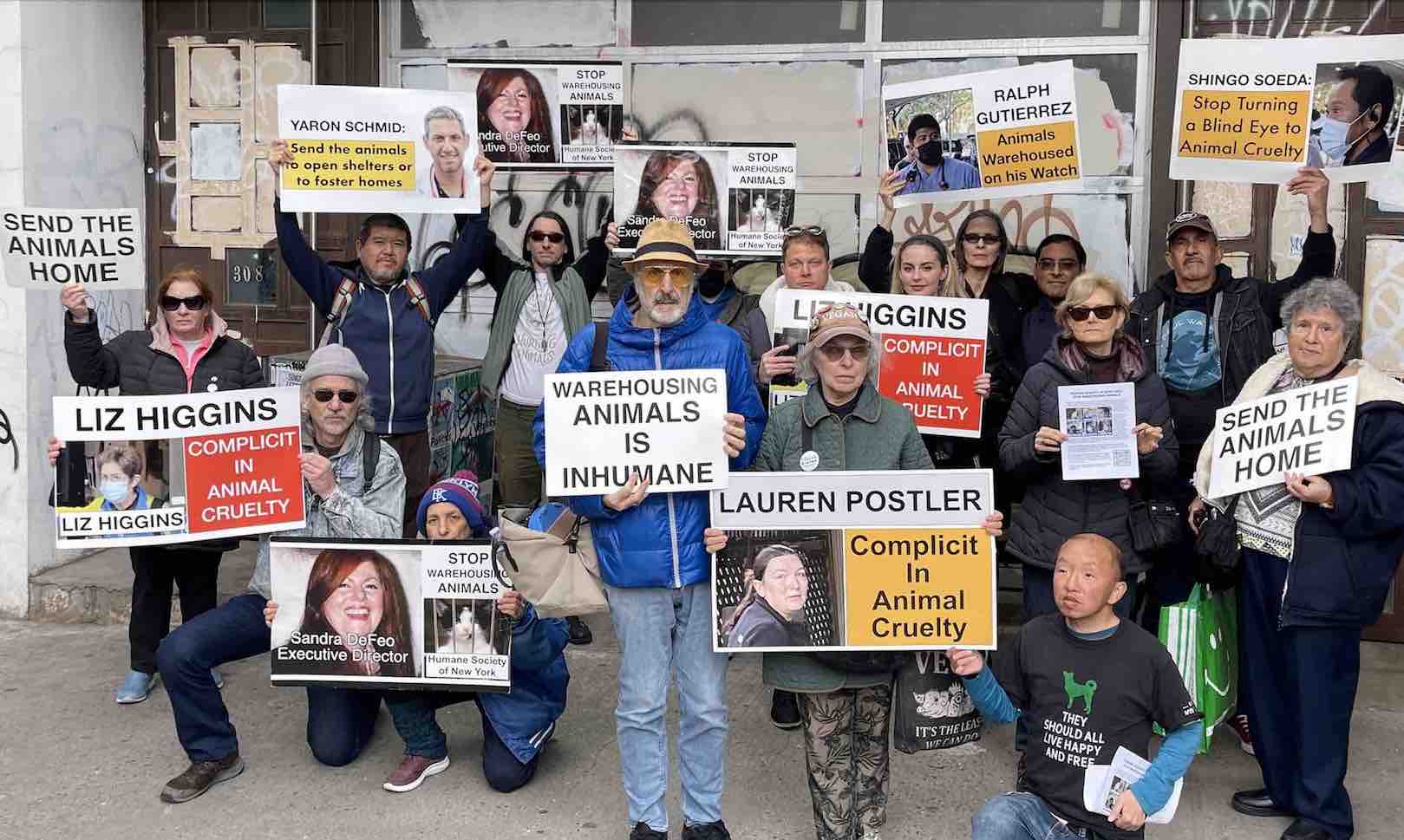
Photo of protest at the Humane Society of New York

Animal rights activists are calling on the Humane Society of NY to send the animals in their care to foster homes

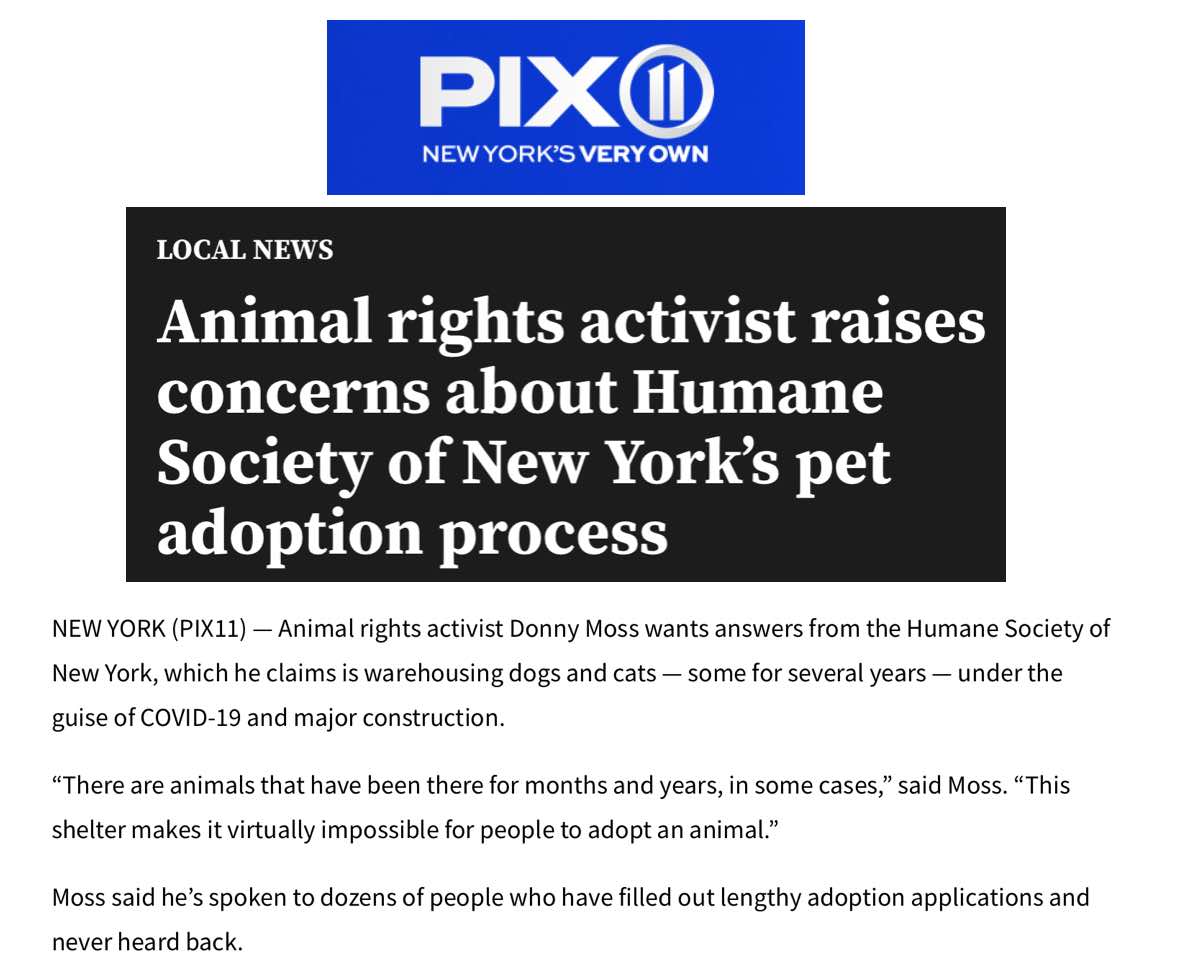
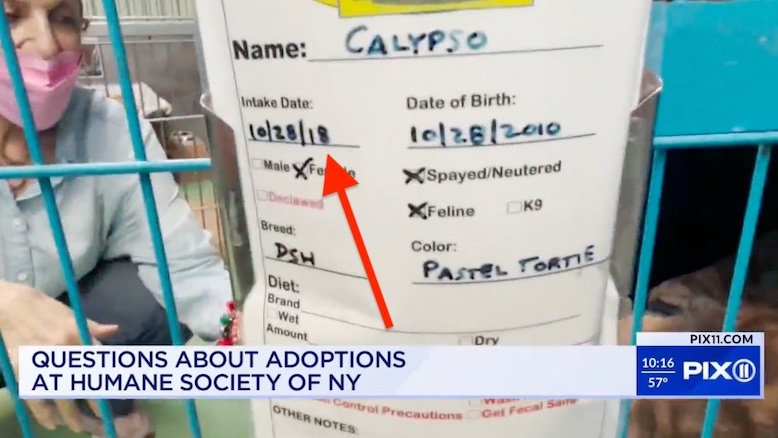
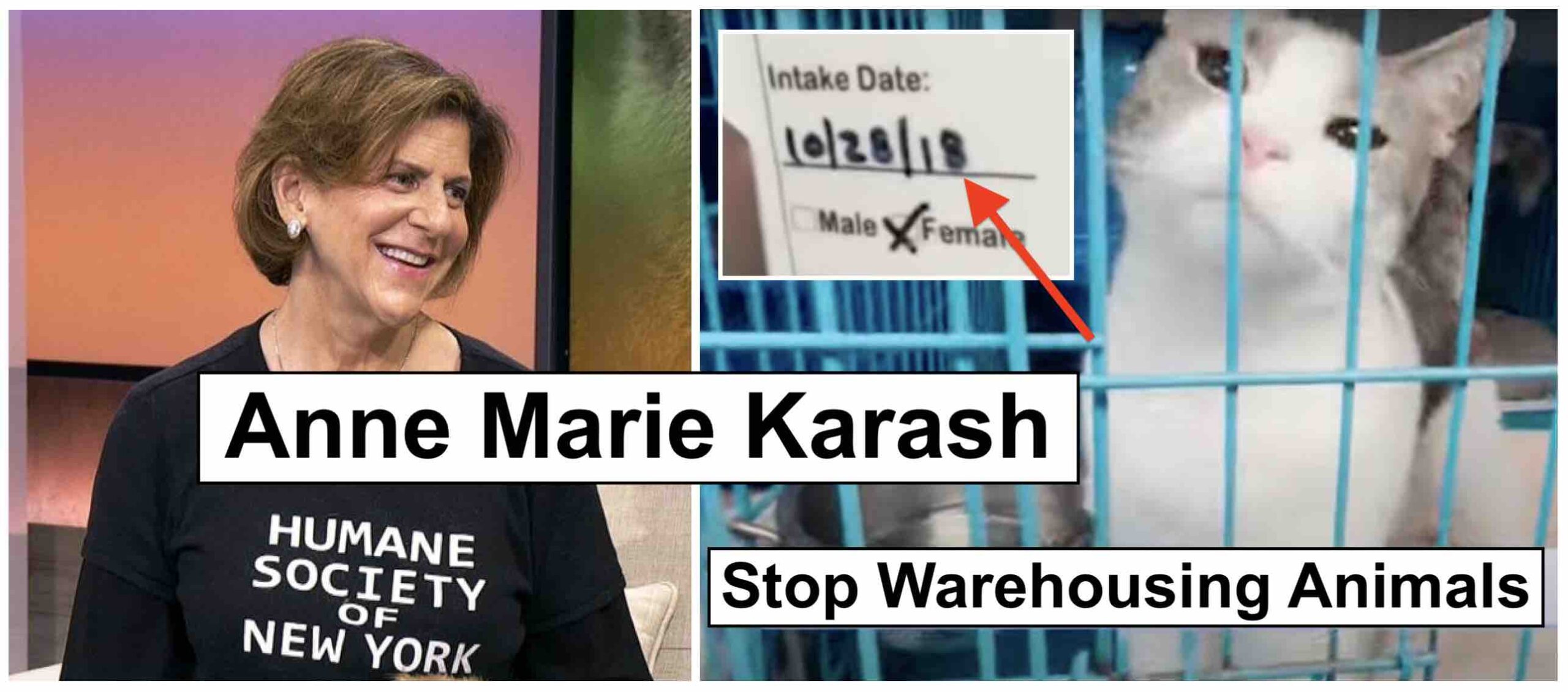
In a March 2023 TV news story, Pix11 corroborated the whistleblower allegations regarding animal warehousing, airing video clips of adoption cards with intake dates of 2018 and 2019.

Until 2020, guardrails were in place to protect the animals — a full time Adoption Director; an active board president; and an adoption center that was open to adopters. When these guardrails came down, the animals were left in the hands of an Executive Director who believes that cages are “apartments” and that the shelter is a “foster home.”
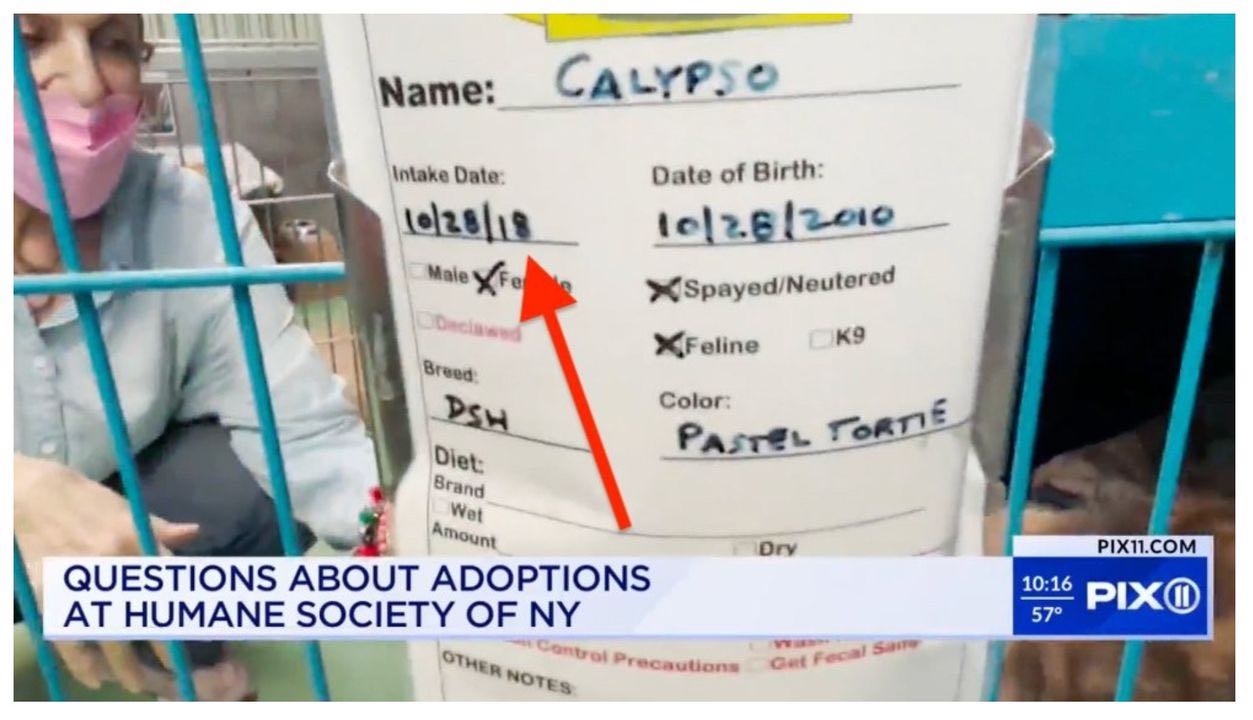
Photo taken in March 2023 of adoption card with intake date of 2018

Pix11 News corroborated whistleblower allegations that animals had been living in cages at the Humane Society of New York for several years

By warehousing cats and dogs for several years, the HSNY has needlessly created a population of animals with emotional and physical problems who are more difficult to place in forever homes.
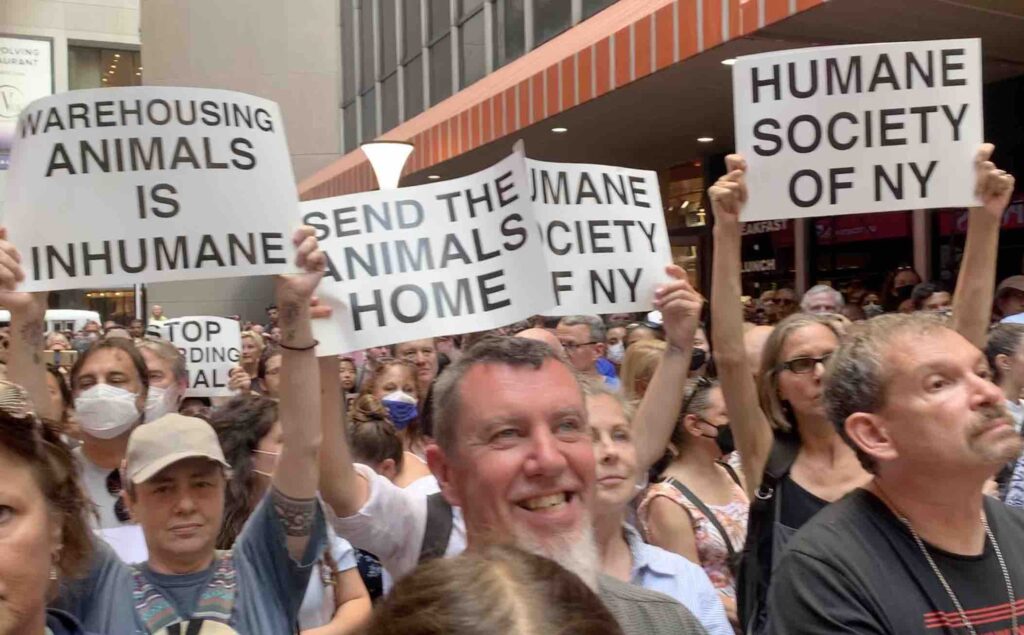
In July 2022, approximately 30 activists protested the Humane Society of New York (HSNY) over the warehousing of animals at its shelter when actress Bernadette Peters brought the shelter’s animal trainer onto the stage during Broadway Barks, a star-studded adoption event in NYC’s theater district.

The Construction Project

After caving into pressure from advocates, who asserted that an adoption center cannot be permanently closed to adopters, DeFeo broke ground on an extensive renovation to make the lobby wheelchair accessible under ADA guidelines. The construction crew has cut an opening in the facade and is installing a wheelchair accessible elevator that opens onto the street level.
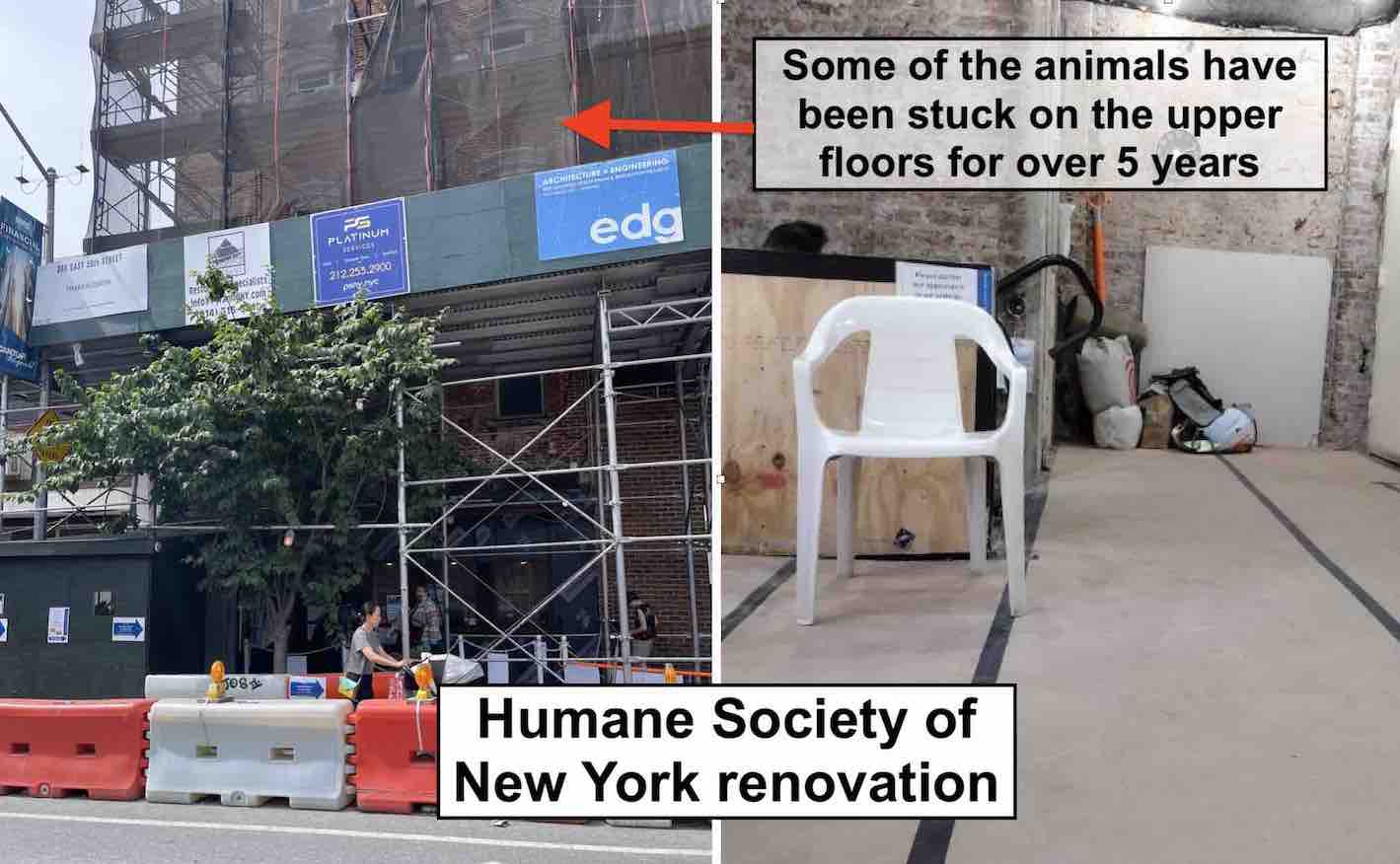
Photo of Humane Society of New York renovations

The Humane Society of New York was closed to the public for over three years and is now undergoing a major renovation, which is continuing to keep prospective adopters out of the organization’s adoption center

Despite the loud and messy renovation, which is not only limiting access to the building, but also further compromising the quality of life of the animals, the HSNY refuses to send the remaining animals to foster homes, where they would have human companions and not be confined to a cage. The advocates surmise that the HSNY continues to ignore adoption applications because they don’t want prospective adopters entering the building during the renovation.

Change in Procedure for How Adopters Meet Animals

In March 2023, the Associate Director of the HSNY, Anne-Marie Karash, told Pix11 News that the HSNY would no longer allow prospective adopters into the building unless their adoption applications were “approved.” That announcement begged many questions. How can the HSNY approve adoption applications if they are ignoring them?  How can they approve an application if the applicant hasn’t met the animal(s)? And how can they approve of prospective adopters without meeting them?

Before the HSNY closed the building to the public, prospective adopters who filled out an application in the lobby were invited into the adoption center to meet the animals. The advocates assert that the HSNY should hire an Adoption Director (to replace the one who retired in early 2020) and revert back to this process.

Prospective Adopters Give On-Camera Testimonials

In recent weeks, several seemingly well-qualified applicants who read about the animal warehousing controversy online after submitting adoption applications contacted TheirTurn to share their experience. Three of them agreed to provide on-camera testimonials.
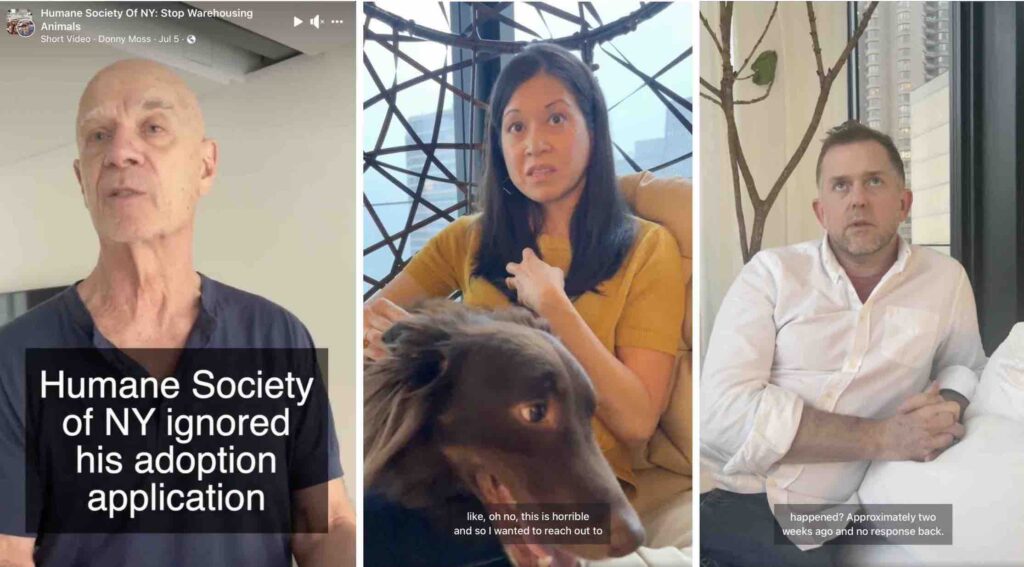
Photo of individuals who attempted to adopt from the Humane Society of NY and never heard back

Three seemingly well qualified adopters who did not receive a response to their adoption application agreed to speak on camera

Since starting this campaign in 2021, the advocates have spoken to dozens of other prospective adopters who never received a response to their application, even when they followed up.

Advocates Protest at the Home of the HSNY’s Associate Director

During an interview with PIX11 News. Anne-Marie Karash, the Associate Director of the HSNY, attempted to justify keeping animals in cages for “years” by stating that they wait to place animals until they find “responsible homes.” Her remarks suggest that they engage in exhaustive due diligence when, in fact, they don’t even respond to adoption applications.

In April and May, advocates decided to hold Karash accountable for the misleading statements by staging protests at her Brooklyn home. The entrance to her building was bustling with people, many with dogs, who were eager to learn why the advocates were there. Several said they recognized Karash and would address our concerns with her if they bump into her.

When they arrived at Karash’s home for the first protest, a security guard who advocates recognized from the HSNY was waiting for them. Because he set up a lounge chair next to the building entrance, as if to suggest that the protest was an event worth watching, his presence drew added attention to the protest. Advocates noted that the same guard once opened his vest to reveal a gun and, on several occasions, flashed a badge, as if to suggest he is employed by the NYPD.
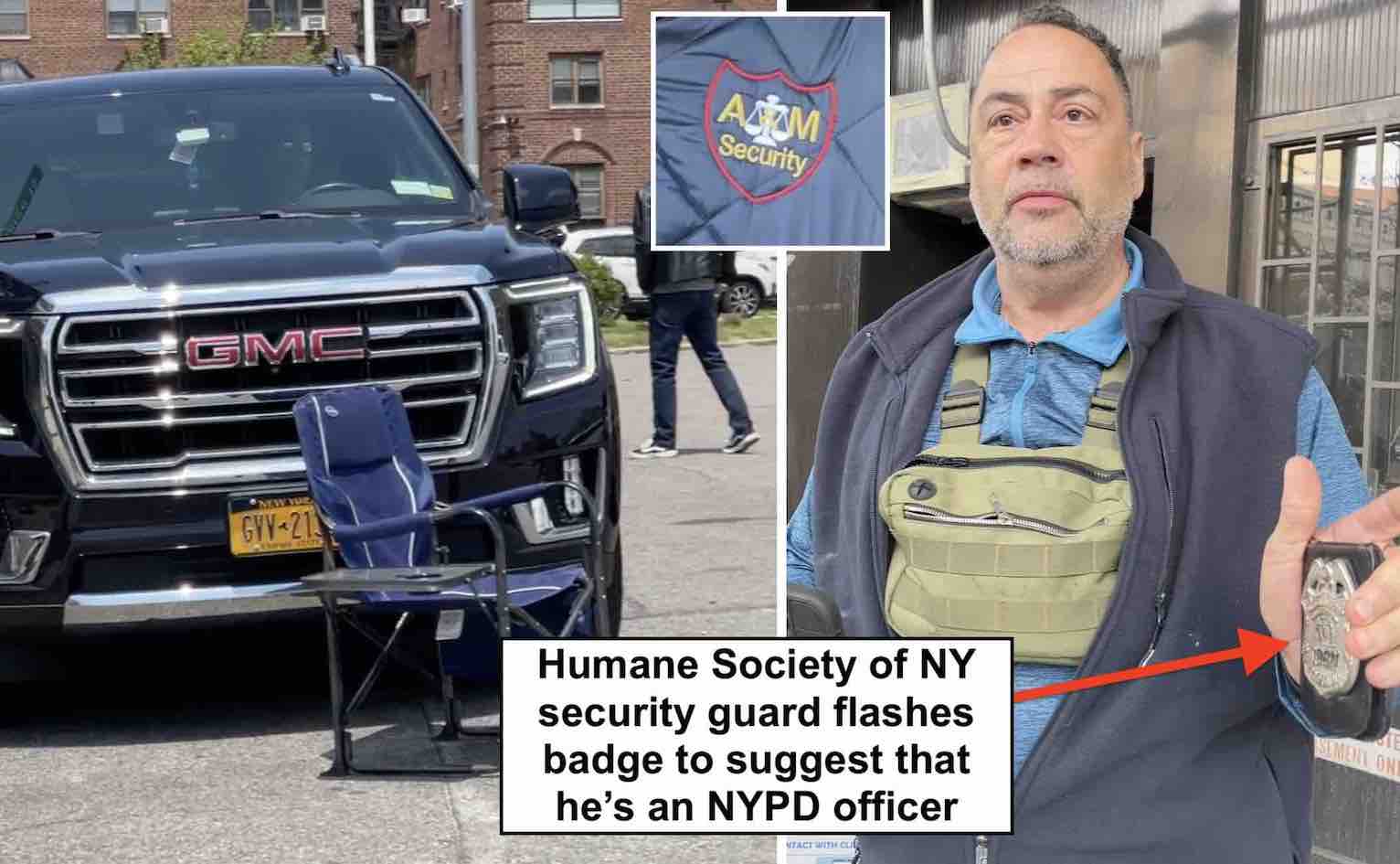
Photo of Humane Society of New York security guard attempting to pass himself off as an NYPD officer

A Humane Society of New York security guard, who drew more attention to a protest by setting up a lounge chair, has twice attempted to pass himself off as an NYPD officer

Letter to the NY State Attorney General and IRS

Bonnie Klapper, an attorney representing the advocates, sent a letter to the state Attorney General and the IRS asking that they conduct an investigation “to determine whether the HSNY is in violation of its charter and other federal and state rules and regulations governing nonprofits.”
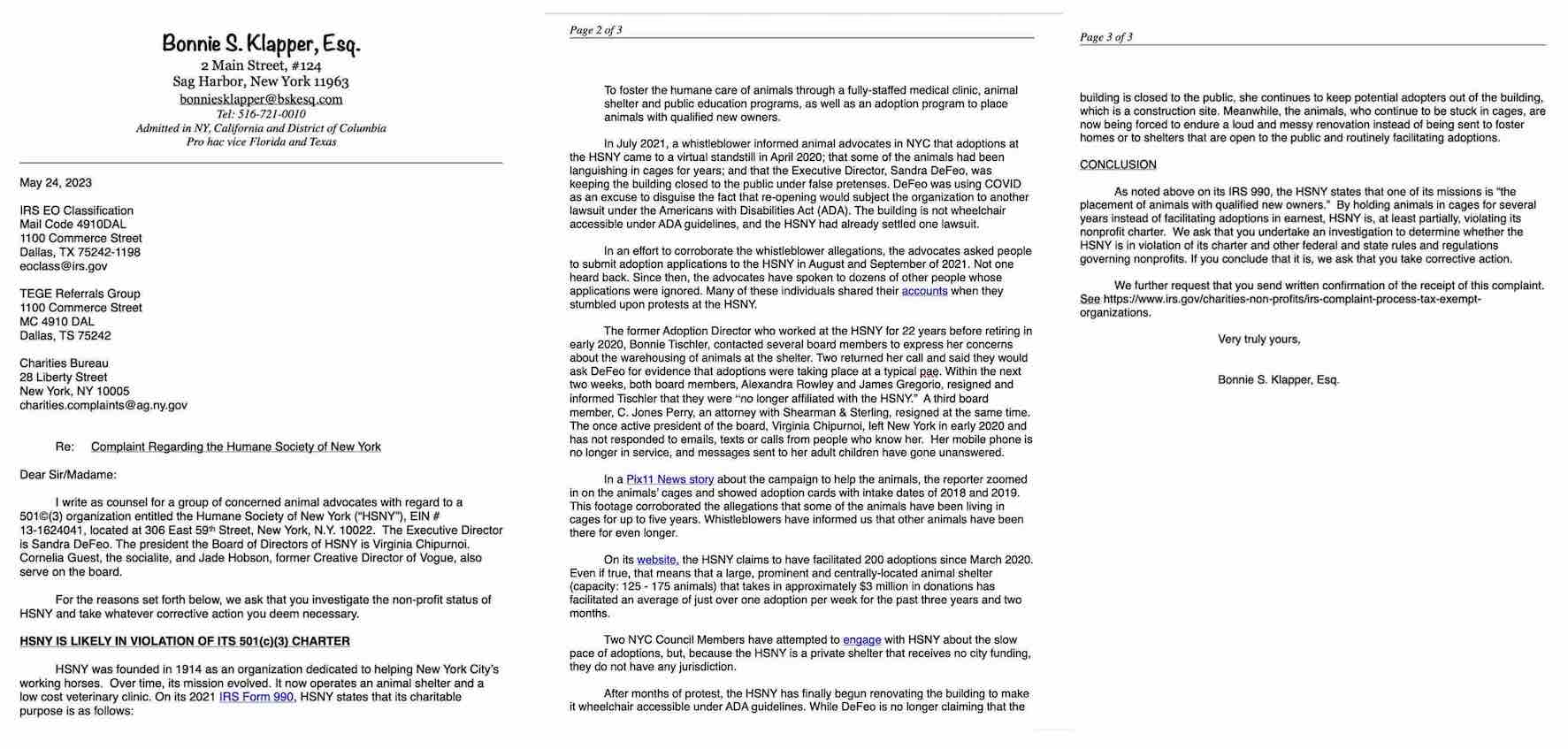
Photo of letter of complaint about the Humane Society of New York sent to the NY State Attorney General and the IRS

Attorney Bonnie Klapper sent a letter to the NYS Attorney General and the IRS to ask that they undertake an investigation “to determine whether the HSNY is in violation of its charter and other federal and state rules and regulations governing nonprofits.”

Media Coverage

In June 2023, BronxNet News conducted an in-depth interview with Donny Moss of TheirTurn.net, an organizer in the campaign to help the warehoused animals.

In March, Pix11 News aired a three minute segment about the controversy and included an interview with Julie Menin, the Council Member who represents the district where the HSNY is located. During the interview, Menin said, “Why are the adoptions only one per week? That seems like a very slow pace for a relatively large organization that’s well funded. So, we do have concerns about that. We’re also concerned about why can’t the public come in?”

Advocates Receive Threatening Letters

Donny Moss and Bonnie Tischler, the former Adoption Director and a co-organizer on the campaign, received threatening and homophobic letters in the mail. The letter targeting Moss was sent to his husband at work.

Photo of letter sent to Bonnie Tischler, the former Adoption Director at the Humane Society of NY

Letter sent to Bonnie Tischler, the former Adoption Director of the Humane Society of New York and an organizer on the campaign to help the animals being warehoused there

In the letter to Tischler, the sender warned her that she “better tell your daughter to watch herself crossing the street.”

In the letter to Moss’s husband, the sender accused Moss of being a “child molester” and wrote that they “reported this behavior to police.”
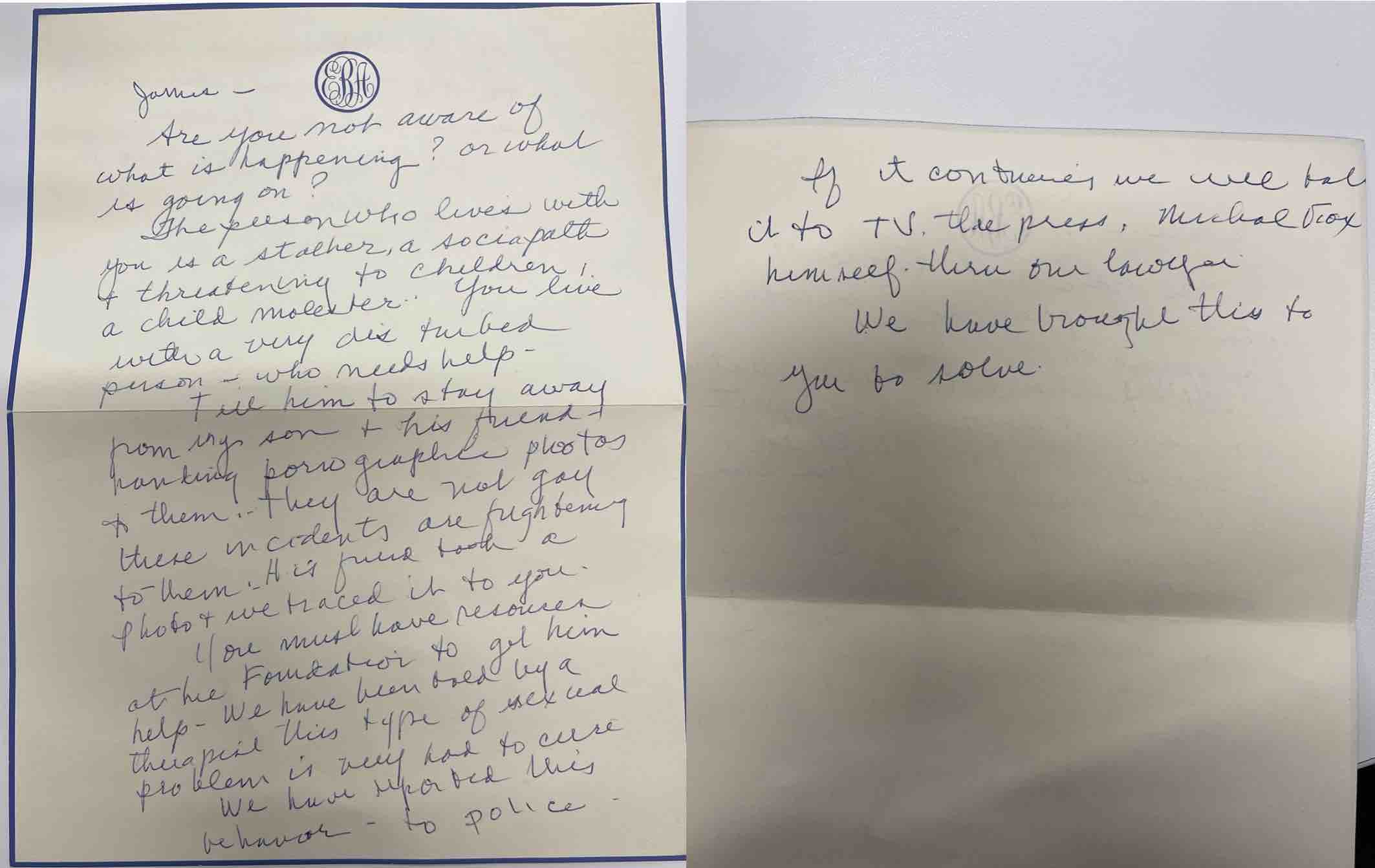
Photo of letter sent to the husband of Donny Moss, an organizer in the campaign to compel the Humane Society of NY to stop warehousing animals

Letter sent to the husband of Donny Moss, an organizer in the campaign to compel the Humane Society of NY to stop warehousing animals

Lack of Promotion and Interest in Doing Adoptions

The HSNY’s website and social media platforms feature only some of the homeless animals in the shelter. With the building largely closed due to the renovations and a new policy that prevents members of the public from entering, prospective adopters have no way of knowing that some of these unlisted animals even exist.

The HSNY has also disabled comments on its social media platforms. As a result, people cannot ask questions when the HSNY posts a photo of an animal who needs a home. Furthermore, the HSNY does not respond to direct messages, according to several people who have attempted to make inquires.

When prospective adopters submit applications, they receive a discouraging automated response: “If we are interested in pursuing your application further, we will call you to discuss and then possibly make an appointment for you….Unfortunately, we cannot call everyone, but we will reach out if we are ready to take the next steps with you.”
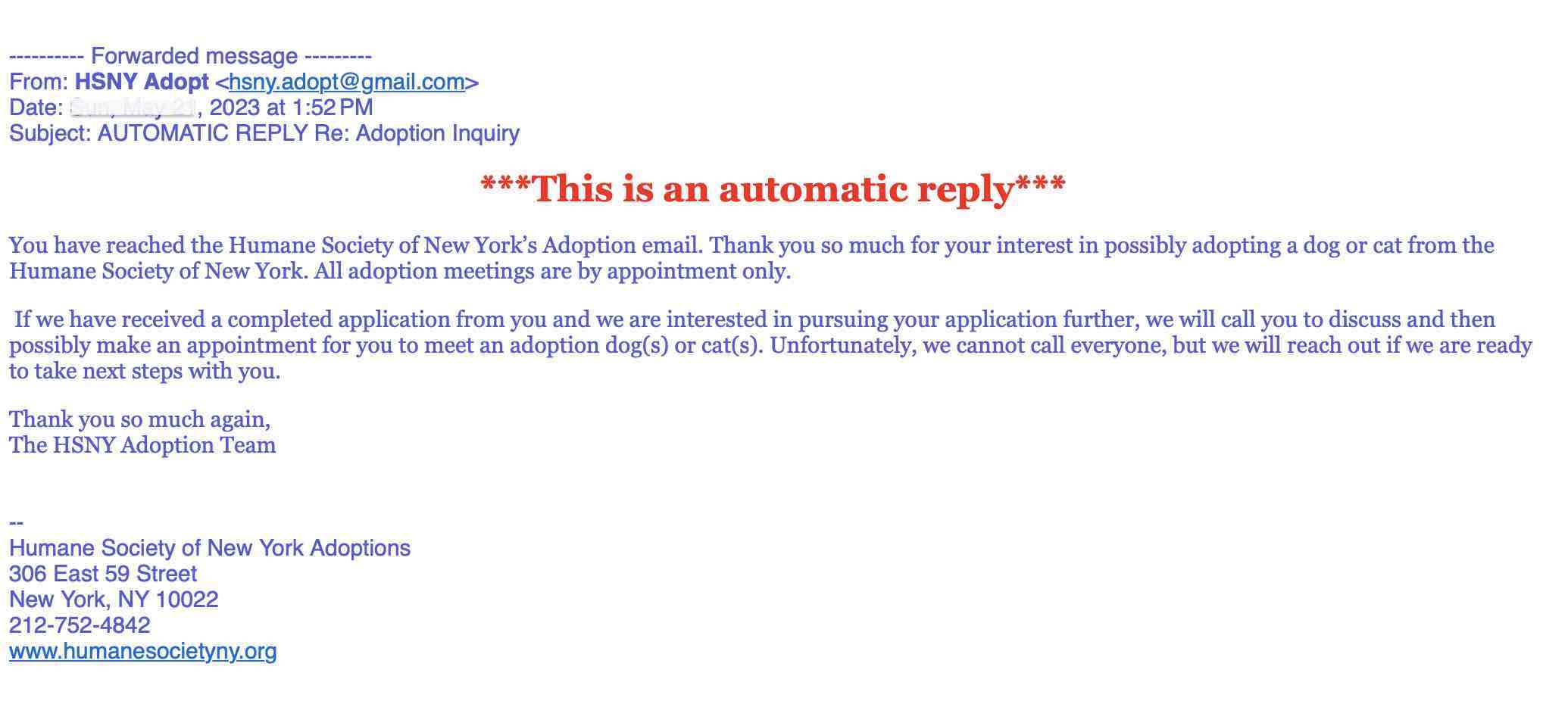
Photo of automated reply that the Humane Society of New York sends to people who submit adoption applications

Automated reply that the Humane Society of New York sends to people who submit adoption applications

Advocates assert that, if the HSNY was serious about placing animals in forever homes, then the automated response would be more encouraging, like this: “Thank you for your application. We have many cats and dogs who are looking for forever homes. If the cat or dog in whom you’re interested is not a good match, we can probably introduce you to other wonderful animals who might be. We will review your application and follow up with you in the next one to two days.”
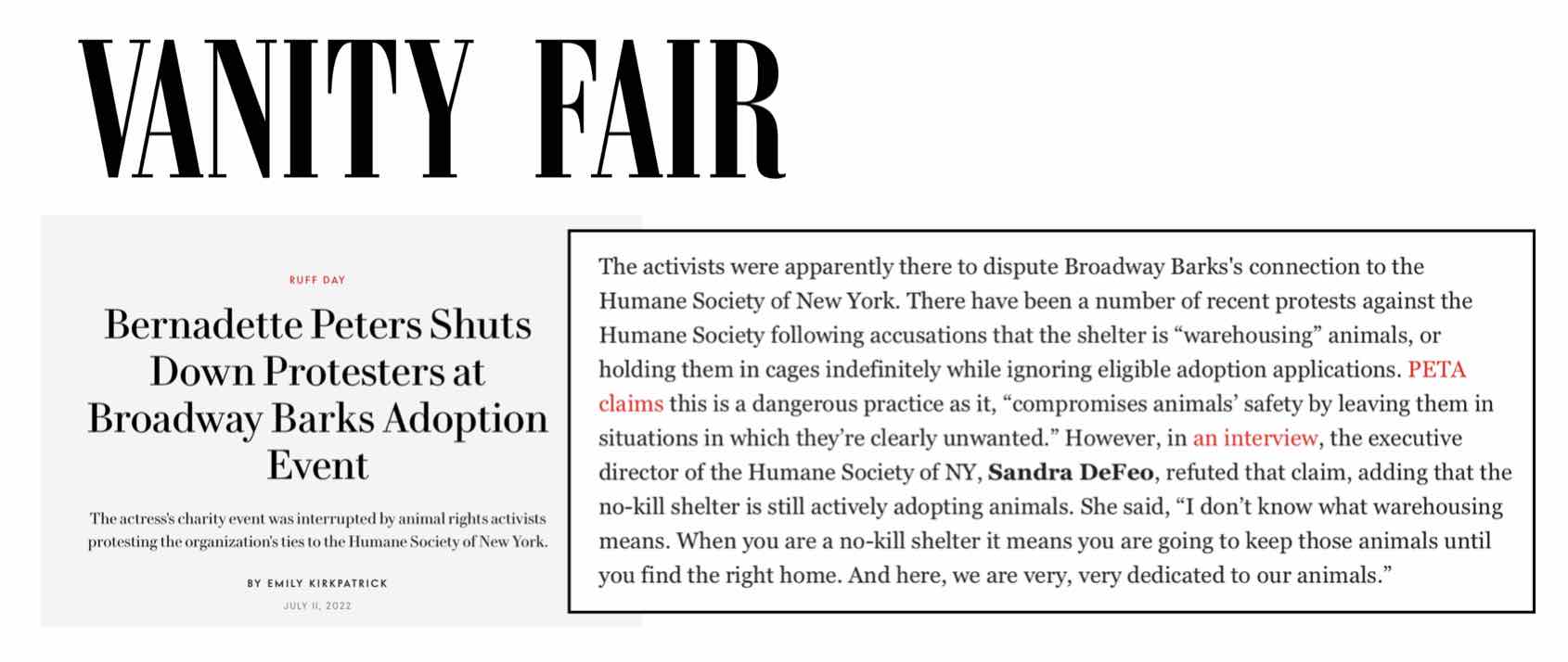
Photo of Vanity Fair's coverage of a protest targeting the Humane Society of New York

Vanity Fair, the Today Show and several other mainstream media outlets reported on the 2022 animal warehousing protest against the Humane Society of New York during Broadway Barks, a star-studded adoption event during which Bill Berloni, an animal trainer with the HSNY, was brought onto the stage

The HSNY runs a vet clinic in the same building as the adoption center. When advocates speak to vet clinic clients who are waiting for their animals in front of the building, the majority state that they did not know that the HSNY even has an animal shelter.

What the Advocates Want?

The advocates are calling on the HSNY to send the remaining animals to foster homes until they reopen the building to the public and resume adoptions in earnest.
Court Dismisses D.C. Restaurant Owner’s Lawsuit Against Anti-Foie Gras Activists

June 29, 2023 by 1 comment


The News

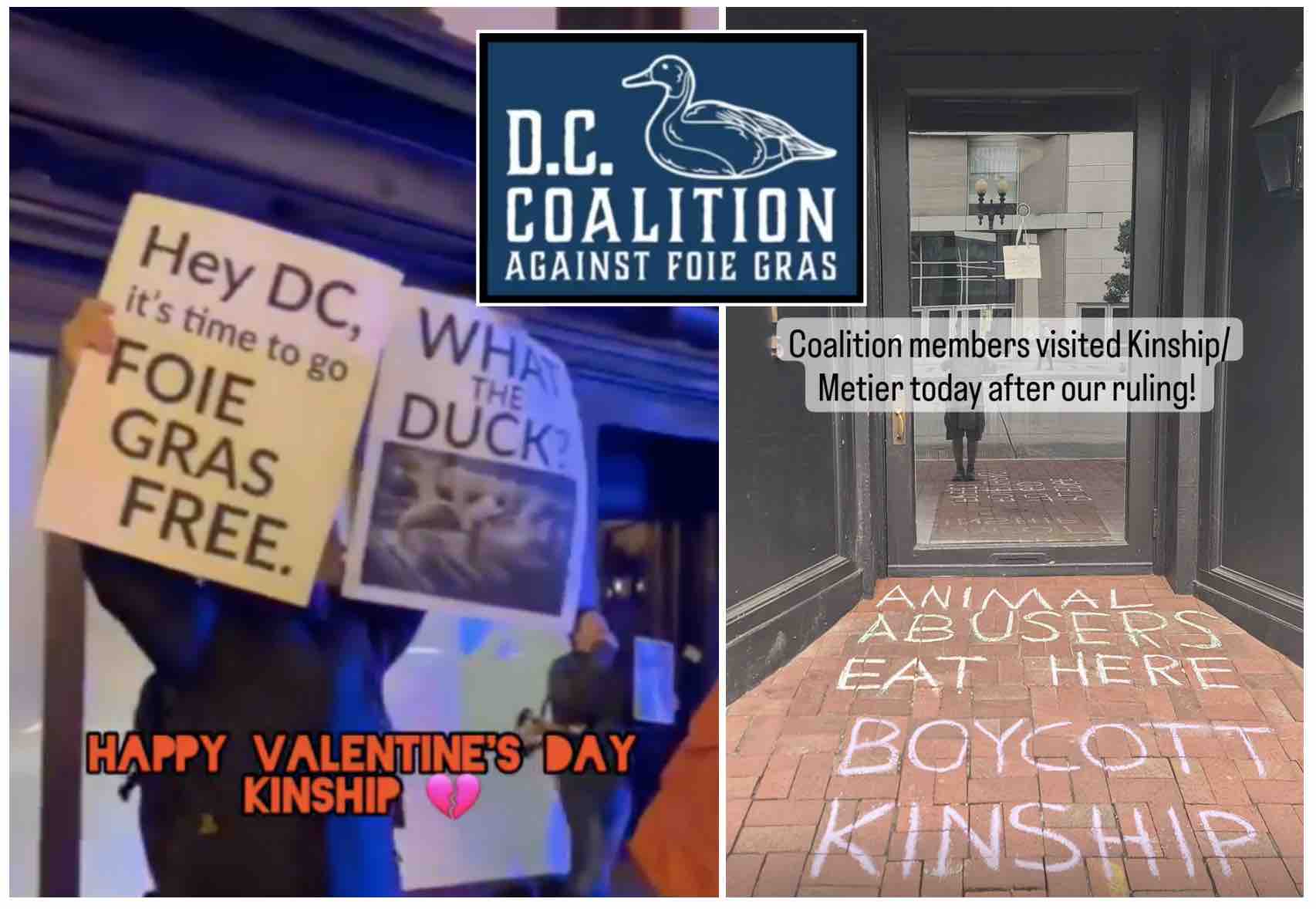
The Washington, D.C. Superior Court has ruled in favor of three animal rights activists sued for stalking by a restaurant owner attempting to curb their anti-foie gras protests and online speech. The activists, members of the D.C. Coalition Against Foie Gras, are calling on Eric Ziebold to stop selling the fatty liver product at his restaurants, Kinship and Métier.

Photos of protest at Kinship, a Washington-D.C. restaurant targeted by animal rights activists over its sale of foie gras

Washington D.C. restauranteur Eric Ziebold sued animal rights activists with the the D.C. Coalition Against Foie Gras in an effort to stifle their protests and online activity

The defendants’ lawyers, Matthew Strugar, Nigel Barrella and Chris Carraway from the University of Denver Animal Activist Defense Project, won the case by filing Anti-SLAPP (Strategic Lawsuit Against Public Participation) motions. The motions argued that Ziebold was attempting to silence the activists by burdening them with legal costs. The Superior Court granted the anti-SLAPP motions and dismissed Ziebold’s case. In addition to paying his own legal bills, Ziebold is obligated to pay those of the defendants.

Lead anti-SLAPP attorney Matthew Strugar stated, “Belligerent rich people like Eric Ziebold think they can shut down their critics through costly litigation. Anti-SLAPP laws are essential to protect free speech and punish bullies like Ziebold who try to weaponize the legal system to escape accountability.”

Upon hearing the verdict, defendant Lauren Melchionda made the following statement on behalf of the D.C. Coalition Against Foie Gras: “Our silence cannot be bought or won in court. We began this campaign to end the sale of foie gras in D.C due its immense cruelty. We will not capitulate what amounts to a tantrum from Eric Ziebold and once again urge him to take the pledge.”

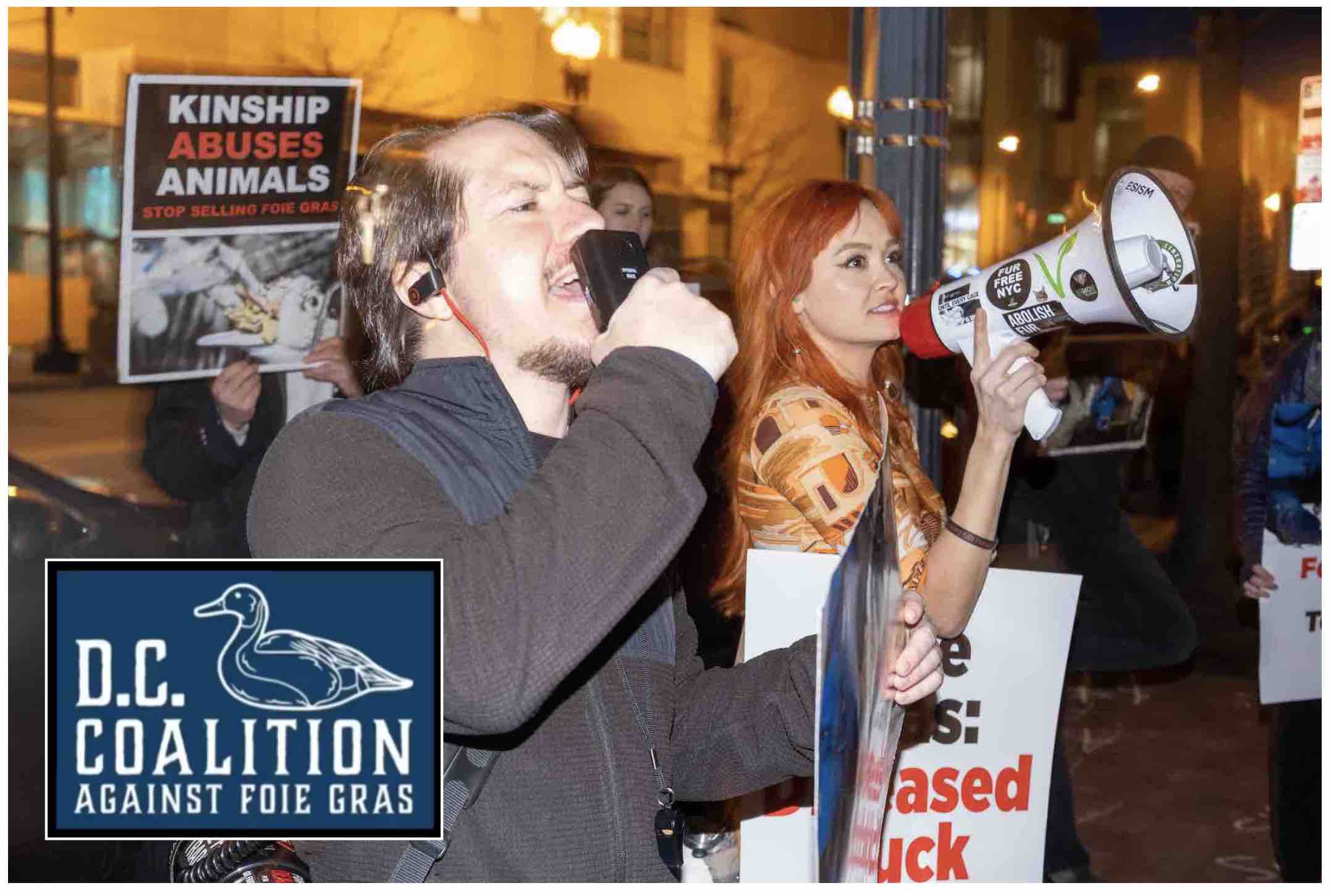
Photo of foie gras protest in Washington, D.C.

Animal rights activists with the D.C. Coalition Against Foie Gras protest at the restaurant Kinship, which sells the fatty liver product

Co-defendant Jenn Werth added, “Eric Ziebold wants to continue operating restaurants like it’s the 80s. Meanwhile, the world around him is evolving. Foie gras has been banned in several developed countries, and D.C.’s progressive community doesn’t want to eat food that is a product of cruelty.”

According to the defendants, Ziebold grew increasingly agitated by the protests over the course of two months. On one occasion, he locked activists inside of the restaurant until police arrived and forced Ziebold to let the activists out. According to the police, forcing them to stay inside was tantamount to kidnapping.

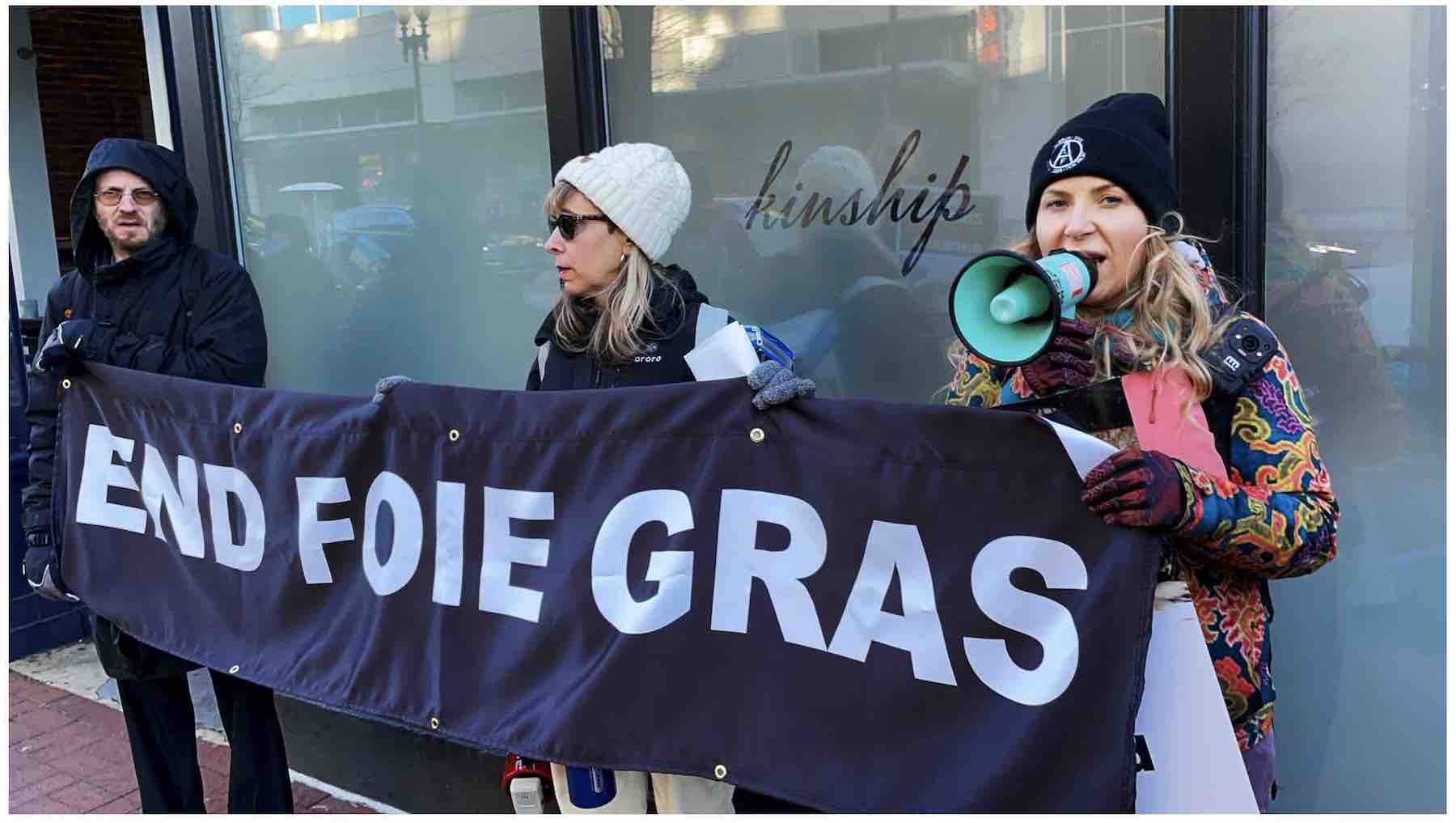
Photo of animal rights activists holding banner that says End Foie Gras

The D.C. Coalition Against Foie Gras calls on Eric Ziebold to stop selling foie gras in his restaurants

Despite claiming that the suit was not about the protests or free speech, Ziebold’s lawyers asked the court to curb the protesters’ online activity and to prohibit future protests within 100 yards of Kinship. A magistrate judge initially approved of these restrictions, but the Superior Court Judge removed them weeks before dissolving the injunction altogether. The court found that the stalking lawsuits were meritless because Ziebold sued the activists over their speech and protest activity, and Ziebold could not show he was likely to win his cases.

Co-counsel Chris Carraway said, “This victory reaffirms you cannot weaponize an anti-stalking measure, designed to protect actual victims of stalking, to silence criticism against the inhumane treatment inherent in serving foie gras.”

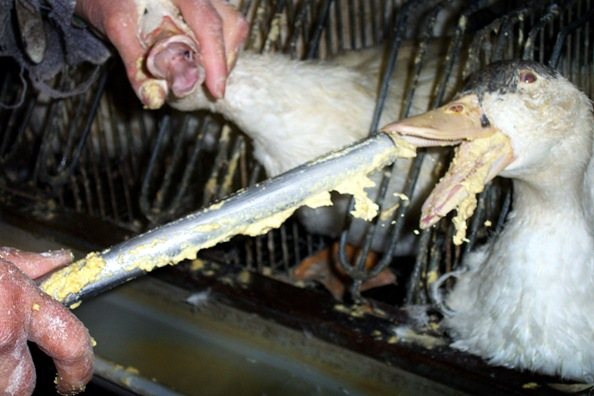
Foie gras is the diseased liver of a force-fed duck or goose. Undercover investigations of the country’s largest foie gras producer, Hudson Valley Foie Gras, have repeatedly found ducks dying from their injuries or choking to death as a result of the force-feedings. “Ducks on foie gras farms have been found with broken beaks, punctured esophaguses, choking to death on their own vomit,” said Mark Schellhase, the third defendant. “It is the height of animal cruelty.”

Gavage, force feeding

Gavage, the process by which the livers of ducks and geese are fattened, is French for force feeding.

Foie gras is banned in California, Italy, Germany, the UK, and several other countries due to the cruelty associate with force-feeding.

The D.C. Coalition Against Foie Gras says it will continue protesting at Kinship and other Washington, D.C.-based restaurants until the city is foie-gras free.


New Investigative Technique Transforms “Food” Animals Into Investigators

June 27, 2023 by 8 comments


The News

An animal rights organization in Israel has announced a groundbreaking investigative technique to help activists around the world expose the cruelty that animals endure inside of the secretive factory farms, trailers and slaughterhouses where they are raised, transported and killed.

The organization, Sentient, customized a small, disposable, camouflaged cameras that are affixed to an animal’s back by harmless glue and take streaming video from the point of view of the animal. By wearing the cameras on their backs, the animals are transformed into undercover investigators and whistleblowers.

According to Ronen Bar, the Executive Director of Sentient, the new investigative technique, dubbed “Camera on Animal,” helps to address the challenges faced by activists attempting to expose the dark underbelly of the animal agriculture industry and violations of animal welfare laws. ”As animal advocates worldwide face “Ag-Gag” laws and other hurdles, this novel approach – “Camera On Animal” – offers a creative, lower-risk approach to exposing the truth.”

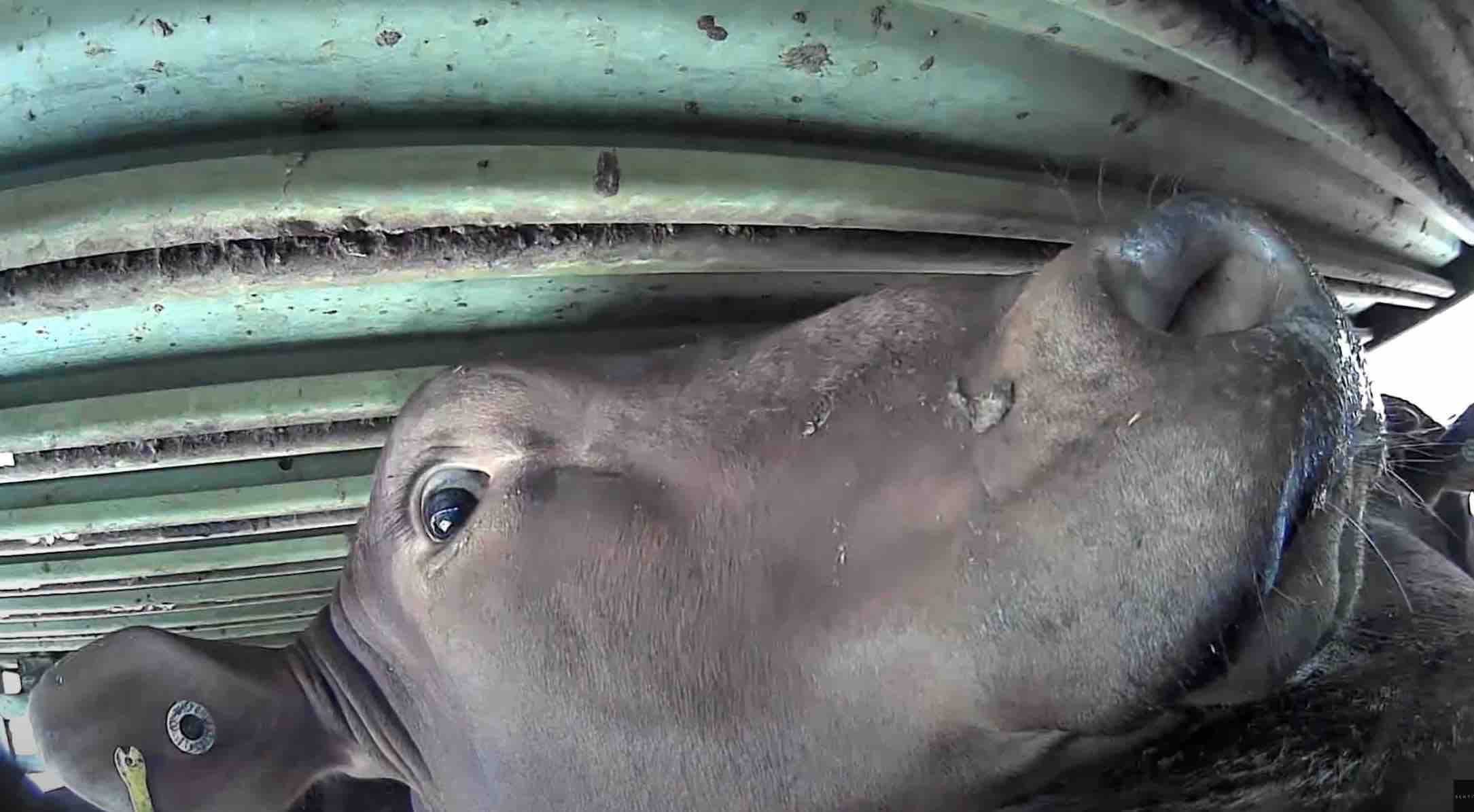
During the first Camera On Animal, Sentient’s cameras captured dozens of hours of footage in Israel of the final hours of bulls, pigs and sheep. Bar says the footage reveals not only “the brutal reality inside of hidden and sealed facilities,” but also the harrowing journeys of individual animals who are wearing the cameras. He describes a calf who “somehow manages to turn around in the narrow slaughter line and climb over another calf in an effort to escape” and a bull who is “repeatedly electrified in the anus with a probe because he refused to move forward.”

Photo of distressed cow in transport truck

A small camera affixed to a cow’s back takes streaming video from the point of view of the animal

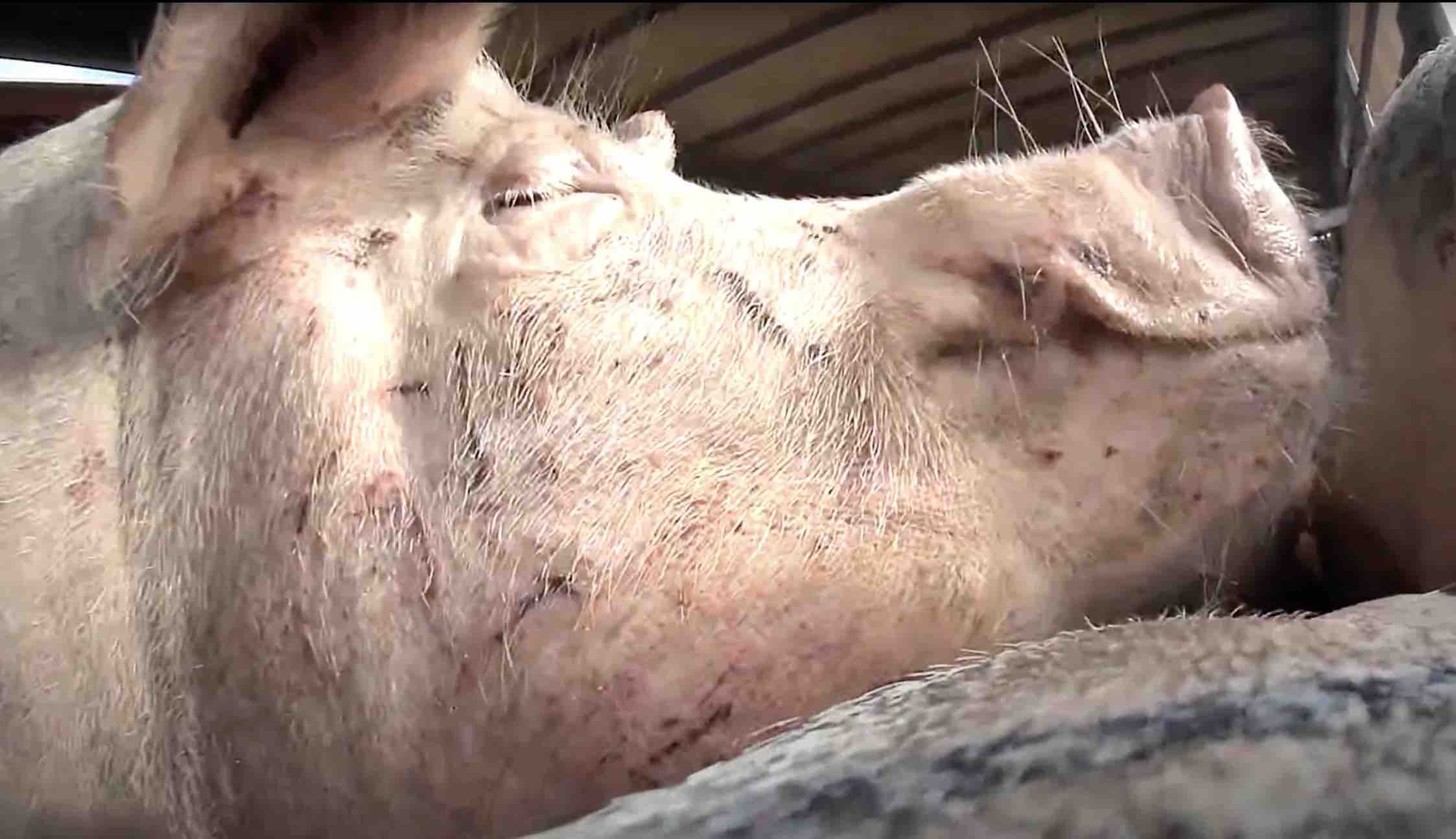
Bar also describes a few moments of a pig’s journey in a transport trailer filled with other pigs. At one point, the pig pushes his way through the other pigs to get to metal slats on the side of the trailer in order to access fresh air and sunlight.

Photo of a pig on a crowded transport truck attempting to get fresh air and sunlight

The image of this pig on a crowded transport truck was taken by a camera affixed to the back of another pig

Bar hopes that activists will use this new investigative technique in campaigns targeting specific companies or industries. He also hopes that stories of individual animals will resonate among compassionate people who aren’t already living a cruelty-free lifestyle.

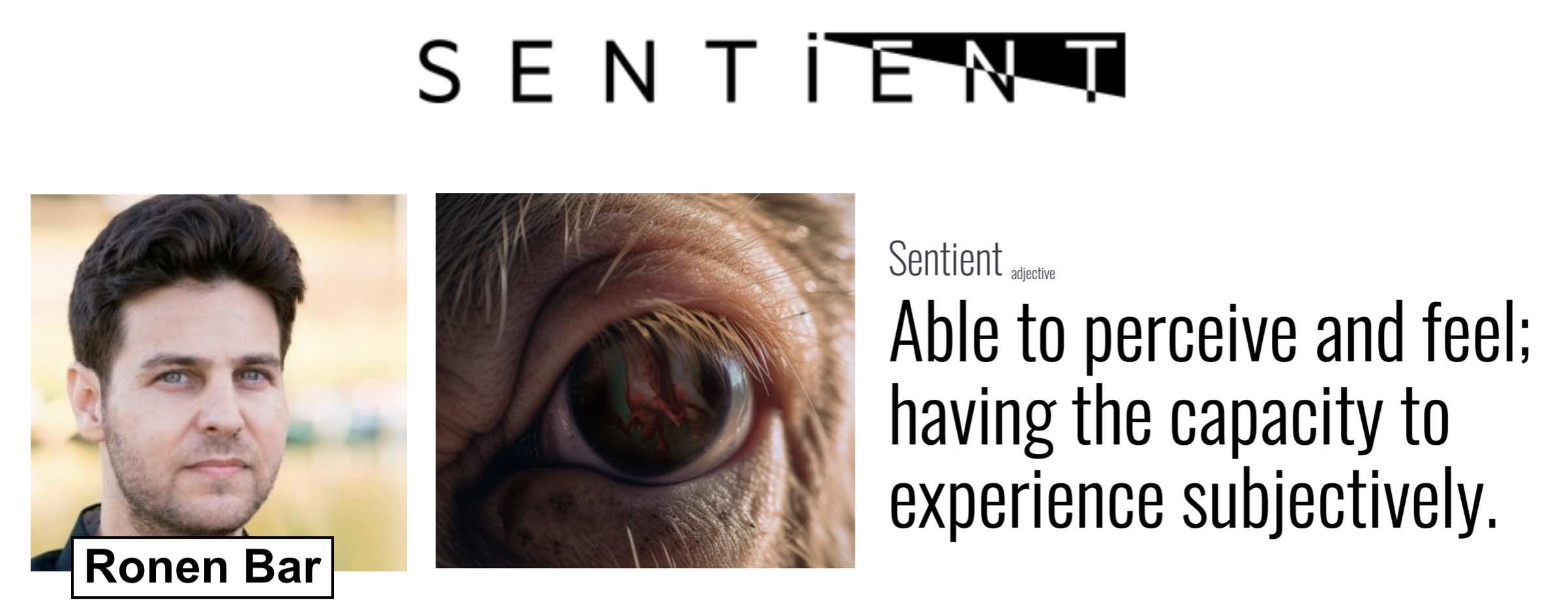
Photo of Ronen Bar, co-founder and Executive Director of Sentient

Ronen Bar, co-founder and Executive Director of Sentient

In order to share this tool with activists around the world, Sentient is launching a Kickstarter crowdfunding campaign. The Kickstarter page contains a video that explains more about the camera and process. According to Bar, the fundraiser will “enable us to develop the space of animal storytelling, turning the numbers into what they truly are — stories of sentient individuals.” Funds will be used to place 100 cameras on animals, unveiling their individual stories and effecting tangible change.  To support the Camera On Animal campaign, please visit Sentient’s Kickstarter page.

Sentient is is an Israel-based animal rights organization that creates tools for undercover investigations worldwide. Activists or reporters with questions about the “Camera on Animal” technique can contact Ronen Bar: ronen@sentientworld.org


Animal Rights Activists Protest Adidas over Kangaroo Slaughter

June 5, 2023 by 3 comments


The News

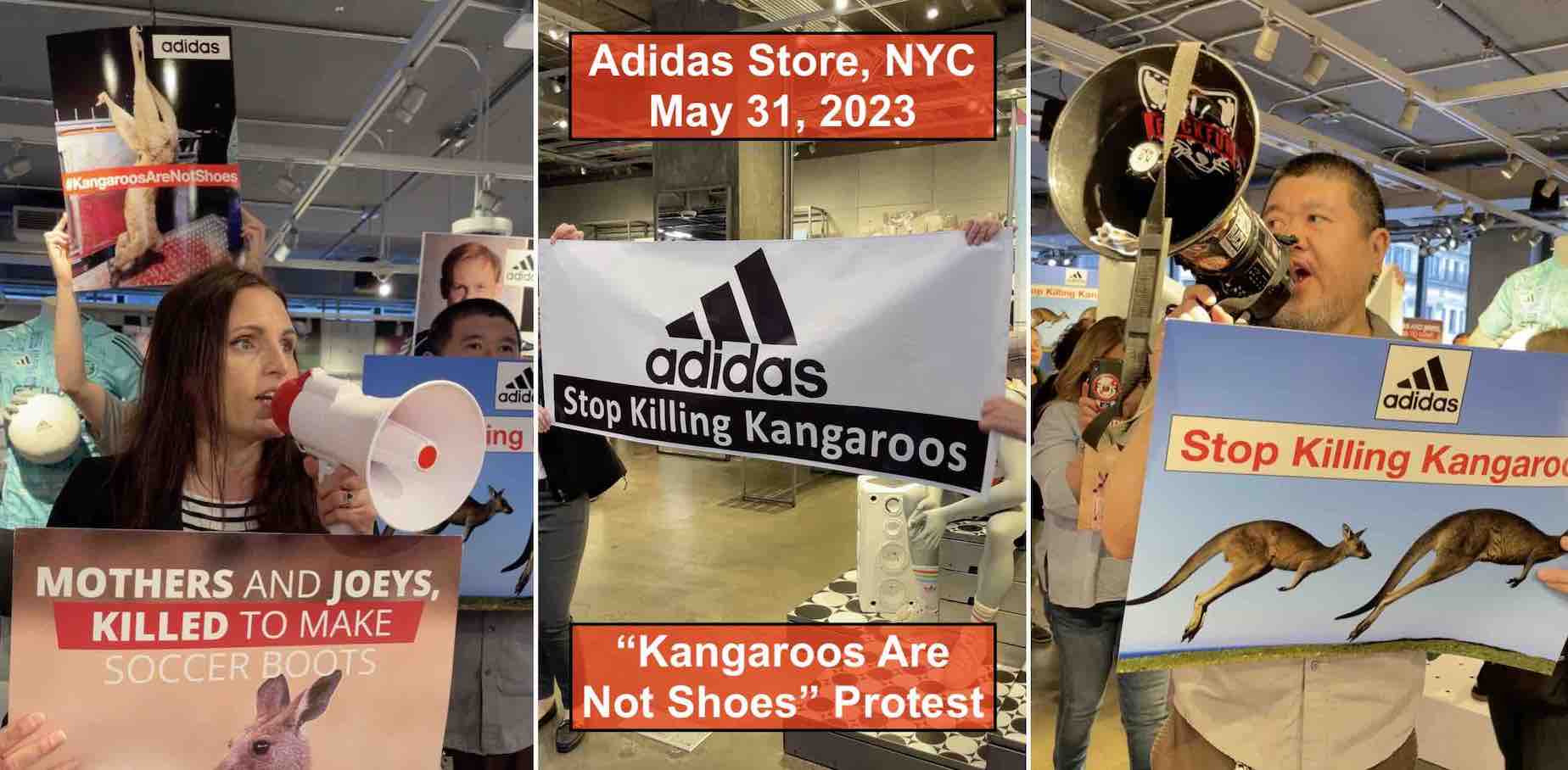
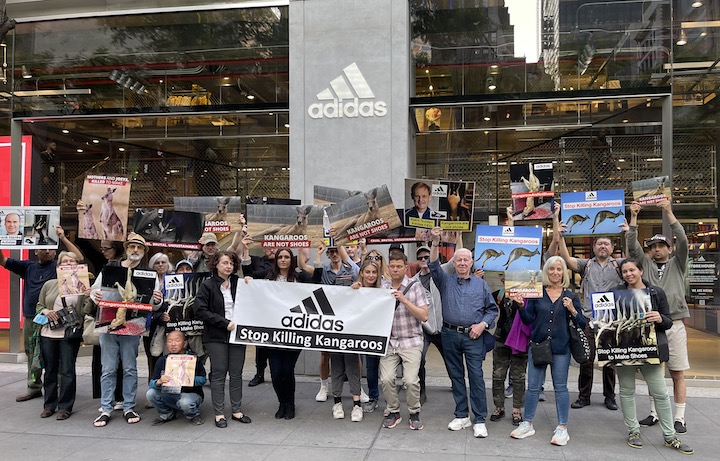
Approximately thirty animal rights disrupted business inside of Adidas’s flagship store in New York City as part of a global effort to compel the sportswear giant to stop using kangaroo skin in its soccer cleats. The protest was organized by the animal rights groups NYCLASS and TheirTurn with the support of The Center for A Humane Economy, a Washington-D.C.-based animal welfare organization running a global campaign to compel sneaker manufacturers to replace “k-leather” with cruelty-free materials.

Holding posters and chanting “Kangaroos Are Not Shoes, Just Stop The Slaughter,” the protesters marched throughout the store’s three floors, stopping twice to deliver speak outs about the cruelty associated with the kangaroo hunt. When the police arrived after 25 minutes, the activists left the store and staged a moving picket on the sidewalk while distributing information. Dozens of curious pedestrians, including Adidas customers, said they were shocked and outraged to learn that Adidas uses kangaroo skin in its soccer cleats.

"Kangaroos Are Not Shoes" Protest at Adidas flagship store in NYC

Animal rights activists with the NYCLASS, TheirTurn and the Center for a Humane Economy protest Adidas over the company’s use of kangaroo skin in its soccer cleats

“Adidas claims to source its animal skins humanely, but chasing down terrified kangaroos in the dark of night and shooting them in the head are acts of extreme cruelty,” said Edita Birnkrant, the Executive Director of NYCLASS. “Adidas needs to do the right thing by joining Nike and Puma in replacing kangaroo skin with cruelty-free materials.”

Photo of animal rights activists protesting at the Adidas store in NYC

Animal rights activists are calling on Adidas to join Nike and Puma in replacing the kangaroo skin used in its soccer cleats with cruelty-free materials

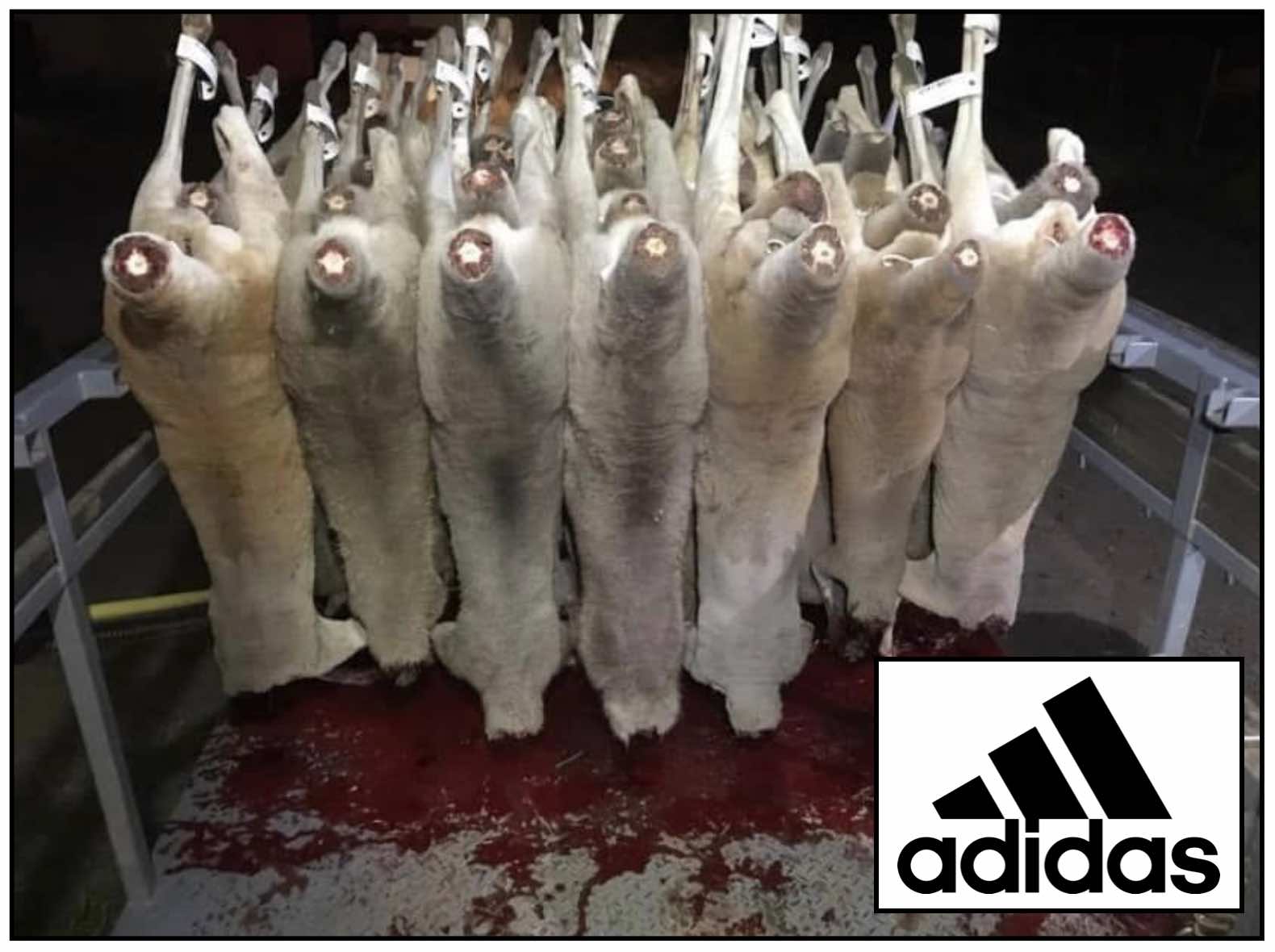
Commercial hunters hired by companies like Adidas kill approximately two million kangaroos each year. It’s the largest commercial slaughter of land-based mammals on the planet. according to the Center for a Humane Economy. An estimated 40% of kangaroos are shot in the neck or body instead of the head, which often wounds the kangaroos instead of instantly killing them. Those who escape the hunters die slowly from their gunshot wounds. 

Some of the females who are shot have babies (joeys) in their pouches or by their sides. Code dictates that hunters either decapitate or bludgeon them to death. The joeys who are not in their mother’s pouch die from exposure and predation. Each year, an estimated 500,000 to 800,000 joeys fall victim to the nightly kangaroo hunt.

Photo of kangaroos killed by commercial hunters

Adidas hires commercial hunters in Australia to kill kangaroos for their skin, which the company uses to make soccer cleats

“When Adidas peels the skin off of the bodies of the kangaroos who they kill, they are engaging in theft,” said Jamie Logan. U.S. Campaign Manager of Generation Vegan. “The kangaroos don’t belong to Adidas, and the skin is not theirs to take.”

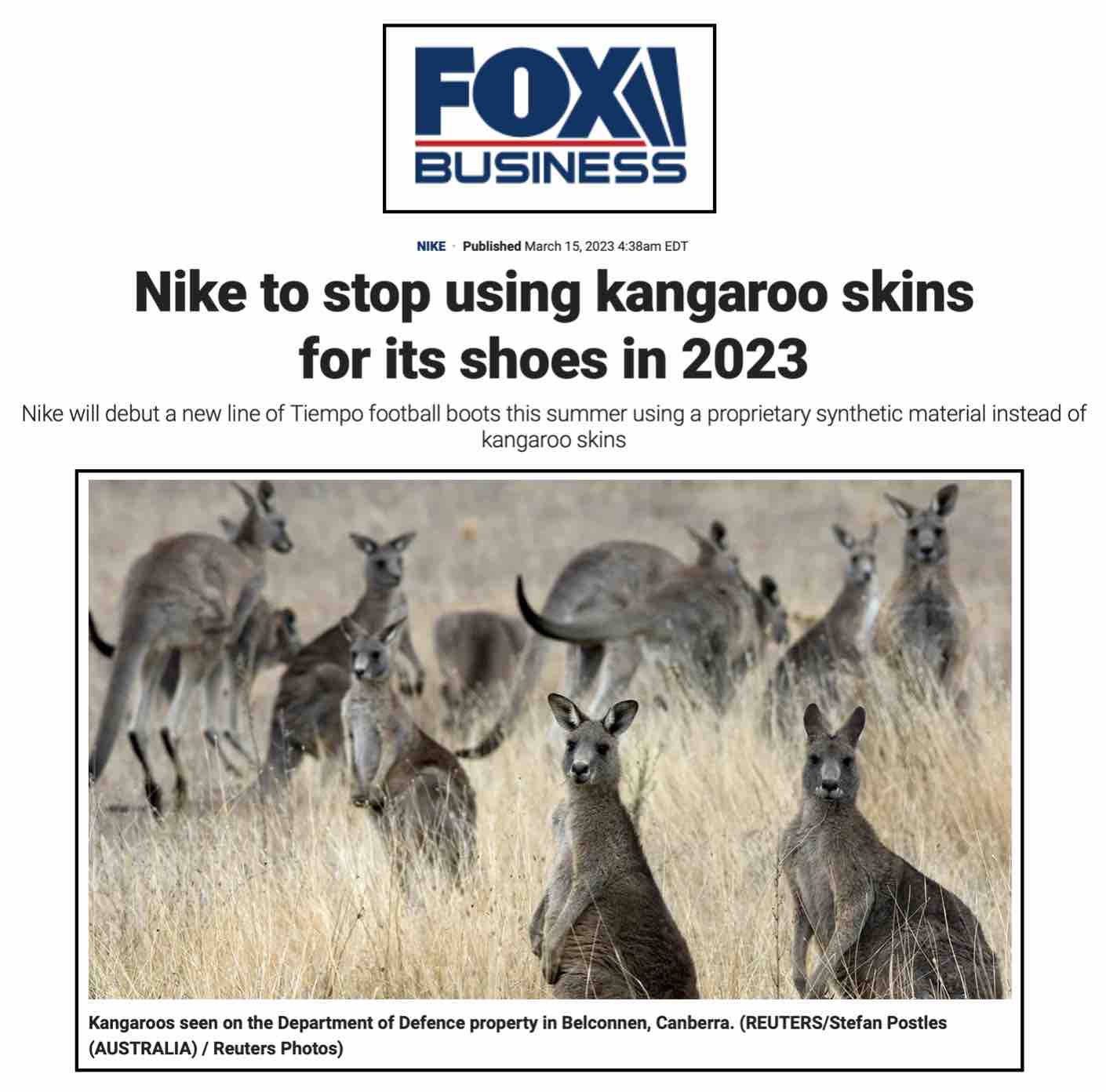
The May 31st protest at Adidas took place two months after Nike and Puma announced that they would discontinue their use of “k-leather” and replace it with cruelty-free materials by the end of 2023.

“Adidas has become an outlier in the athletic shoe industry by continuing to source kangaroo parts even though other fabrics can be used for high-performance shoes,” noted Wayne Pacelle, president of the Center for a Humane Economy. “We are so grateful to TheirTurn for so boldly raising awareness of this form of cruelty to wildlife and demanding that Adidas do better.”

Photo of news coverage of NIke's announcement that it would stop killing kangaroos to make soccer cleats

In March 2023, Nike and Puma announced that they would stop using kangaroo skin by the end of 2023

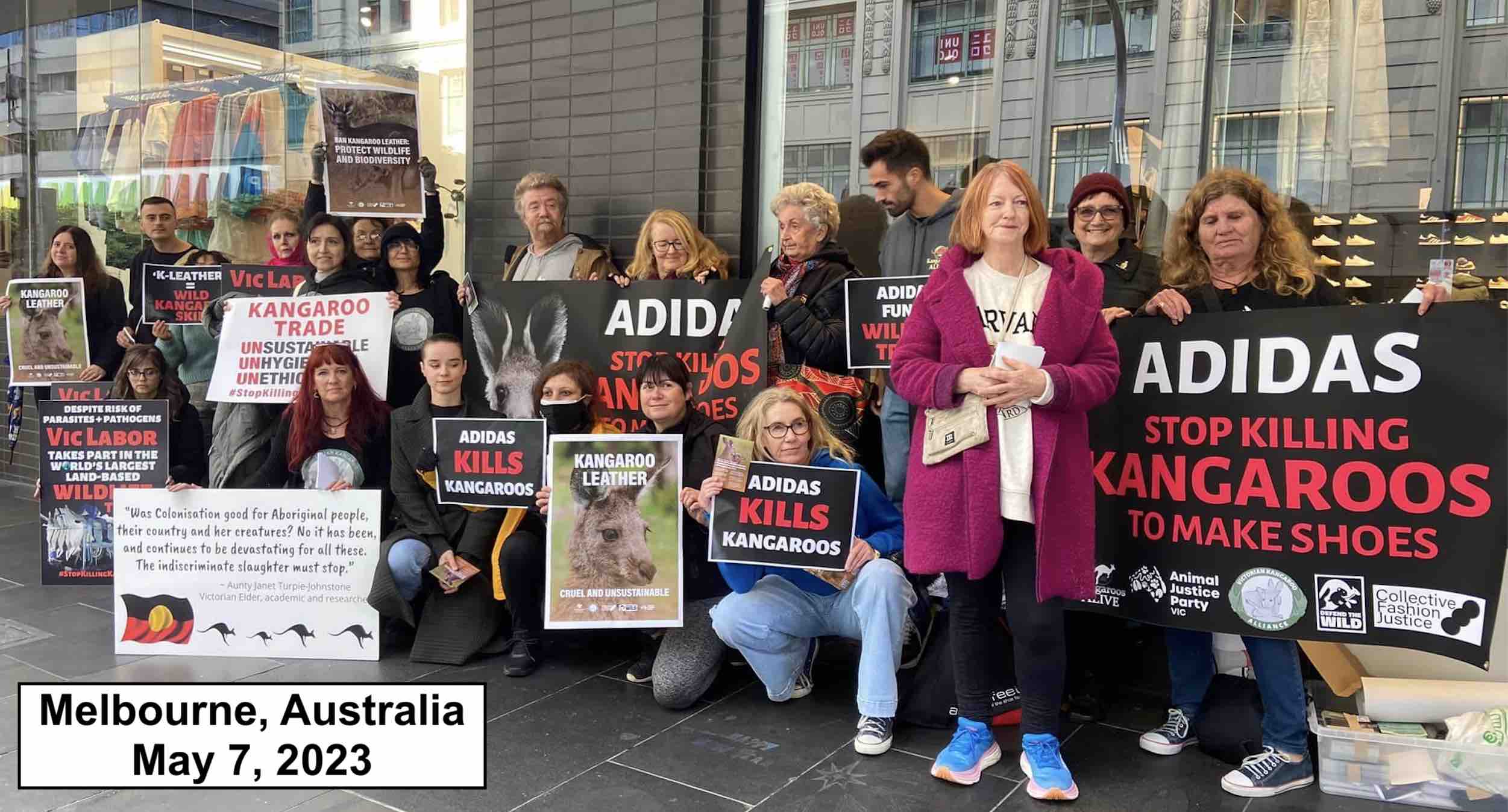
Animal rights groups in Australia, which are especially protective of their native kangaroos, staged their first protest against Adidas on May 7th in Melbourne. The activists in New York say they will continue to protest at Adidas until the company announces a kangaroo-free policy.

Photo of Australian animal rights activists protest Adidas in Melbourne over the use of kangaroo skin in their soccer cleats

A coalition of animal advocacy groups in Australia staged a protest at the Adidas store in Melbourne (May 7, 2023)

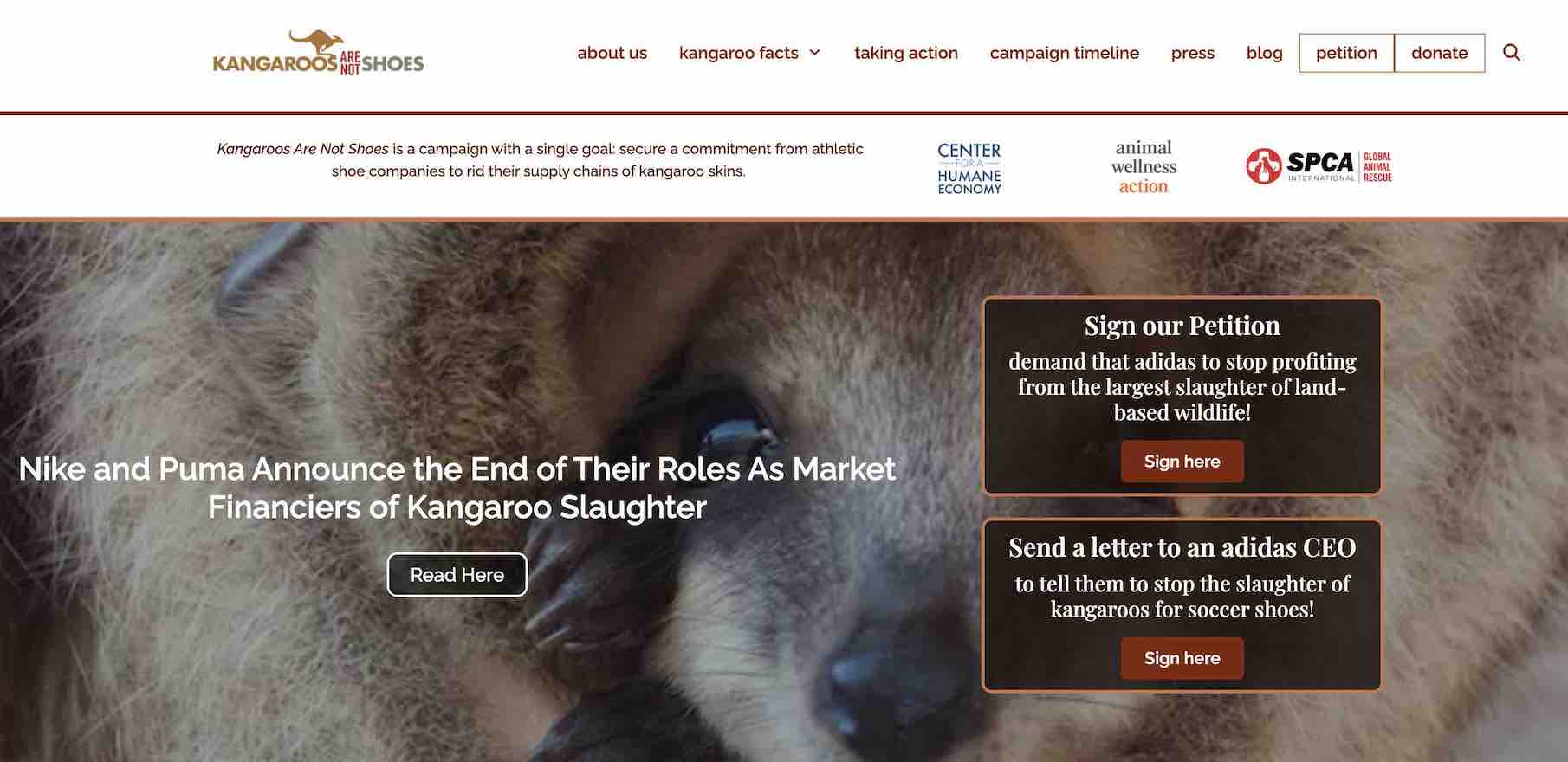
To learn more about the campaign to end the use of kangaroo skin, please visit Visit KangaroosAreNotShoes.org.

Kangaroos Are Not Shoes

The Center for a Humane Economy’s KangaroosAreNotShoes campaign website


NYC Lawmakers Encourage Humane Society of New York to Relocate Animals

April 9, 2023 by 8 comments


The News

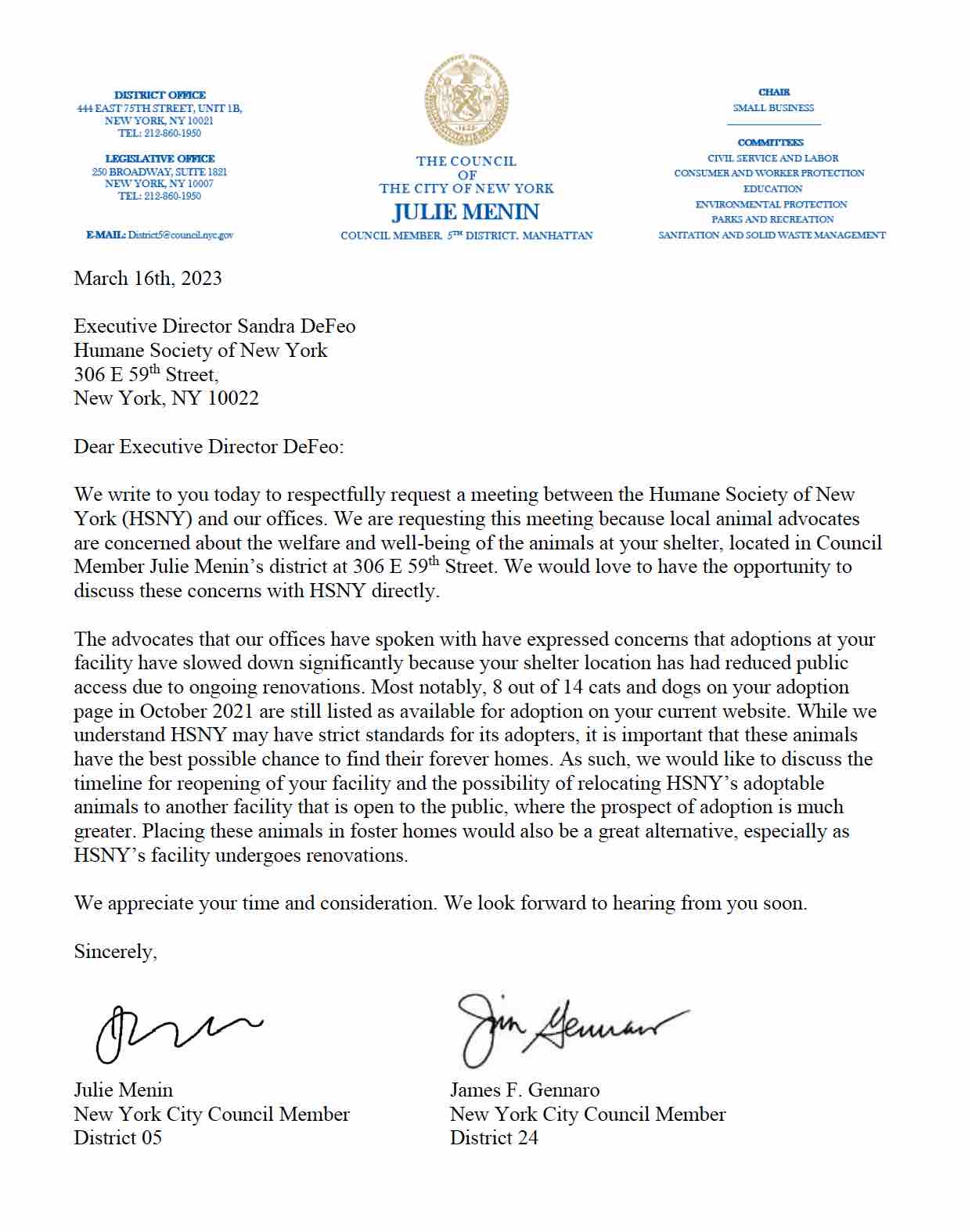
In an open letter to the Humane Society of New York (HSNY), two New York City Council Members have suggested that the large and prominent NYC shelter relocate their adoptable animals to “another facility that is open to the public, where the prospect of adoption is much greater,” or to “foster homes” so that “these animals have the best possible chance to find their forever homes.” According to whistleblowers and animal rights activists, adoptions at the HSNY came to a virtual standstill in April 2020, when the organization closed its doors to the public.

Photo of a letter sent to the Humane Society of New York by two NYC Council Members

NYC Council Members Julie Menin and James Gennaro sent a letter to the Humane Society of New York expressing concern about the welfare of the animals in the prominent Manhattan shelter

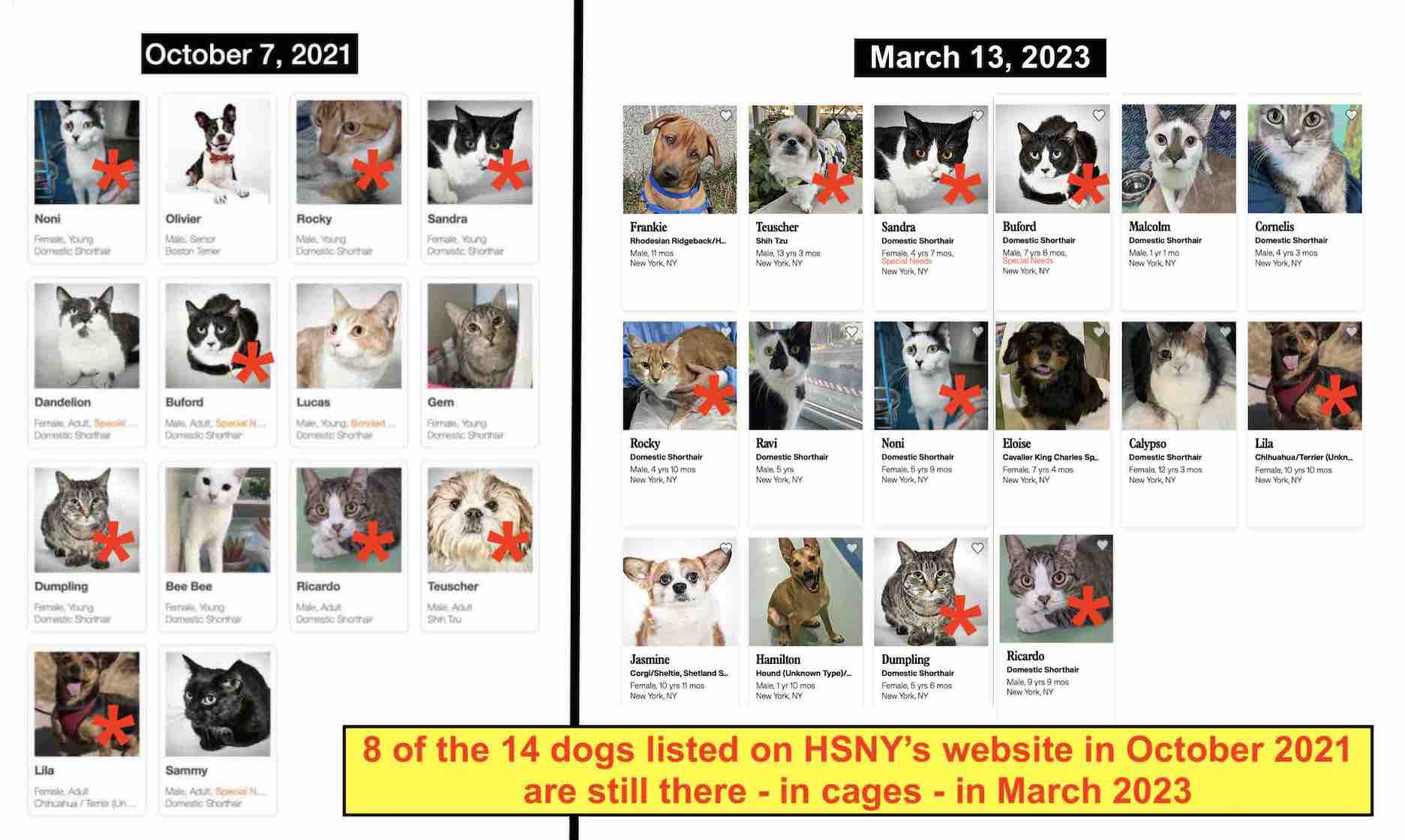
In the letter, which is addressed to the organization’s Executive Director Sandra DeFeo, the lawmakers express concern about the welfare of the animals, noting that “8 out of 14 cats and dogs on your adoption page in October 2021 are still listed as available for adoption on your current website.”

Photo shows that 8 of the animals listed on the Humane Society of New York's website in October 2021 were still there in March 2023

Since August 2021, animal rights activists have been sounding the alarm about the warehousing of animals at the Humane Society of New York

The Council Members, Julie Menin and James Gennaro, sent the letter after being contacted by constituents who expressed concern about the welfare of the animals.

In an interview with Pix11 News, Council Member Menin, whose district includes the Humane Society of New York, remarked on the slow pace of adoptions: “Why are the adoptions only one per week? That seems like a very slow pace for a relatively large organization that’s well funded. So, we do have concerns about that. We’re also concerned about why can’t the public come in?” Discussions between the Council Members and the HSNY are ongoing.

TV news coverage about animal warehousing at the Humane Society of New York

Pix11, a TV news station in New York, aired a three minute story about the animal warehousing controversy at the Humane Society of New York

Animal rights activists learned that animals were being warehoused at the HSNY in July 2021 when a whistleblower wrote that adoptions had come to a virtual standstill 15 months earlier and that DeFeo, the Executive Director, was keeping the building closed to the public under false pretenses. After conducting an investigation which corroborated the allegations and revealed that the building was closed indefinitely due to violations of the Americans with Disabilities Act (ADA), animal rights activists began calling on the HSNY to send its animals to shelters that are open to the public or to foster homes, where they could live with a family outside of a cage and where adopters could more easily meet them. During a phone call in August 2021 in which Donny Moss of TheirTurn asked DeFeo why she wasn’t sending the animals to foster homes while the building was closed to the public, DeFeo said that the HSNY is their foster home and that their cages are “apartments.”

Adoption cards on the animals cages at the Humane Society of New York show intake dates of 2018 and 2019

While reporting on the animal warehousing controversy at the Humane Society of New York, Pix11 News zoomed in on the adoption cards that show intake dates of 2018 and 2019 for two of the cats. Because the shelter has been closed to adopters for three years, advocates suspect that many of animals have been living in the shelter for at least that long

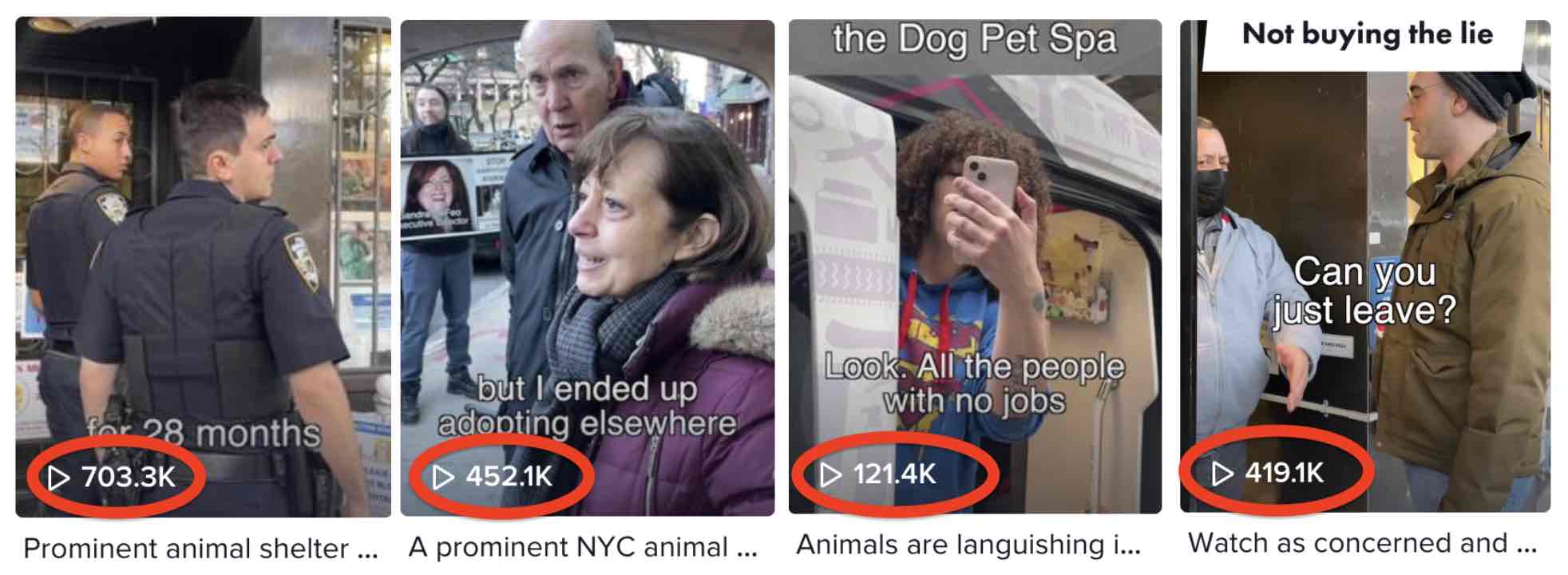
After being dismissed by DeFeo and ignored by the HSNY’s board members, animal rights activists began staging protests at the HSNY and the nearby home of one of its board members, Alexandra Rowley. During the approximately 20 protests that have taken place so far, dozens of area residents stopped to share their stories of being ignored or turned away after submitting adoption applications or calling to inquire about adoptions. Videos with these testimonials have gone viral on TikTok, garnering over 2.5 million views and attracting national attention to the plight of the animals.

Photo of TikTok videos of protests at the Humane Society of New York

Videos of the protests at the Humane Society of New York have gone viral on TikTok, garnering more than 2.5 million views

From April 2020 to March 2023, DeFeo claimed that the HSNY was closed to the public “due to COVID-19,” an excuse that, according to whistleblowers, she intended to use indefinitely in order to avoid acknowledging violations of the Americans with Disabilities Act (ADA) that would have to be fixed in order to reopen the building to the public. Activists believe their campaign, which raised public awareness about the plight of animals living in a shelter closed indefinitely to adopters, ultimately left DeFeo with no choice but to move forward with the renovations, which are underway now.

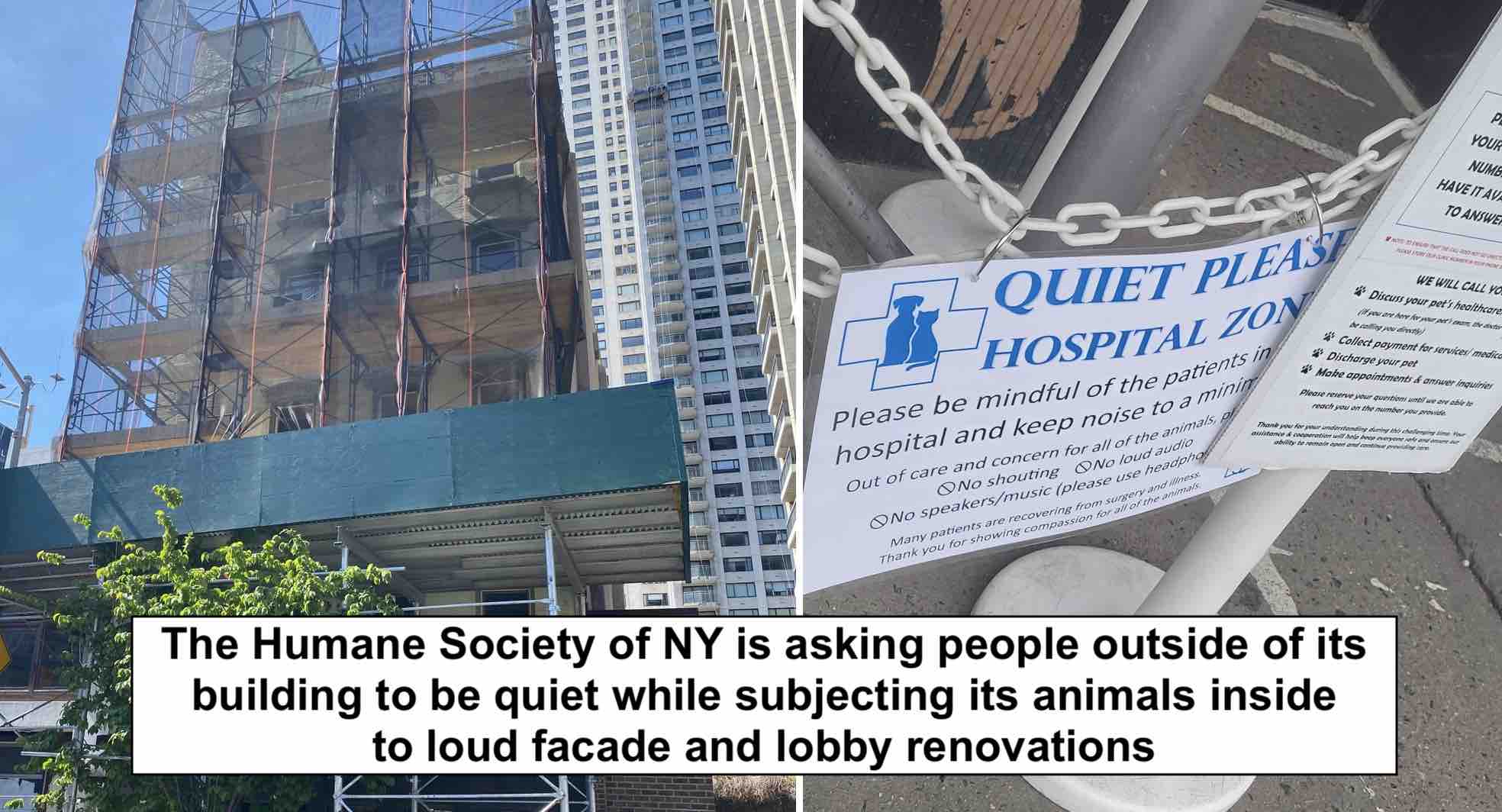
Photo of construction at the Humane Society of New York

In an effort to silence protesters outside of the building, the Humane Society of NY has put up signs asking for quiet despite the fact that they are subjecting the animals inside to loud interior and exterior construction projects instead of sending them to foster homes

Throughout the course of the campaign, members of public have asked the advocates why the HSNY has kept the cats and dogs instead of placing them in shelters that are open to the public or to foster homes. According to Donny Moss of TheirTurn, an organizer in the campaign, the problem lies with the Executive Director. “Sandra DeFeo has always held the view that cages are ‘apartments’ and that the shelter is a ‘home,’ but that warped perspective mattered less before 2020 because guardrails were in place to protect the animals – an adoption center that was open to adopters; an Adoption Director who was sending animals home and a board president who worked at the shelter four days per week. When the guardrails came down, the animals were at the mercy of someone who believes that a cage in a shelter is home.”

Photo of protest at the Humane Society of New York

During bi-weekly protests at the Humane Society of New York, animal rights activists call on the Manhattan shelter to send the cats and dogs in their care to foster homes where they won’t have to live in a cage or be subjected to construction noise

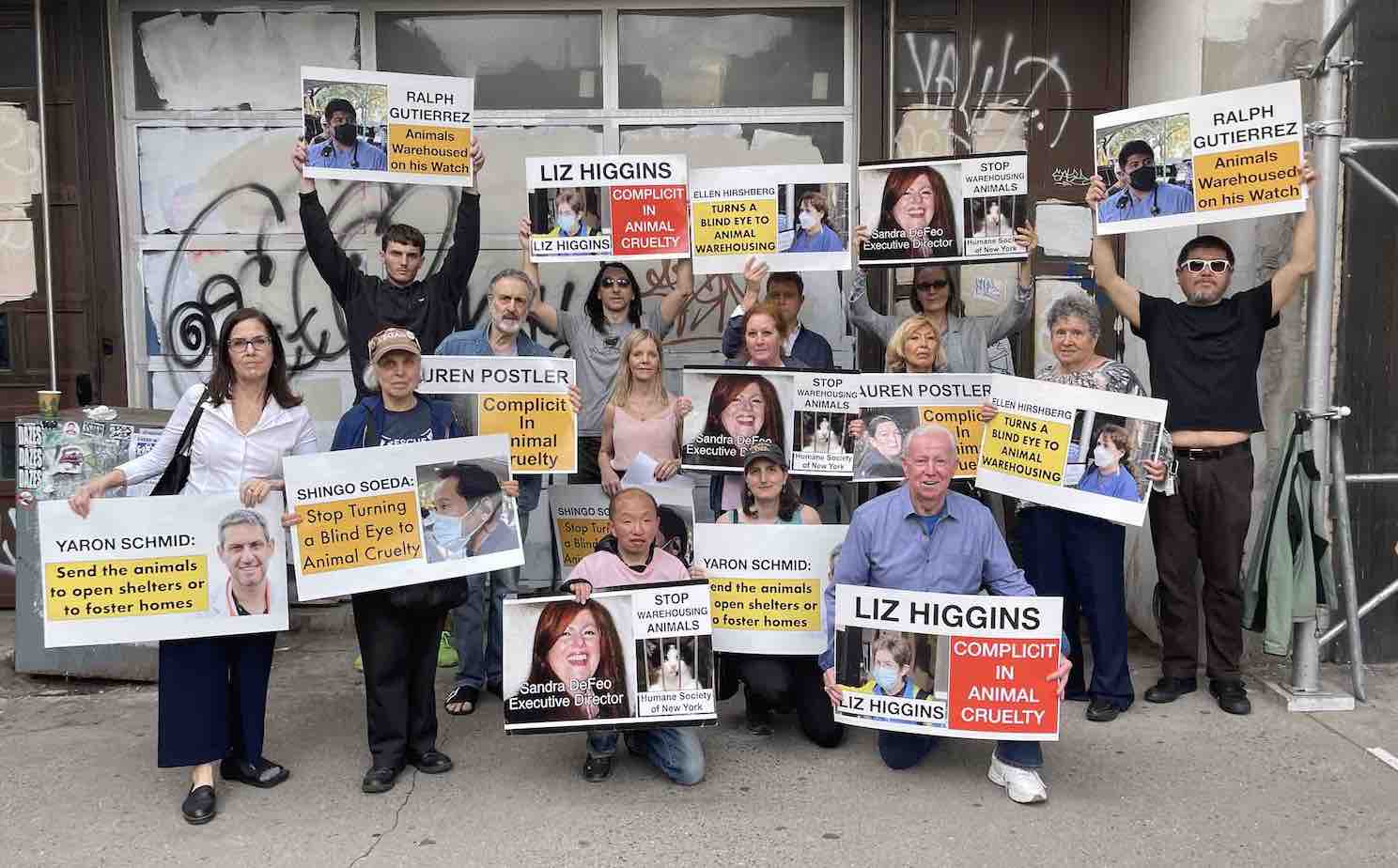
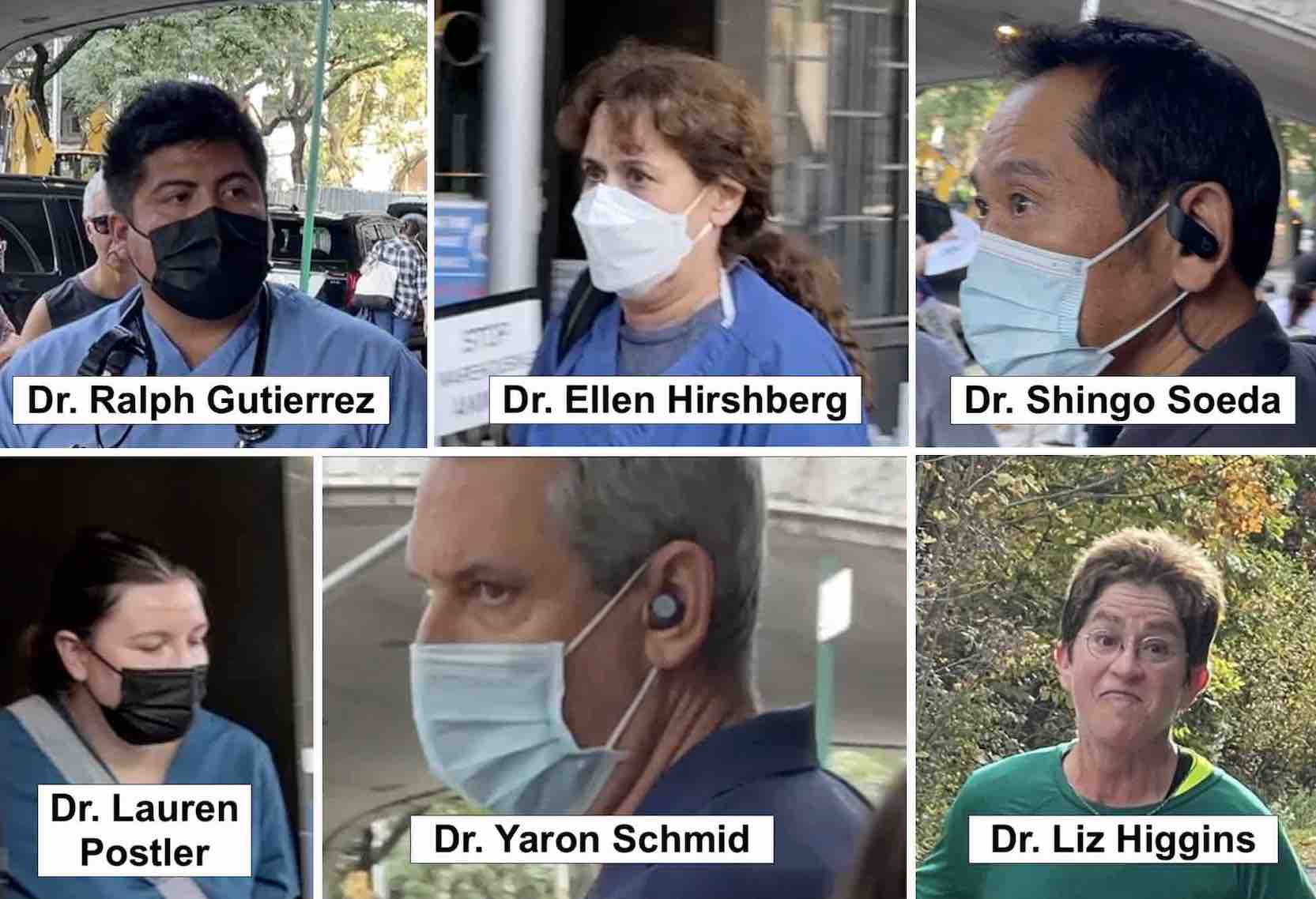
In addition to operating an adoption center, the HSNY runs a low cost vet clinic that is subsidized by private donors. Like the adoption center, the vet clinic, which is located on the ground floor of the same building, has been closed to the public for the past three years. Despite pleas from the advocates, the six veterinarians who work in the clinic have refused to address the warehousing of animals. During the first two protests at the HSNY, the advocates asked the vets to use their influence to relocate the animals to foster homes, but they refused to engage them. The vets — Drs. Lauren Postler, Shingo Soeda, Ellen Hirshberg, Yaron Schmid, Ralph Gutierrez and Liz Higgins —  avert their eyes and ignore the advocates as they exit the building.

Photo of Dr. Ralph Gutierrez, Dr. Ellen Hirshberg, Dr. Shingo Soeda, Dr. Lauren Postler, Dr. Yaron Scmid and Dr. Liz Higgins

Advocates assert that the veterinarians who work in the Humane Society of New York’s clinic are complicit in the warehousing of animals in the organization’s adoption center. (From left to right: Drs. Ralph Gutierrez, Ellen Hirshberg, Shingo Soeda, Lauren Postler, Yaron Schmid, Liz Higgins)

Among the other senior HSNY staff members who have ignored the advocates are the Associate Director, Anne Marie Karash, and the Director of Animal Behavior and Training, Bill Berloni. When Pix11 News reported on the animal warehousing scandal, Karash acknowledged that some of the animals have been living in the adoption center for years. She justified the long-term captivity by stating that the animals have medical conditions and that they’re selective about the people to whom they adopt. Bonnie Tischler, the HSNY’s Adoption Director who retired in early 2020 after serving in that role for 22 years, is not convinced:

People will adopt and foster animals with special needs and animals who are elderly, so there’s no reason those animals should be there for so many years. Every animal, if given the opportunity, can be adopted. That said, the longer these animals are held in cages, the more issues they have due to the stress of the long-term confinement. Also, being selective about the adopters is commendable, but there’s a big difference between ‘being selective’ and ignoring adoption applications altogether, which is what the HSNY has done for the past three years.”

Photo of Anne Marie Karash, the Associate Director of the Humane Society of New York

During an interview with Pix11 News, Anne Marie Karash, the Associate Director of the Humane Society of New York, attempted to use medical conditions and a highly selective adoption process to justify the long term captivity of animals at the shelter.

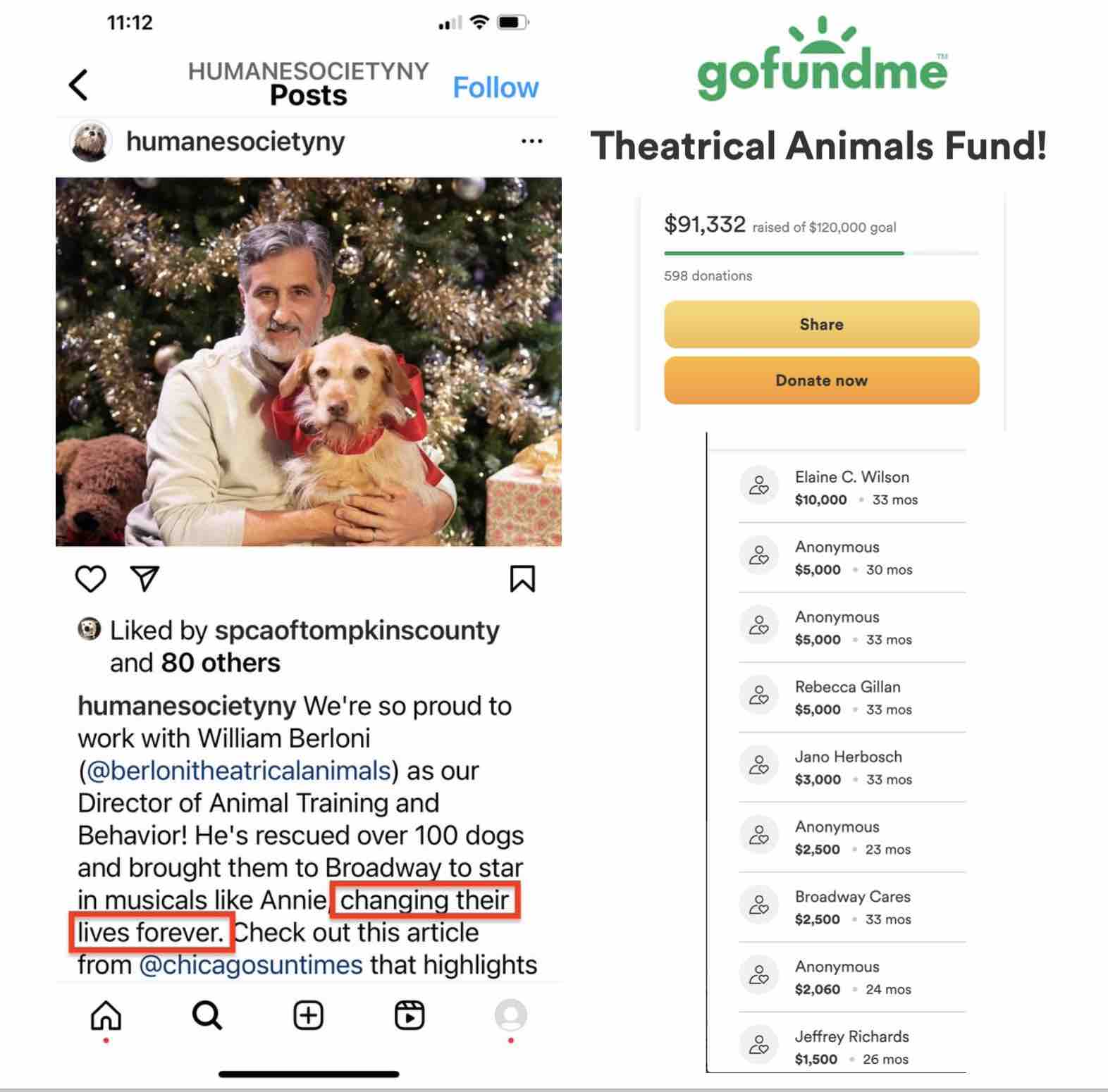
Bill Berloni, the animal trainer and behaviorist, owns a company called Berloni’s Theatrical Animals that leases animals to Broadway shows, movies, TV shows and commercials. According to former HSNY employees, he finds the animals in shelters or buys them from breeders, depending on the needs of his clients. When the musical Gypsy ended its run on Broadway, Berloni told colleagues at the HSNY that he brought the lamb who he procured for the production to a slaughterhouse after telling the show’s star, Bernadette Peters, that he retired her to a sanctuary.

During the pandemic, when Broadway had no use for his animals, Berloni’s friend created a GoFundMe campaign that raised $91,332 for his company. By calling the campaign a fundraiser for the “Theatrical Animals Fund,” at least some of the donors must have assumed they were donating to an animal rescue charity, not a for-profit animal enterprise.

Bill Berloni of the Humane Society of New York

Bill Berloni, who owns a company that leases animals to Broadway shows, movies, TV shows and commercials, has not addressed the public’s concerns about the warehousing of animals at the Humane Society of New York, where he is employed as the Director of Animal Training and Behavior

The HSNY states the animals’ participation in Broadway shows “changes their lives forever,” but advocates disagree: “Dogs don’t aspire to be props in Broadway shows,” said Edita Birnkrant, the Executive Director of NYCLASS, a NYC-based animal rights organization. “They want to live in a home, go for walks, play ball and curl up on the sofa with their family.”

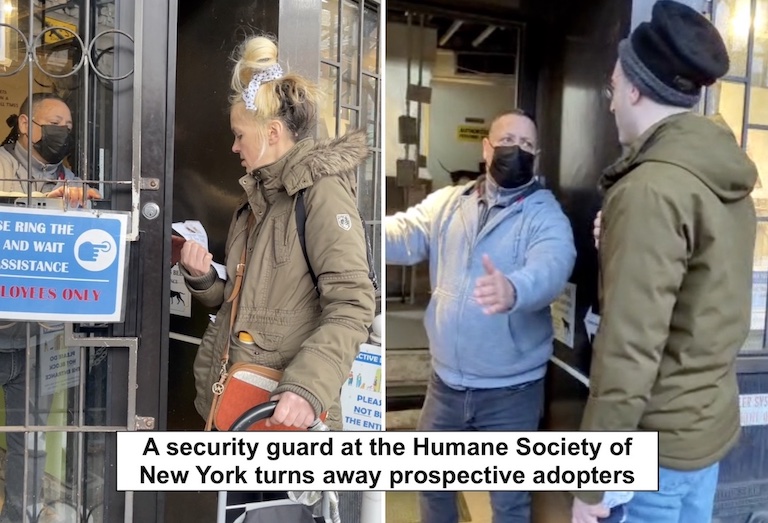
The Humane Society of New York turns away prospective adopters

Prospective adopters who ring the bell at the the Humane Society of New York are asked to leave when they inquire about meeting the animals available for adoption

In the Pix11 News interview, Karash, the Associate Director, said that 27 cats and 13 dogs remain in the shelter. Like Council Members Menin and Gennaro, the advocates are calling on DeFeo to send the remaining animals to foster homes, where they could live uncaged and with a family, until the HSNY completes the renovations and resumes adoptions in earnest.