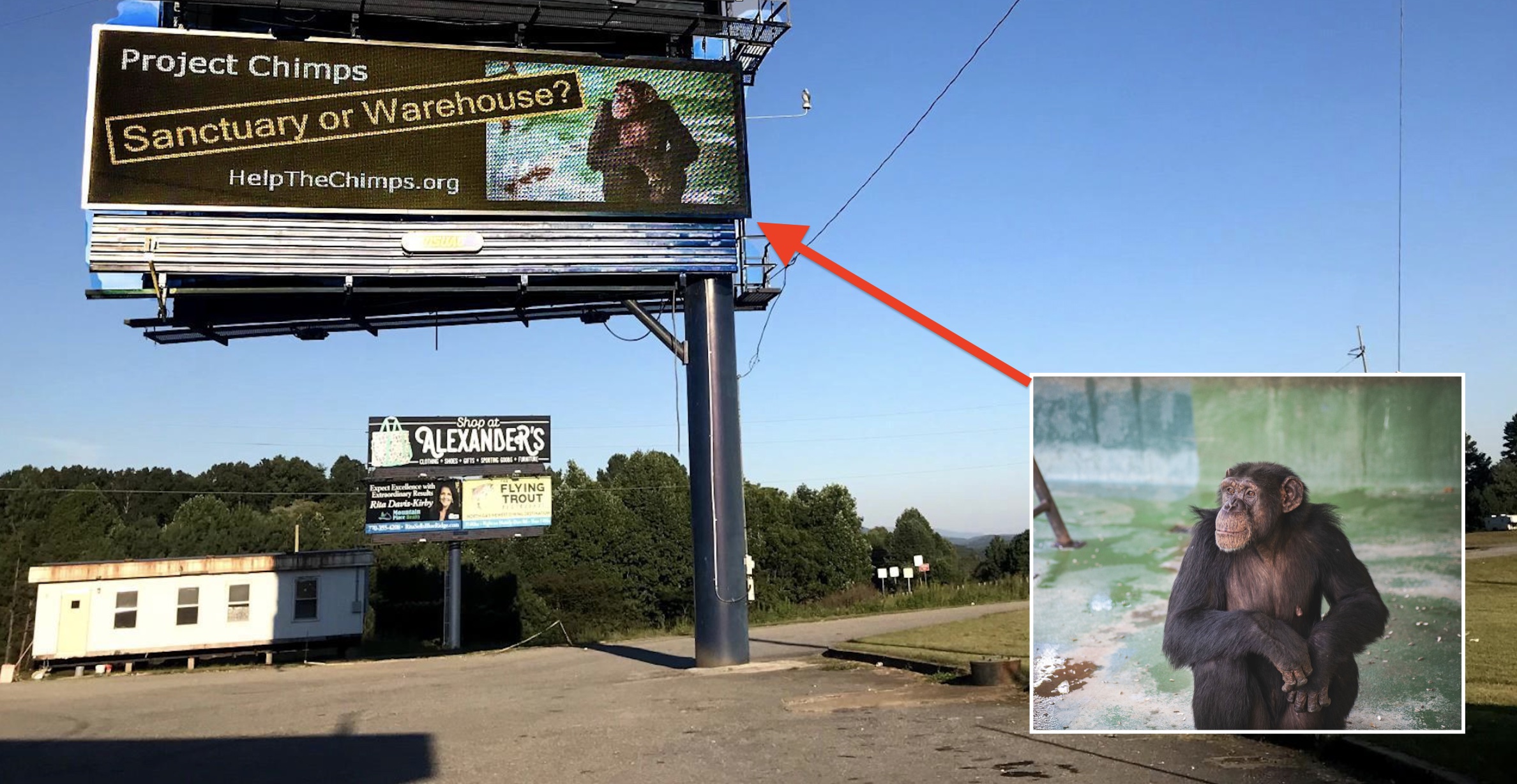
Chimpanzee advocates have erected a billboard near Project Chimps in Georgia to raise awareness of the plight of the 77 chimpanzees who live there. At this Humane Society of the United States (HSUS) facility, the 77 chimpanzees have access to the outdoors for just a few hours every three days. They spend the rest of the time languishing in concrete rooms. Activists put up the billboard on the weekend of September 25th to coincide with “Discovery Days” at Project Chimps, a semi-annual, two day open house that attracts hundreds of visitors.
Advocacy groups erected a billboard calling on The Humane Society of the United States to transform its Project Chimps facility from a warehouse to a true sanctuary
The billboard is the latest tactic in a campaign to compel HSUS to improve animal welfare at Project Chimps. Activists with Chimps Deserve Better, Progress for Science and TheirTurn launched the campaign in July, 2020, after Project Chimps filed a lawsuit against two whistleblowers who came forward with extensive evidence of animal cruelty. As part of the campaign, the advocacy groups are calling on HSUS to transform the facility from a warehouse into a true sanctuary where the chimps spend their days in an outdoor habitat on the 236 acre forested property.
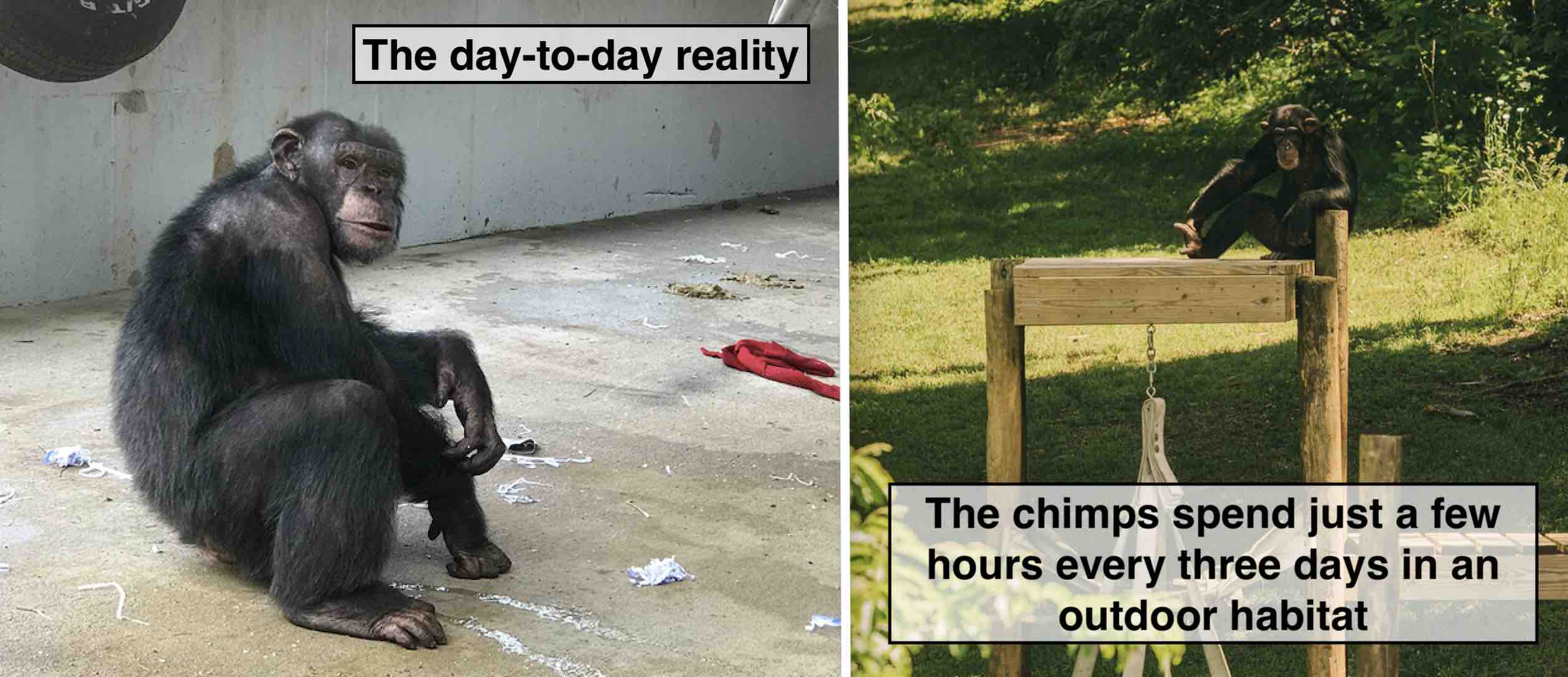
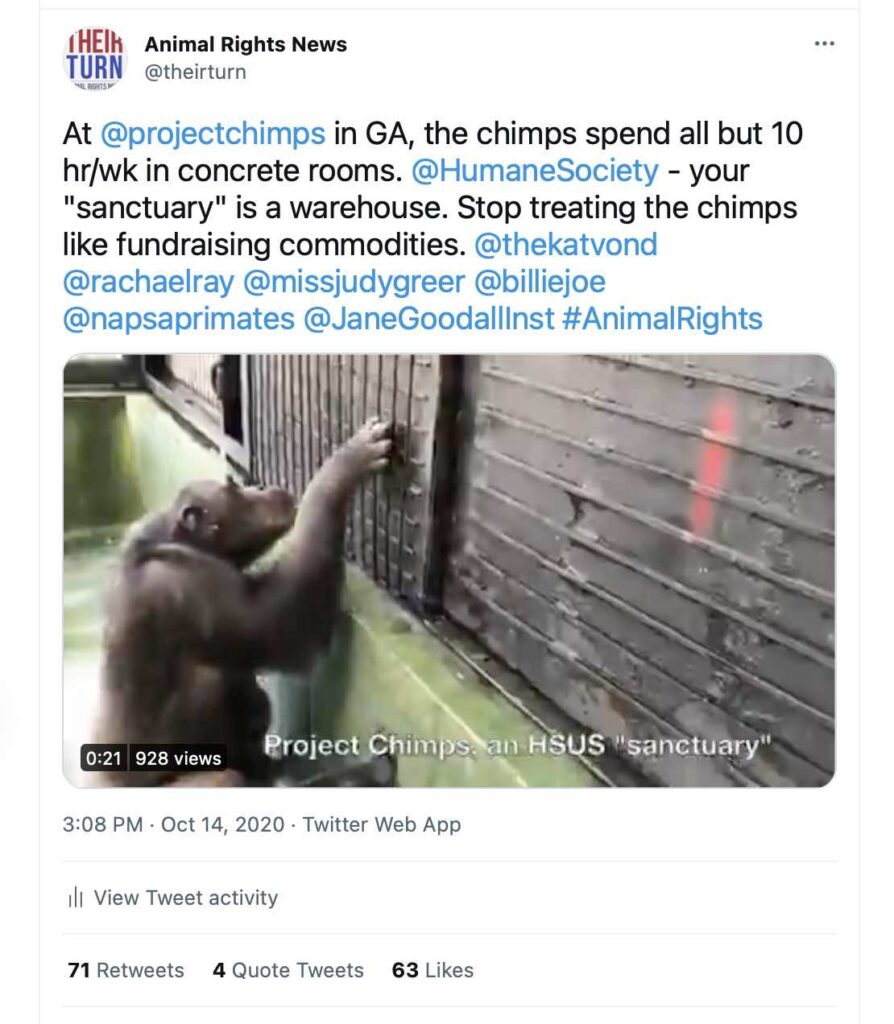
At Project Chimps, the Humane Society’s chimpanzee “sanctuary” in Georgia, the 77 chimpanzees spend most of the time in concrete rooms.
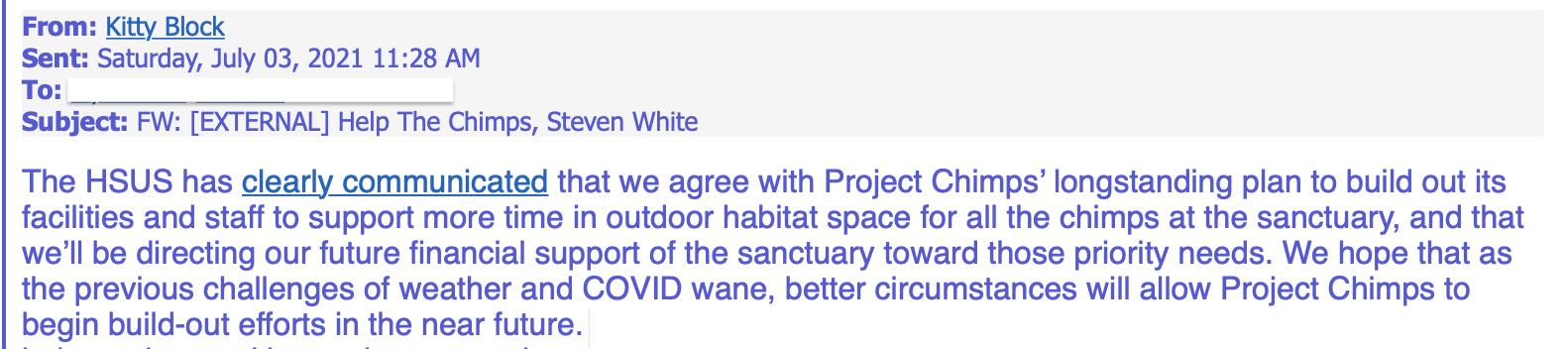
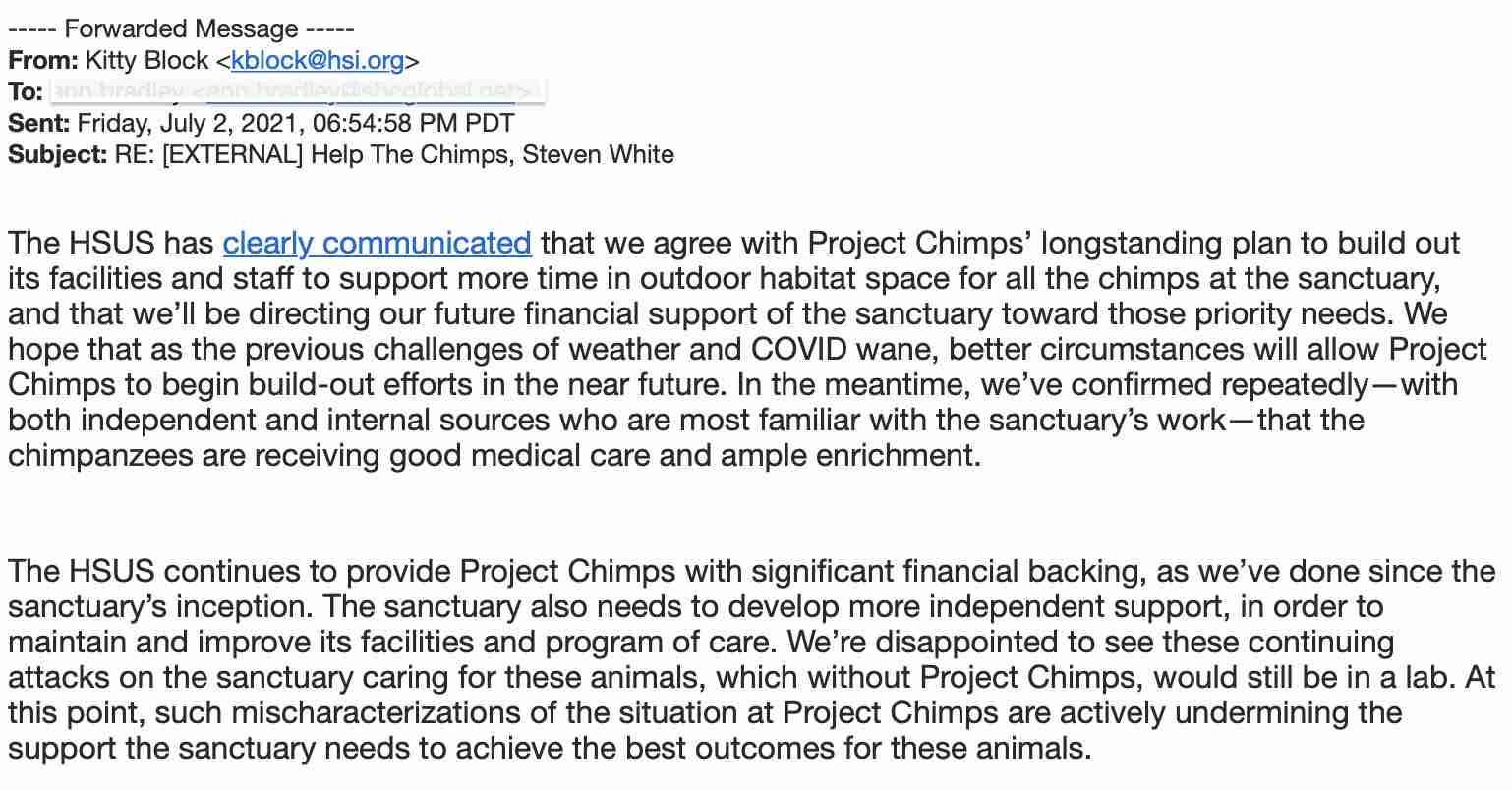
In July, 2021, HSUS CEO Kitty Block acknowledged the need for additional yards, but she did not specify when Project Chimps would create them. In a response to advocates who contacted her about the deficiency, Block blamed “COVID” and “weather” for the delay, despite the fact that the chimpanzees have been living in these conditions since 2016.
HSUS CEO Kitty Block’s response to advocates calling on her to create additional yards at Project Chimps so that the 77 chimpanzees have daily access to the outdoors.
“How can HSUS blame COVID-19 for its inability to build yards for the chimps when Project Chimps was able to create elaborate hiking trails for visitors during the pandemic?” said Lindsay Vanderhoogt, one of 22 whistleblowers who sent a letter to the Chairman of the Board, Bruce Wagman, to sound the alarm about poor welfare conditions. “Project Chimps is supposed to be a sanctuary, not a zoo, yet it continues to prioritize the entertainment of tourists ahead of the welfare of the animals.”
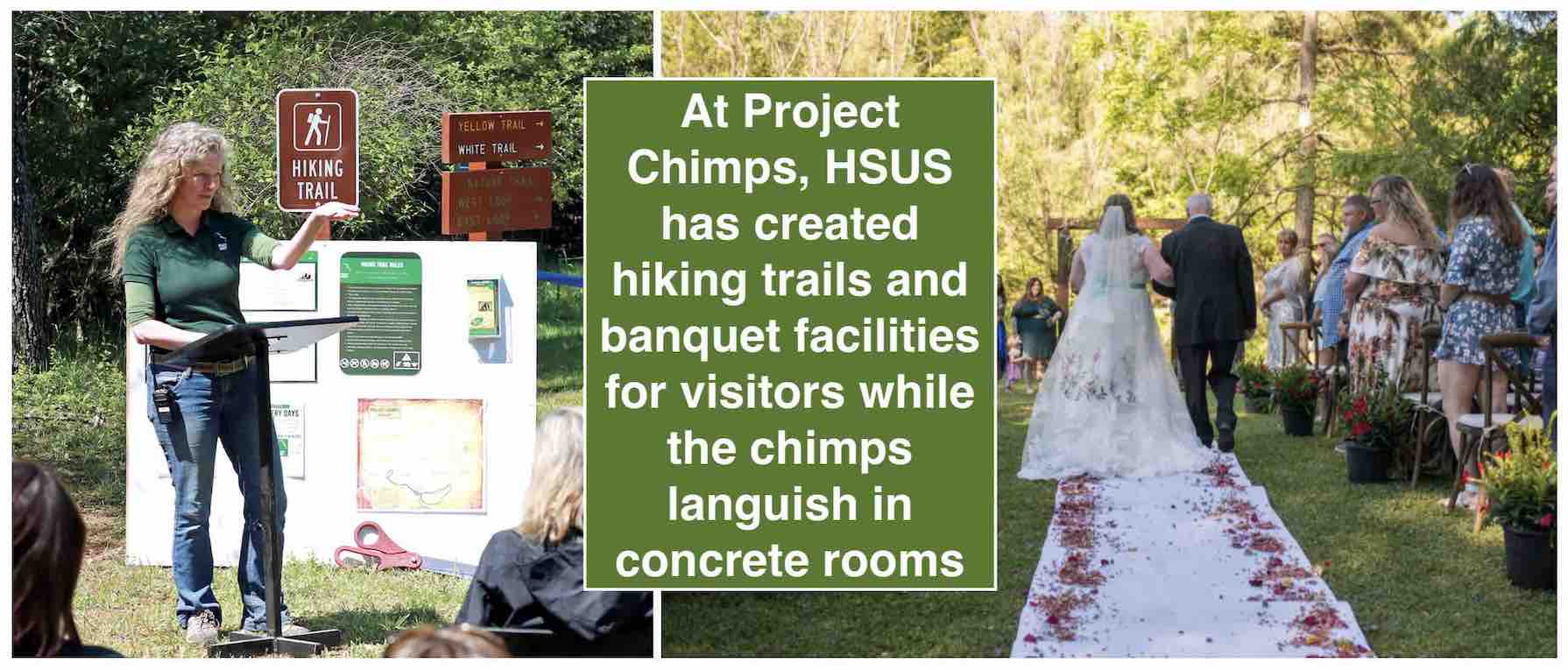
At Project Chimps, HSUS has prioritized amenities for tourists ahead of some of the basic needs of the chimps.
HSUS’s multi-year delay in creating additional yards doesn’t only affect the 77 chimpanzees at Project Chimps; it also impacts the estimated 120 retired chimpanzees at New Iberia Research Center (NIRC) who are waiting to be sent to a sanctuary. In 2016, Project Chimps signed a contract with NIRC which stipulated that its 220 chimps would be sent exclusively to Project Chimps. In a call on August 9th, however, NIRC Director Dr. Francois Villinger told Donny Moss of TheirTurn that he would not transfer any additional chimpanzees to Project Chimps until the sanctuary addresses the space issues. “Because HSUS is dragging its feet on expanding Project Chimps, the chimps at NIRC are stuck there for the indefinite future,” said Moss. “This is especially troubling given the recent instances of animal cruelty uncovered at NIRC by the advocacy group Stop Animal Exploitation Now (SAEN).”
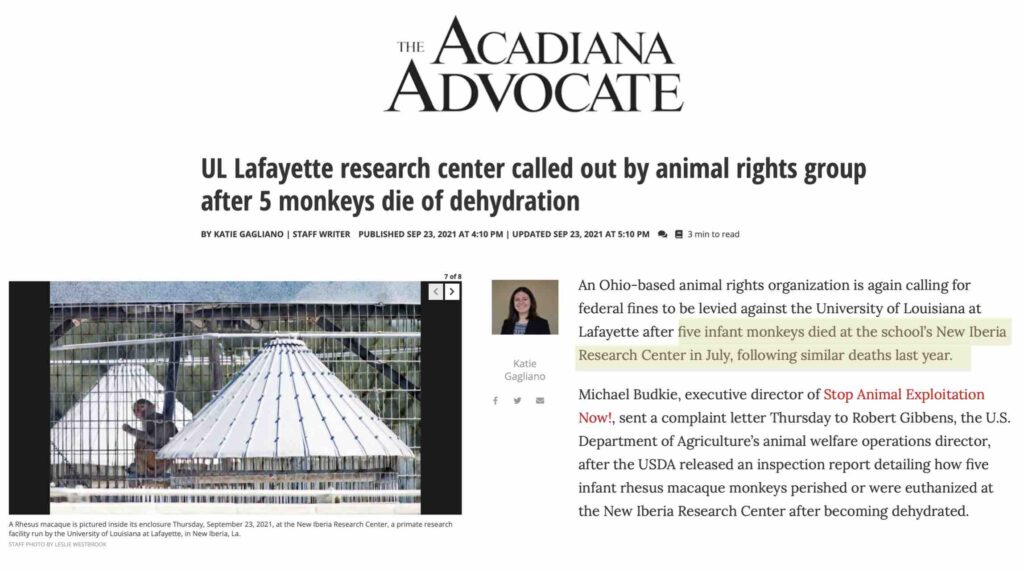
Through a Freedom of Information Act request, Stop Animal Exploitation Now (SAEN) uncovered and publicly exposed animal cruelty at the New Iberia Research Center
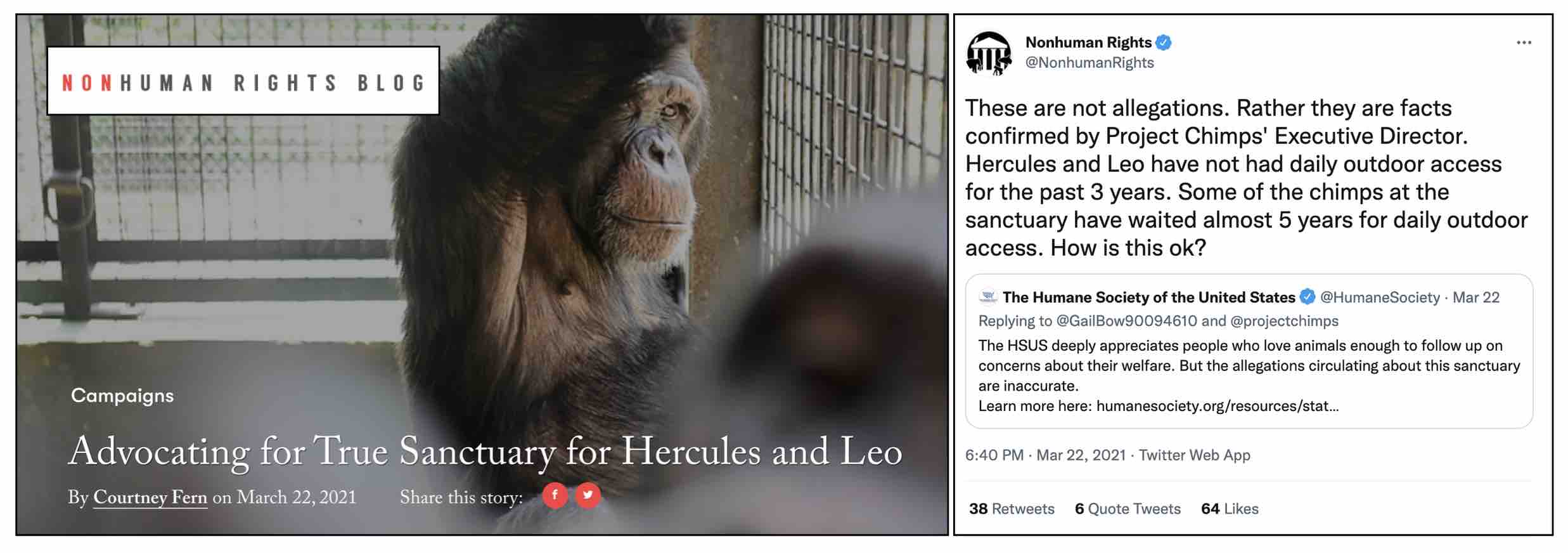
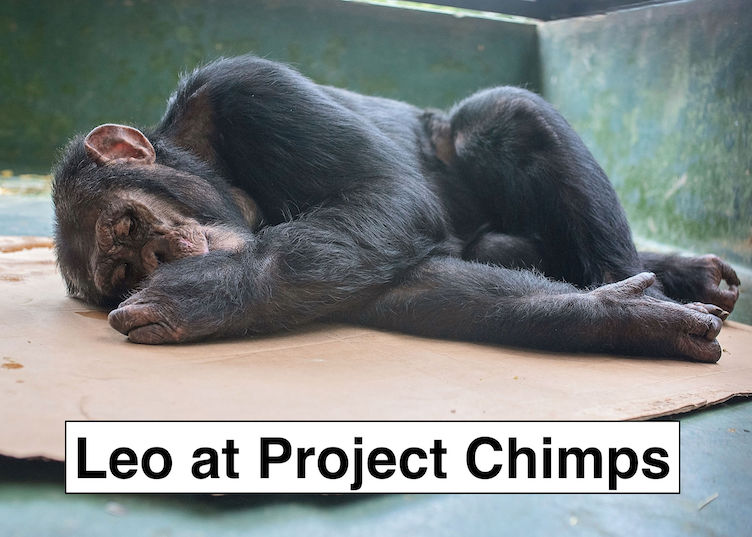
Among the NIRC chimpanzees transferred to Project Chimps before the moratorium are Hercules and Leo, clients of the Nonhuman Rights Project (NhRP) who were made famous by the 2016 documentary film Unlocking The Cage. In 2015, a New York lab (that leased them from NIRC) released them after years of legal pressure applied by NhRP. To ensure a humane retirement for Hercules and Leo, NhRP made arrangements to transfer them from NIRC to Save The Chimps, a sanctuary in Florida where they would spend their days outdoors. Because of its exclusive contract with Project Chimps, however, NIRC sent Hercules and Leo to the Georgia sanctuary instead, where they spend most of the time in concrete rooms. Now, NhRP is engaged in another battle on behalf Hercules and Leo – this time with HSUS. After HSUS privately dismissed their concerns about their clients’ captivity at Project Chimps, NhRP took the unusual step of publicly calling on HSUS to provide Hercules and Leo with daily access to the outdoors.
The Nonhuman Rights Project (NhRP) and the Humane Society of the United States (HSUS) are engaged in a public battle over the plight of Hercules and Leo, NhRP clients who are languishing in concrete enclosures at HSUS’s Project Chimps facility in Georgia.
Crystal Alba, a Project Chimps whistleblower who created a website to expose the mistreatment at the facility, summed up the sentiments of all of the advocates working on the effort to help these chimpanzees: “For the sake of all of the chimps – those awaiting sanctuary at the NIRC and those already at Project Chimps, I hope that HSUS addresses the most serious animal welfare issues by creating more outdoor habitats, hiring a qualified veterinarian, and providing the comprehensive care these chimps need to thrive in captivity.”
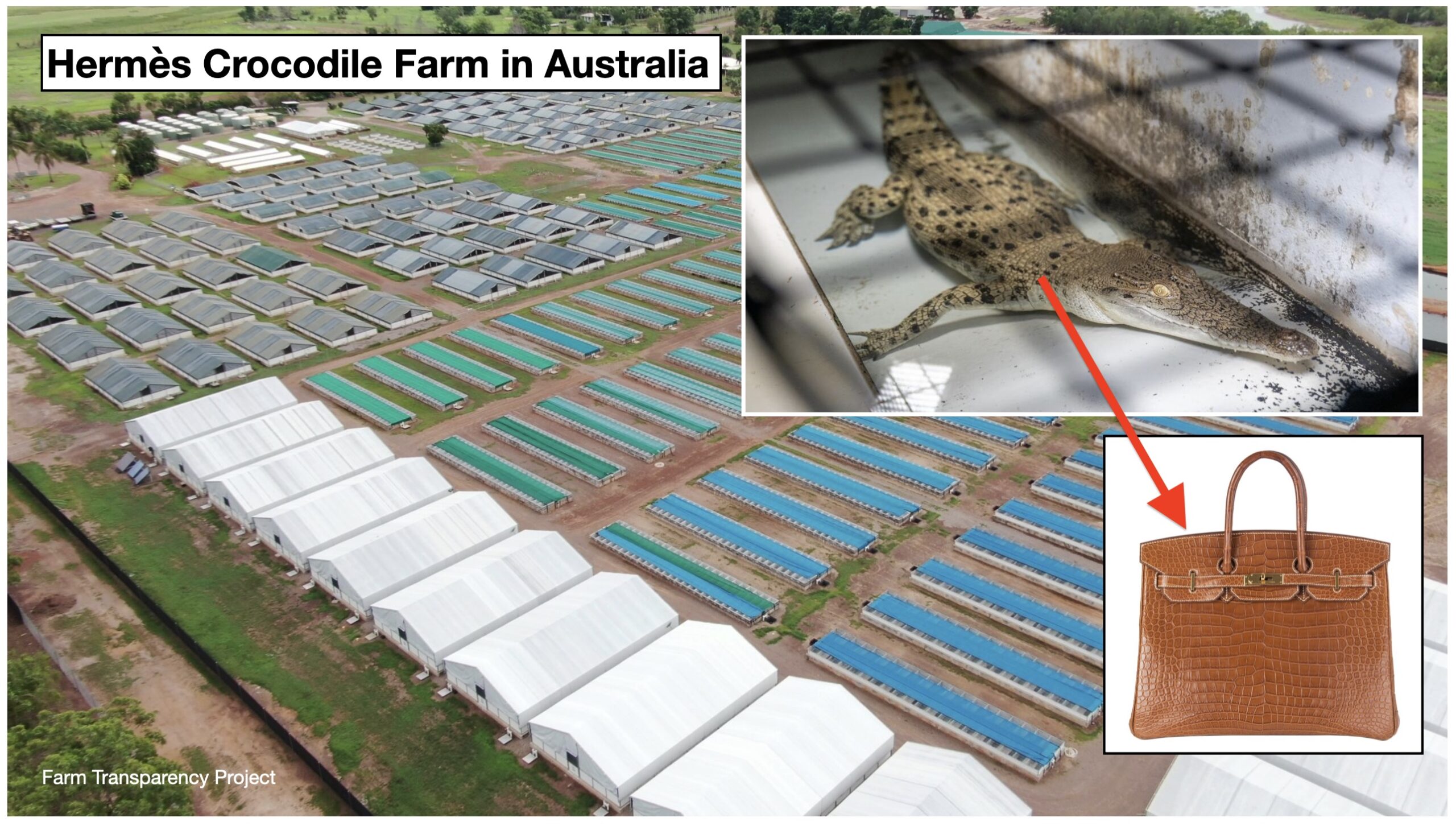
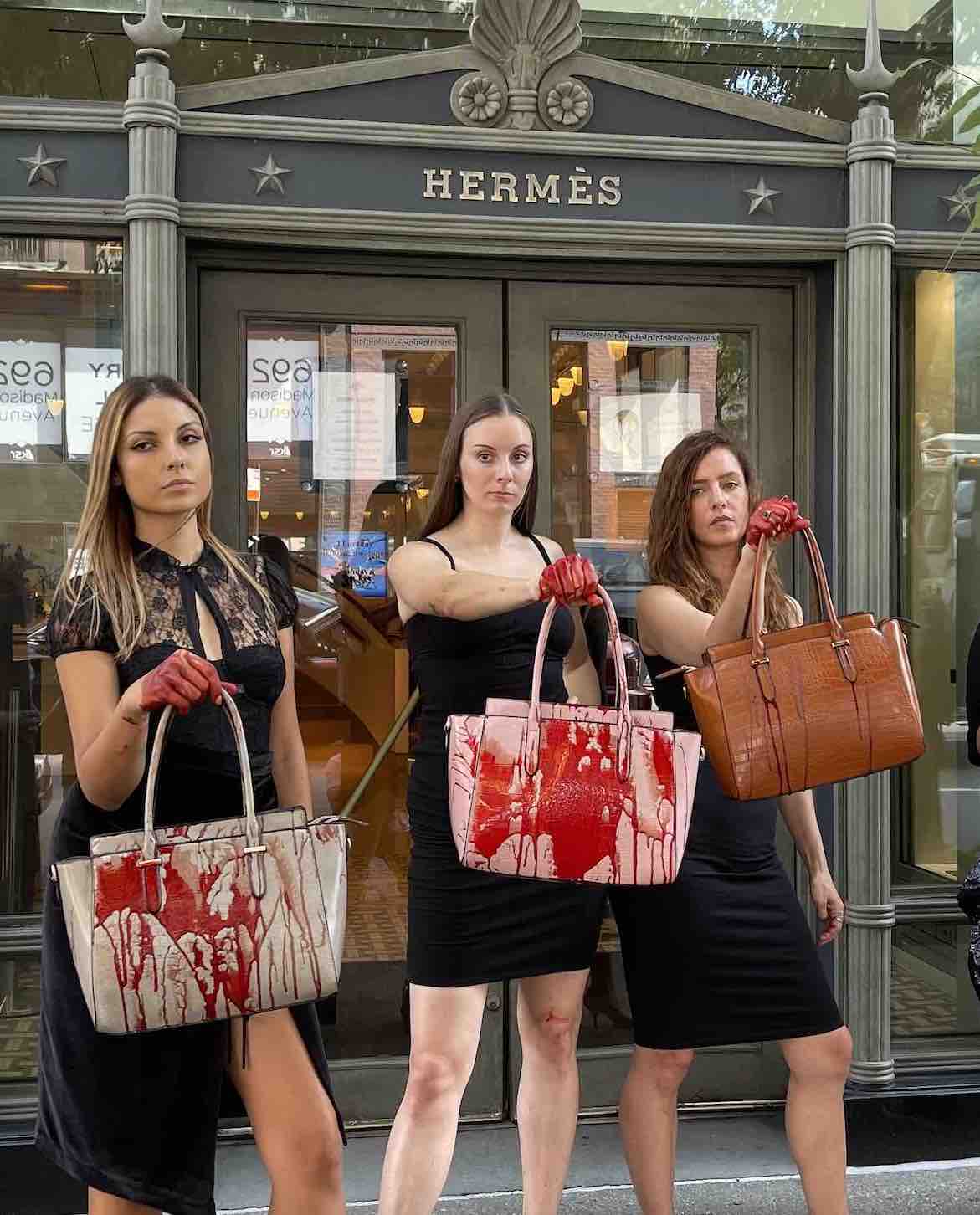
Undercover footage taken by Farm Transparency Project reveals shocking abuses at three crocodile factory farms in Australia owned by Hermès. Upon release of the footage, People for the Ethical Treatment of Animals (PETA) staged provocative protests at Hermès stores in New York City, London and Paris to call on the company to replace crocodile skin with cruelty-free fabrics for their handbags.
Australia accounts for 60% of the global trade of crocodile skins. Crocodiles, who have a natural lifespan of 70 years, are slaughtered by Hermès when they are just 2-3 years old. Birkin bags, which are made from the skins of four crocodiles, sell for tens, if not hundreds, of thousands of dollars at Hermès stores.
Hermès slaughters four crocodiles to produce one Birkin bag
Kindness Project, an Australian animal rights organization that released the Transparency Project footage, has launched a campaign to shut down Australia’s commercial crocodile farms and transition the workers into other jobs. “With so many sustainable and animal friendly alternatives available, there is no need for fashion houses to harm animals in the production of their clothing and accessories. We are asking for an end to Hermès crocodile cruelty, demanding they #dropcroc from their collections, in favor of protecting precious wildlife from cruelty and suffering.”
According to PETA, Hermès is planning to build what would be Australia’s largest crocodile farm, which would hold up to 50,000 individuals. Previous PETA investigations have shown workers shooting reptiles in the head; cutting into their bodies as they struggle to escape; and stabbing still-conscious animals in an effort to dislocate their vertebrae. They also show reptiles moving their legs and tails several minutes after these slaughter attempts. “No purse is worth an animal’s agonizing death,” says PETA Executive Vice President Tracy Reiman. “PETA is calling on Hermès to listen to the outcry against cruelty to crocodiles and bag exotic skins.”
People for the Ethical Treatment of Animals (PETA) staged a protest at Hermès in NYC after Kindness Project released undercover video footage of crocodile abuse at the company’s crocodile factory farms in Australia.
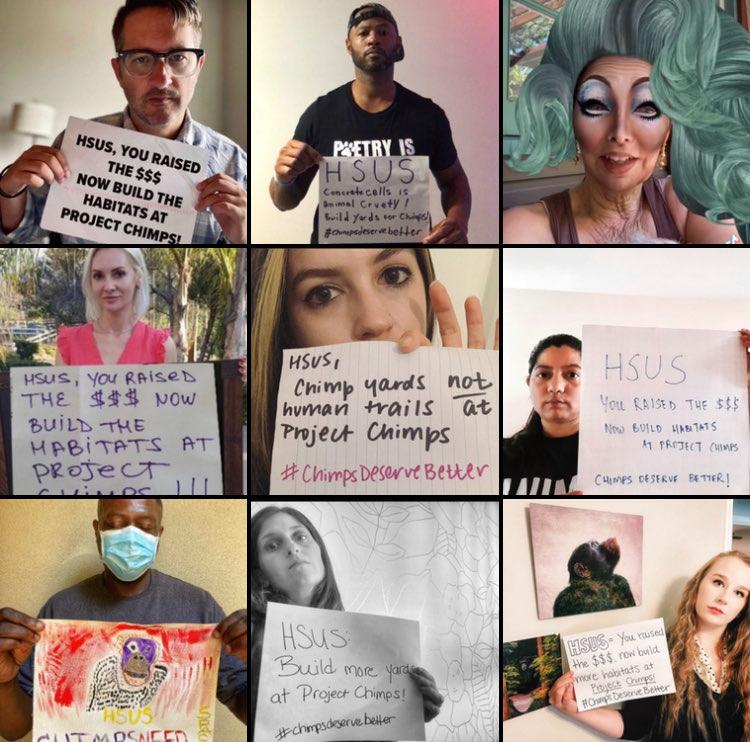
In August, hundreds of animal rights activists across the country took to social media to call on The Humane Society of the United States (HSUS) to provide the 77 chimpanzees in their care at Project Chimps with daily access to the outdoors. At Project Chimps, HSUS’s 236 acre forested sanctuary in Georgia, the chimpanzees have access to an outdoor habitat for just a few hours every three days. They spend the rest of the time in concrete enclosures.
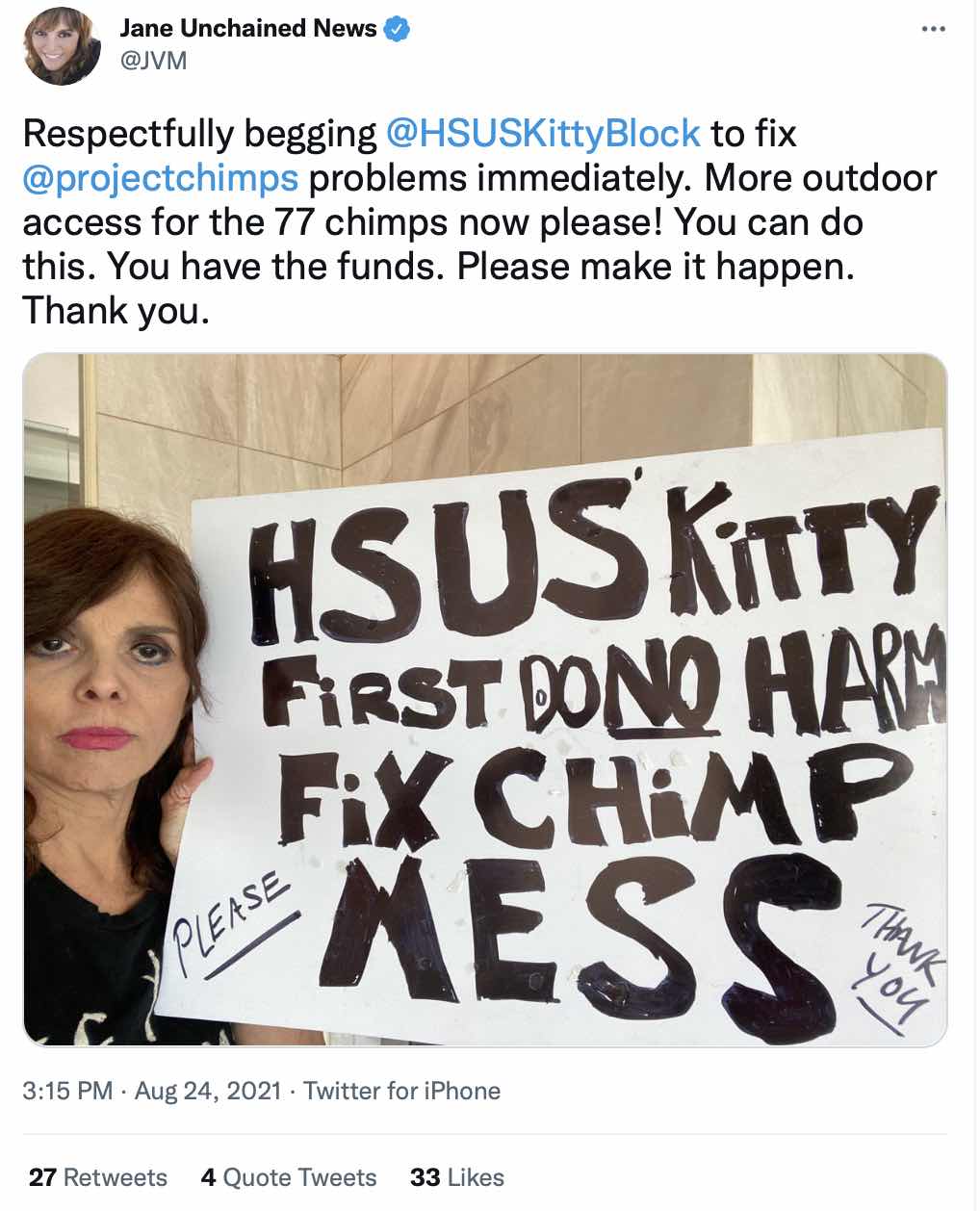
Jane Velez-Mitchell, an author, animal rights journalist and former TV news anchor with HLN, is calling on HSUS to improve animal welfare at Project Chimps.
On August 14th, activists with the animal rights group CAFT staged a protest at the San Francisco home of Susan Atherton, the Chair of the Board of HSUS. “Can you imagine being locked in a cement cage for days on end, and you only get a break for a just couple of hours to get outside in the sun, in the trees,” said Nick Pecoraro, an organizer with CAFT. “The Humane Society should be doing better.”
Lindsay Vanderhoogt, one of two former employees who Project Chimps sued for blowing the whistle about conditions at the sanctuary, created a video explaining the outdoor access issue. (Crystal Alba, the other whistleblower, is creating a video series about the deficient vet care at Project Chimps. This is the first video in the series.)
In response to a grass roots letter writing campaign in July, HSUS CEO Kitty Block acknowledged the need for additional yards, but she did not specify when Project Chimps would create them. She also blamed “COVID” and “weather” for the delay, despite the fact that the chimpanzees have been living in these conditions since 2016.
HSUS CEO Kitty Block’s response to advocates calling on her to create additional yards at Project Chimps so that the 77 chimpanzees have daily access to the outdoors.
“How can HSUS use COVID as an excuse for its failure to build yards for the chimps when it created hiking trails for visitors during the pandemic?” said Bob Ingersoll, a primatologist supporting the calls of advocacy groups and whistleblowers to improve animal welfare at Project Chimps. “Instead of using her public relations team to produce misleading statements, Kitty Block should use HSUS’s vast resources to transform Project Chimps from a warehouse into the sanctuary they claim it is.”
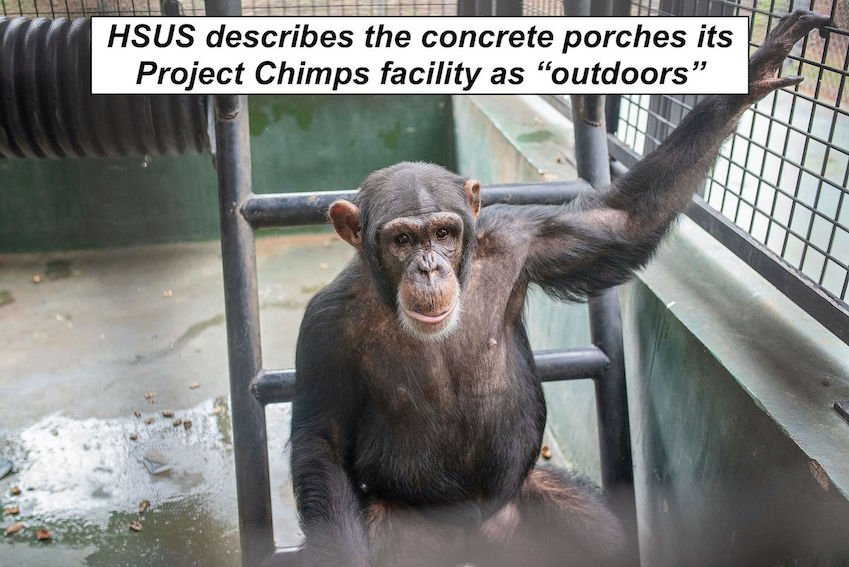
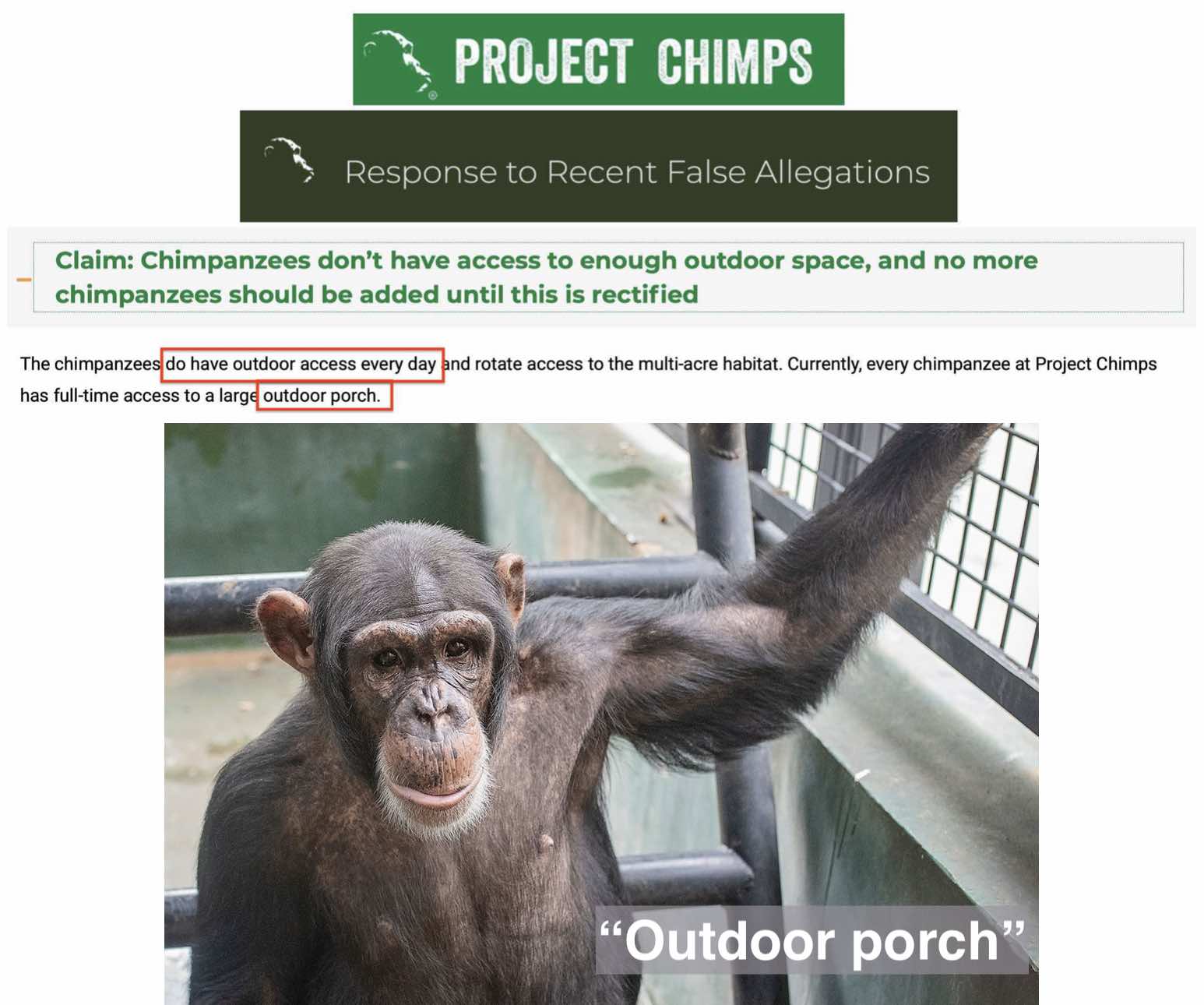
Instead of acknowledging that the chimpanzees have access to the outdoors for just a few hours every three days, HSUS and Project Chimps claim that the chimpanzees have daily access to the outdoors on porches, which are covered concrete rooms with metal bars.
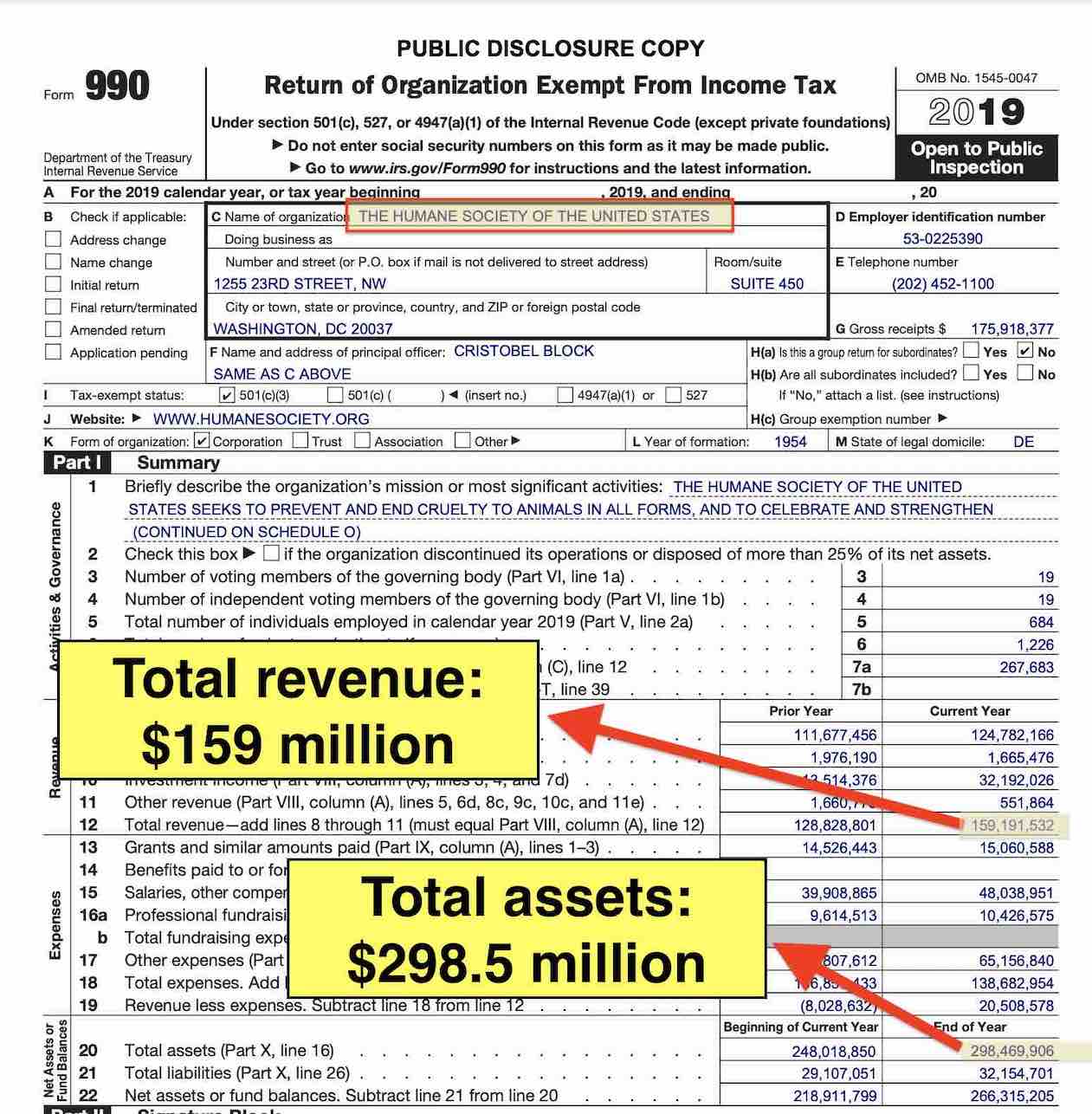
As of 2019, HSUS had $299.5 million in assets according to its tax filings. That year, it generated $159 million in revenues. Given the vast amount of money it raises off of its donors and its penchant for using chimpanzees as fundraising tools, advocates believe that HSUS should invest in outdoor yards now.
Humane Society of the United States 2019 tax filings
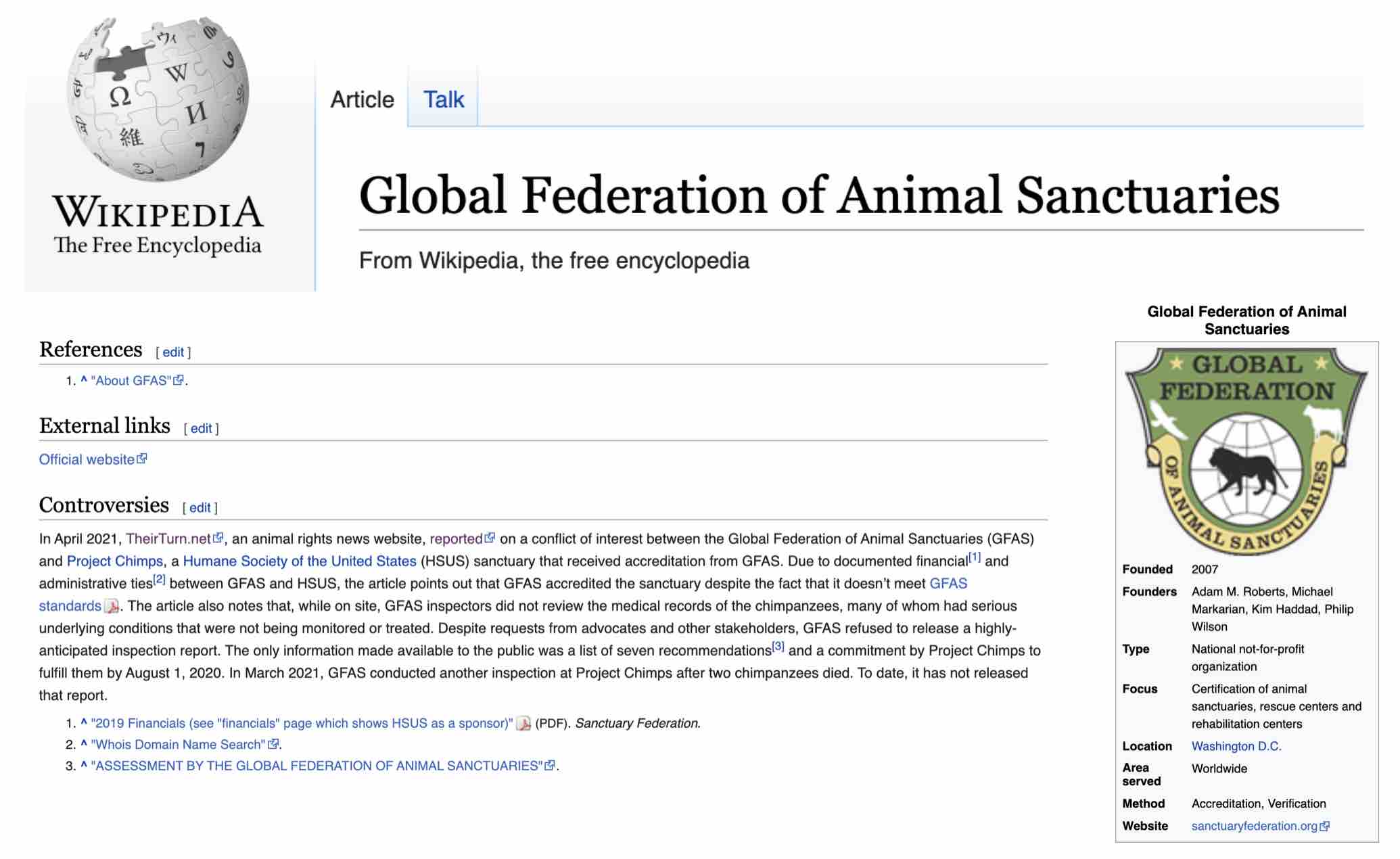
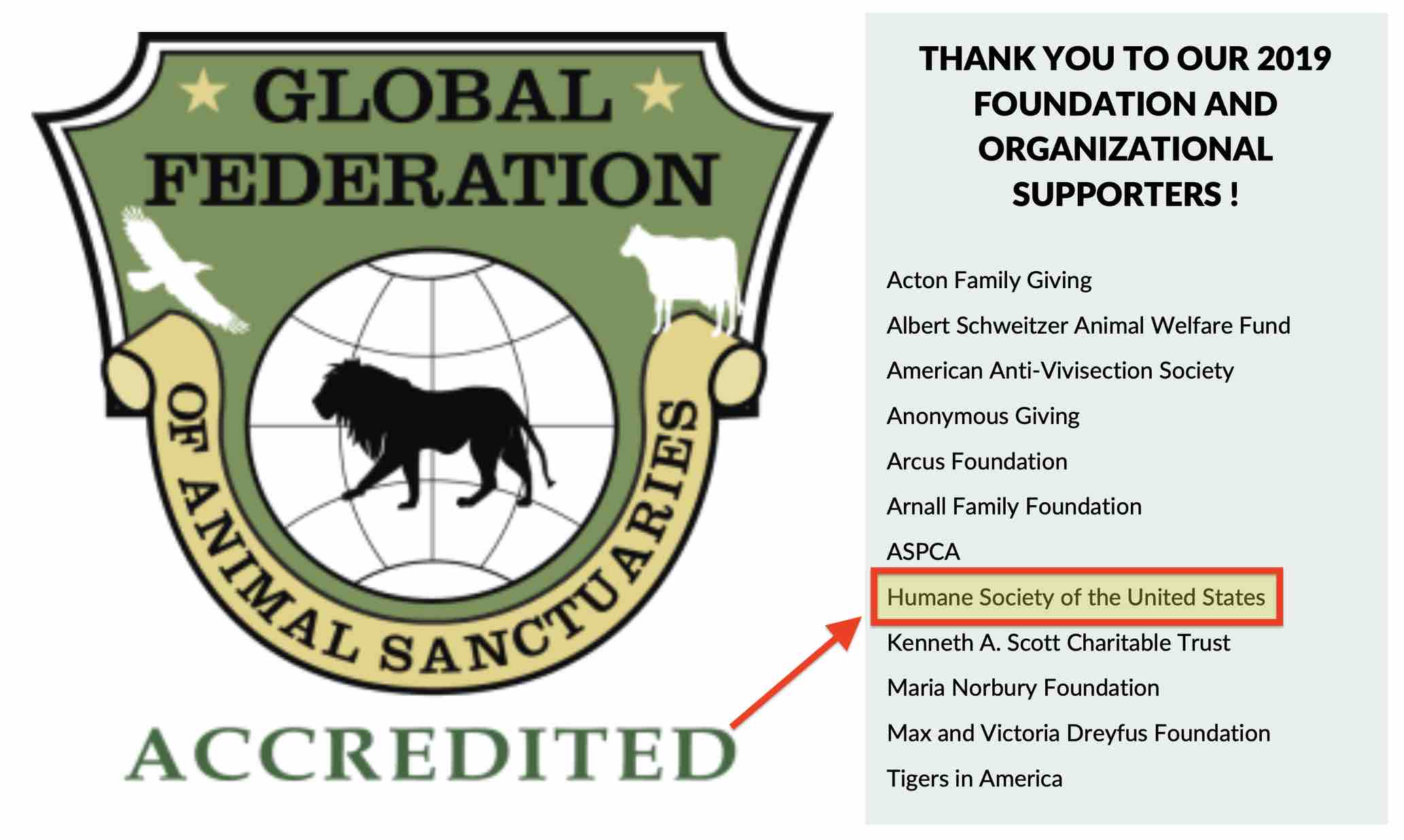
Since launching a campaign to help the chimps in mid-2020, whistleblowers from Project Chimps and animal rights groups have asked the Global Federation of Animal Sanctuaries (GFAS), a highly esteemed sanctuary accrediting body, why it accredits Project Chimps in light of the fact that it doesn’t meet GFAS standards for great ape sanctuaries. While they did not receive an answer, a TheirTurn investigation revealed close financial and administrative ties between GFAS and HSUS. The conflict of interest is addressed on GFAS’s Wikipedia page.
The Global Federation of Animal Sanctuary’s Wikipedia page includes the conflict of interest that explains why the organization accredits a sanctuary that doesn’t meet its standards
In June 2020, animal rights activists with Progress for Science, Chimps Deserve Better, Do The Right Thing and TheirTurn launched a campaign to help the chimpanzees after learning that Project Chimps sued two whistleblowers who came forward publicly about the poor welfare standards at the sanctuary. The whistleblowers, who posted extensive evidence in support of their claims at HelpTheChimps.org, spent $30,000 on their legal defense before Project Chimps dropped the lawsuit.
“HSUS’s efforts to silence and intimidate whistleblowers inadvertently shined a spotlight on the abysmal welfare conditions at Project Chimps,” said Donny Moss, an organizer in the campaign to help the chimps. “If HSUS hadn’t taken page out of the playbook of big animal ag by suing the women who came forward, then the nationwide grassroots efforts to help these chimps might never have taken place.”
Animal rights activists around the country are calling on The Humane Society of the United States (HSUS) to create additional yards at Project Chimps so that the 77 chimpanzees in their care have access to the outdoors every day.
Project Chimps, a 236-acre forested chimpanzee sanctuary in Georgia, features picturesque hiking trails, beautiful banquet facilities and festive events for visitors. What it does not feature, however, is far more remarkable: daily access for the chimpanzees to the 236 forested acres. Access to the forested habitats is so limited, in fact, that the 77 chimpanzees who live at this Humane Society of the United States (HSUS) facility get outside for just a few hours once every three days. It’s the antithesis of a chimp-centric sanctuary.
When, in May 2020, 22 Project Chimps’ employees and volunteers blew the whistle about this and several other serious animal welfare deficiencies at the sanctuary, local and national animal advocacy groups began to privately – and then publicly – demand that HSUS transform Project Chimps into a true sanctuary that meets the standards set by the Global Federation of Animal Sanctuaries (GFAS).
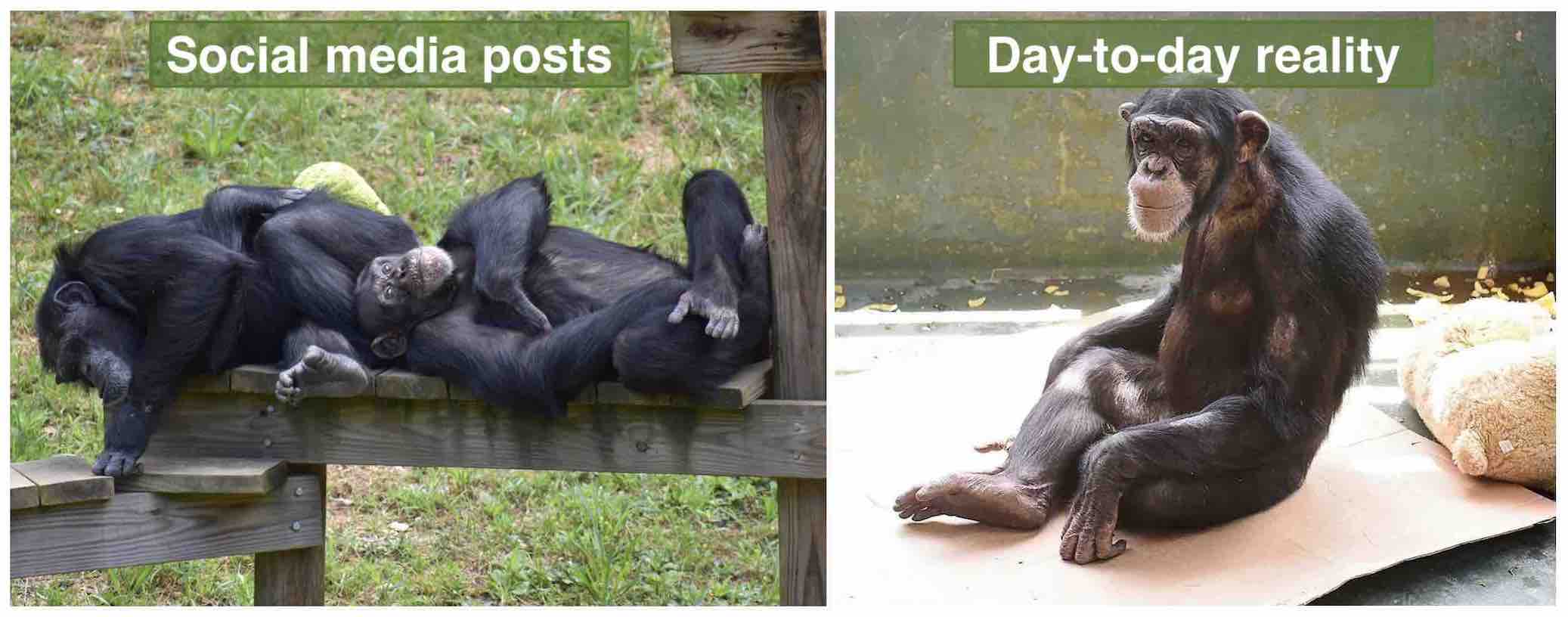
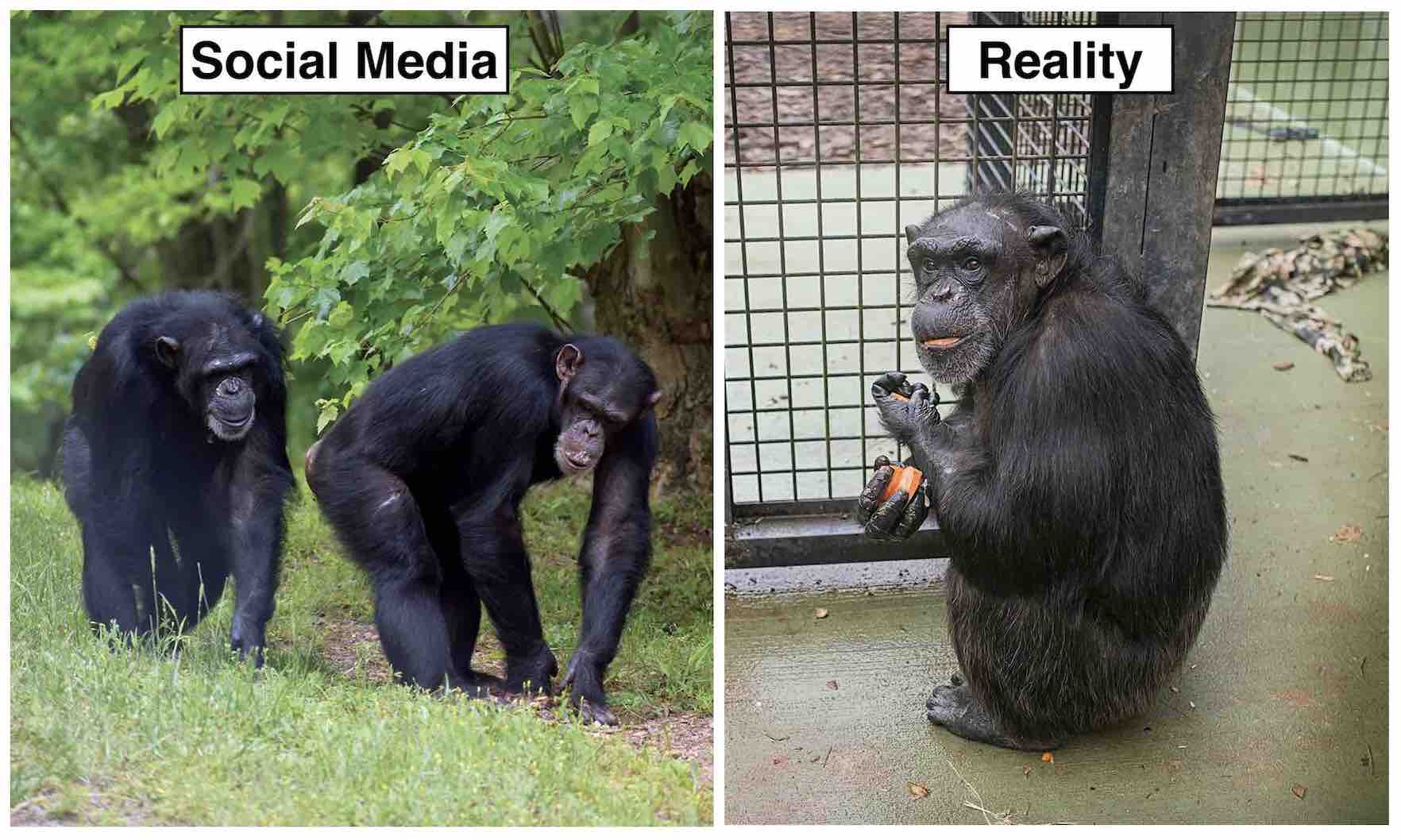
Before the whistleblowers came forward, animal advocates believed that Project Chimps was a true sanctuary. The photos and videos that Project Chimps posts online each day show chimpanzees moving freely through a lush habitat and basking in the sun — not languishing in concrete rooms. “The images of former research chimpanzees enjoying their ‘retirement’ don’t resemble their day-to-day lives behind bars,” said Lindsay Vanderhooght, a whistleblower who Project Chimps sued for defamation. “Images that depict the true conditions in which the chimpanzees live wouldn’t bring in donations, so Project Chimps is engaging in greenwashing.”
Project Chimps’ social media posts give the impression that the chimpanzees spend their days outdoors.
While Project Chimps does acknowledge that the chimps have access to the habitat just once every three days, it claims that the “porches” where the chimps spend their days are also outdoors. This is not true; the porches are covered concrete rooms that merely have a view of the outdoors through metal bars.
Project Chimps claims that the chimpanzees have access to the outdoors every day on “outdoor porches,” but the porches are covered concrete rooms with metal bars
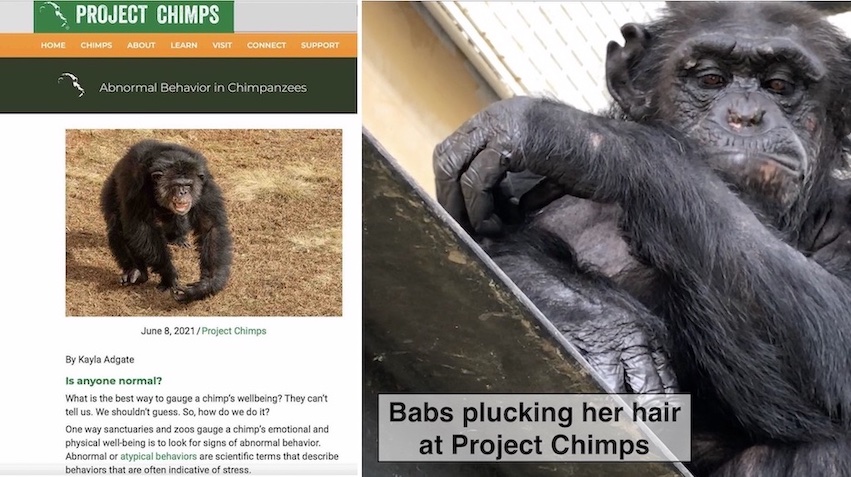
According to animal caregivers who worked at Project Chimps, the incessant confinement in overcrowded spaces with minimal enrichment has triggered and/or exacerbated stereotypic behaviors, such as hair plucking, feces smearing, pacing and swaying. After whistleblowers posted videos of these behaviors, Project Chimps attempted to downplay them in a blog post entitled, “Is Anyone Normal?” While Project Chimps accurately states that chimpanzees display these behaviors if their environment doesn’t enable them to fulfill their behavioral needs, it doesn’t acknowledge its role is causing these behaviors and the gravity and extent of the problem at its own facility.
Project Chimps posted an article about abnormal chimpanzee behaviors without acknowledging its role in causing them
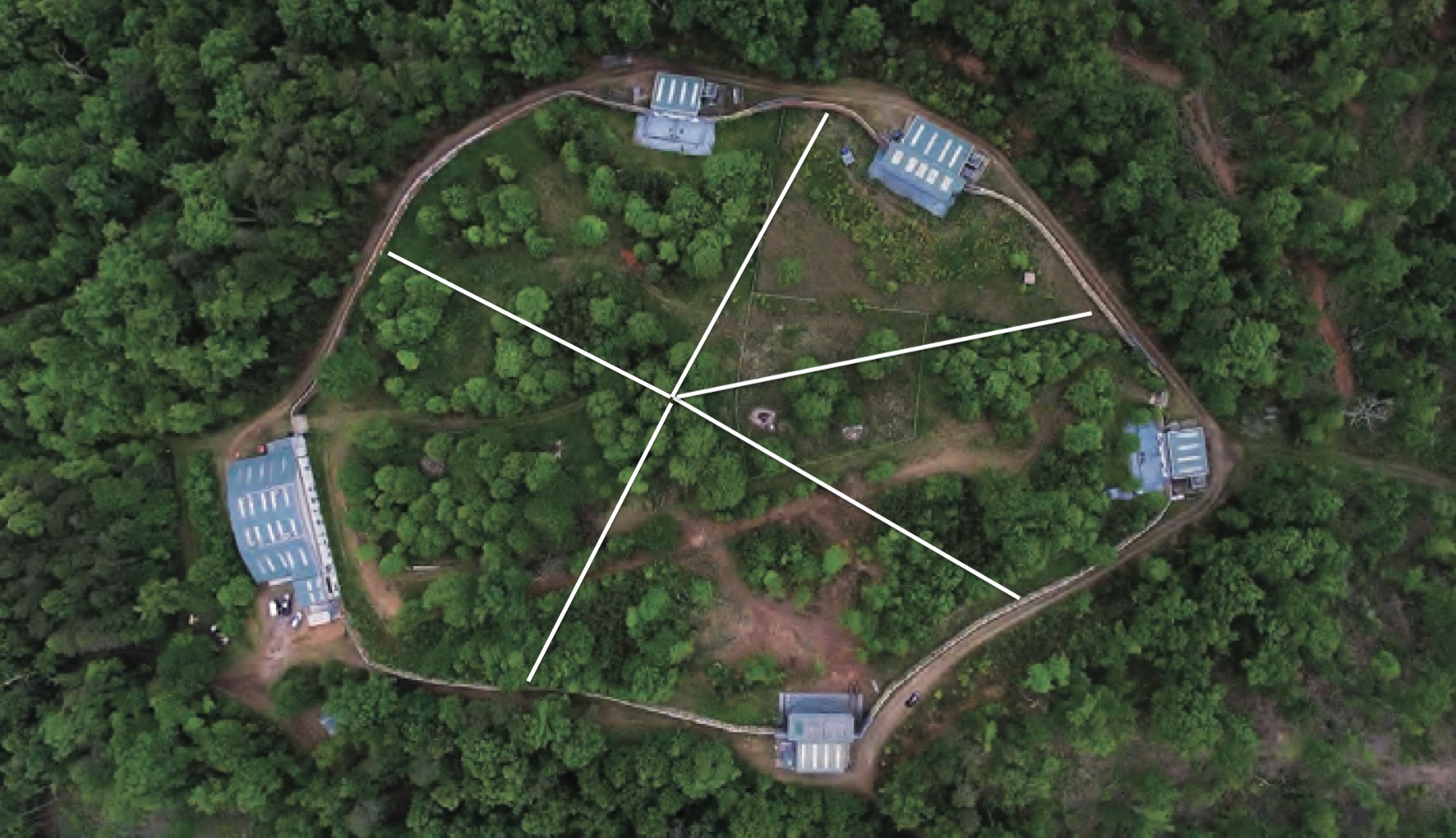
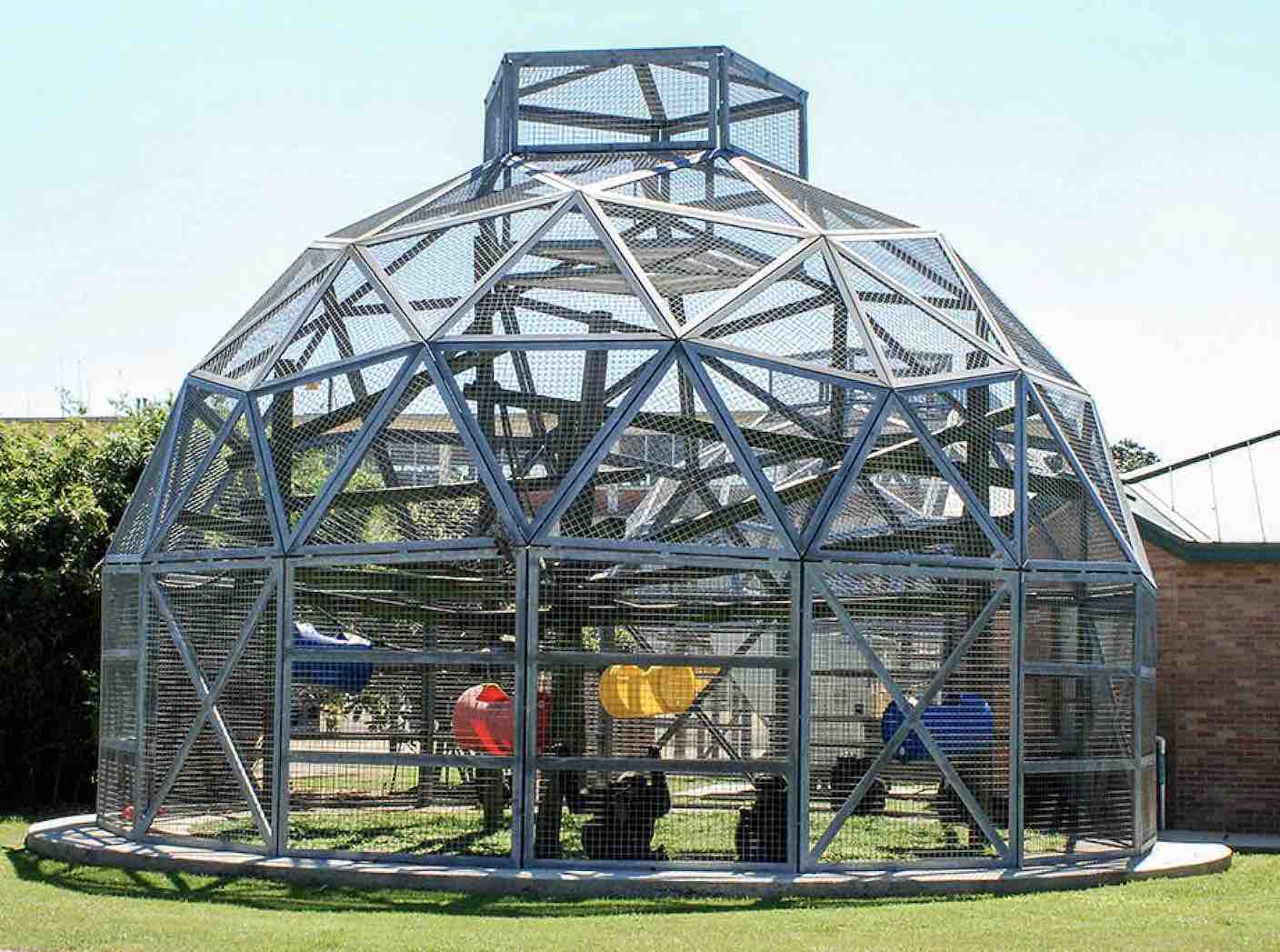
Project Chimps occupies 236 acres, but only six of them serve as an outdoor habitat for the chimpanzees. This habitat is divided into two yards. Each day, Project Chimps rotates one group of chimps into each yard for a few hours. Because Project Chimps currently has five groups, each group has access to a yard just once every three days.
For the past several months, advocates have asked Project Chimps to implement a temporary fix until additional yards are created. Instead of rotating one group of chimps into each yard in the middle of the day, Project Chimps could rotate two groups of chimps into each yard every day – one in the morning and one in the afternoon. That schedule would give the chimps access to the outdoors four or five times per week instead of two or three times.
Another temporary fix would be to split the six acre habitat into five yards instead of two – one yard for each of the buildings (“villas”) that house the chimps. That would provide the chimps with unfettered access to the outdoors every day.
If Project Chimps split the six acre habitat into five yards instead of two, then all of the chimps could have access to the outdoors every day instead of every three days
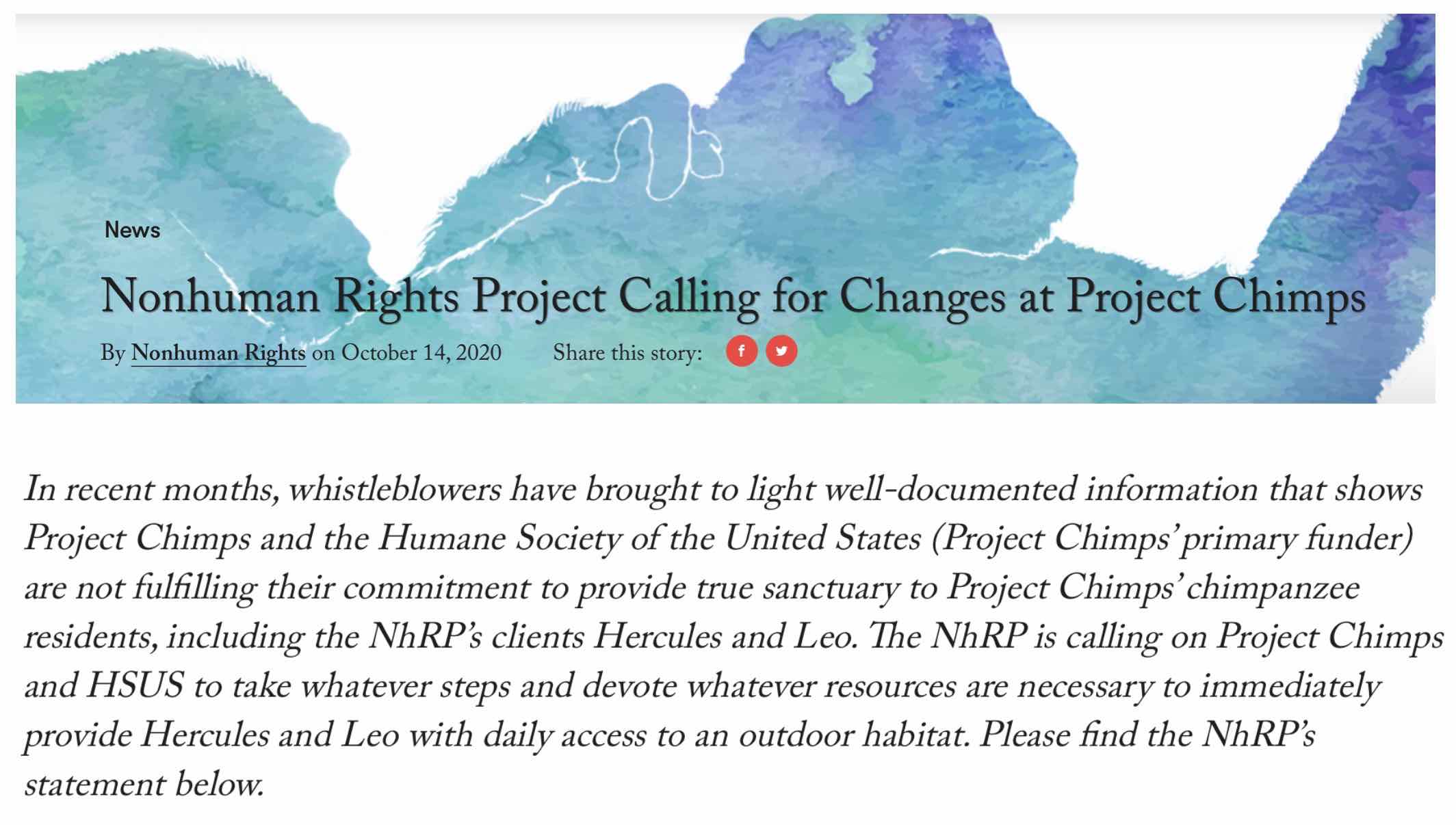
Over the past year, the Nonhuman Rights Project (NhRP), an advocacy group that litigates on behalf of captive animals, has issued several public statements calling on HSUS to give its clients Hercules and Leo, who they liberated from a lab, daily access to an outdoor habitat. Following are excerpts from its first statement, posted in October, 2020:
“In 2018, after Hercules and Leo arrived at Project Chimps, we wrote to Kitty Block, president of HSUS, on behalf of our clients and presented our serious and well-founded concerns about Project Chimps’ capacity to provide appropriate care to Hercules and Leo, especially regarding daily access to an outdoor habitat, which is essential to chimpanzees’ ability to exercise their autonomy and their physical and psychological health. Ms. Block dismissed our concerns, writing that HSUS is ‘confident that Project Chimps will devote the resources necessary to provide the best lifetime care to all of the chimpanzees at its sanctuary, including Hercules and Leo.’”
The Nonhuman Rights Project is calling out the Humane Society for its failure to fulfill the promises they made to Hercules and Leo after they were liberated from a lab.
“We have learned and Project Chimps does not dispute, that Hercules and Leo are confined to an indoor housing structure with cement floors and an enclosed porch all but ten hours a week. Project Chimps’ Executive Director told us they expect the earliest they will receive daily outdoor access is in two years. In our view, this timeline is an unacceptable failure to live up to Project Chimps’ founding promise: lifelong exemplary care for chimpanzees retired from research.”
The Nonhuman Rights Project is calling on The Humane Society of the United States to provide its clients, Hercules and Leo, with daily access to an outdoor yard.
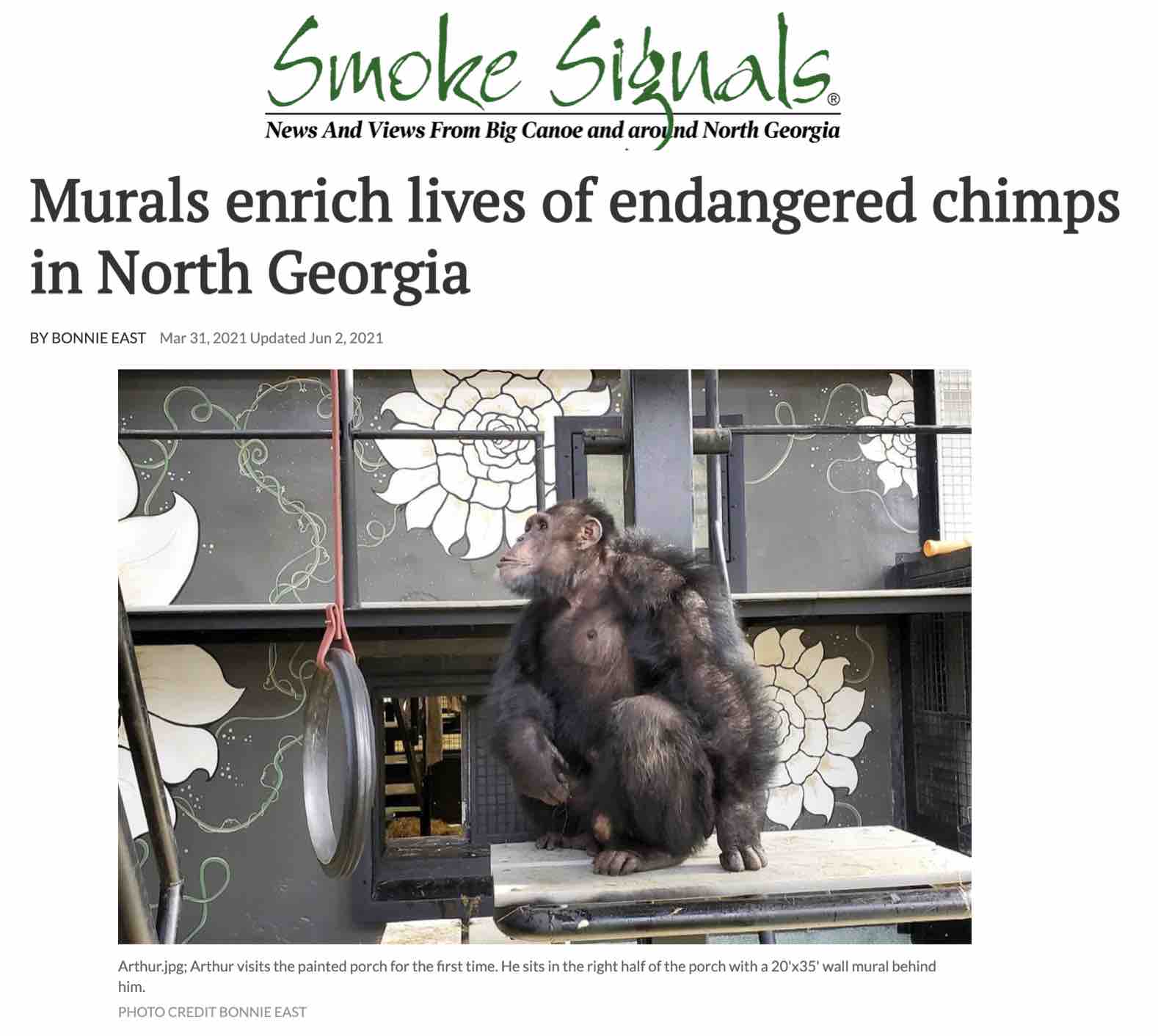
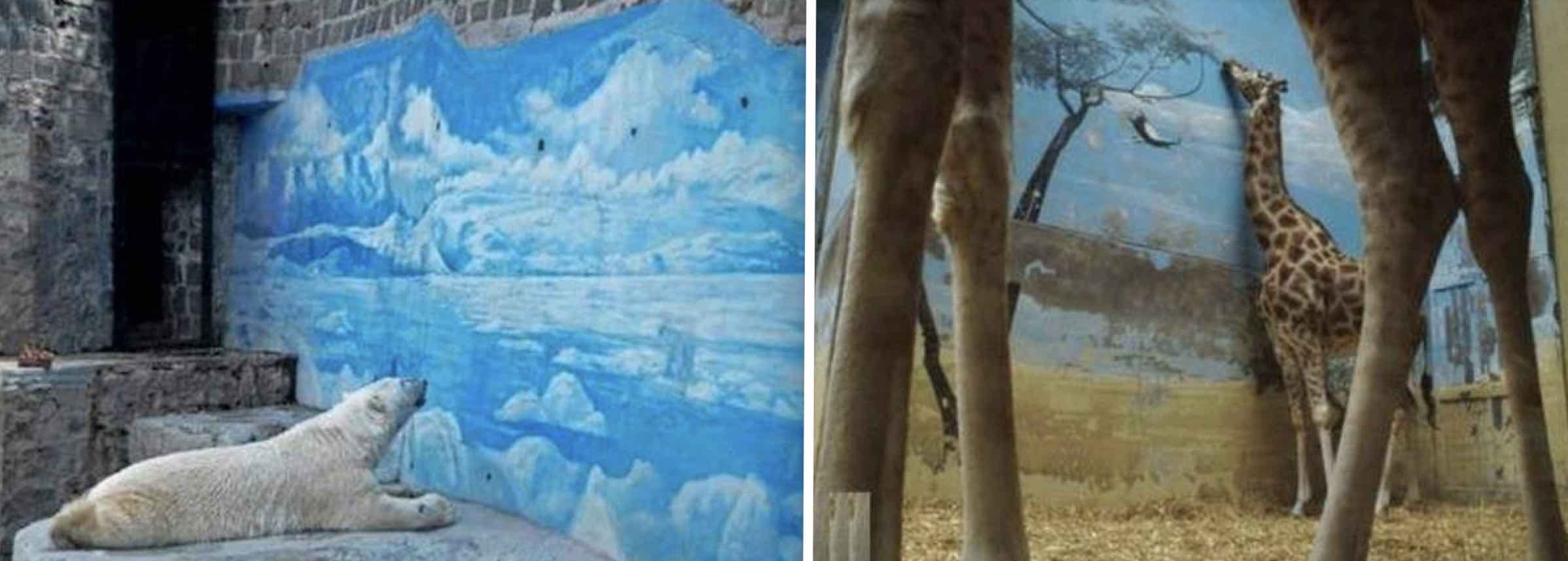
In June, Project Chimps posted an article written by an artist who painted a mural inside of a chimpanzee enclosure: “Murals Enrich Lives of Endangered Chimps in North Georgia.” According to chimpanzee caregivers, murals might serve as a distraction for a few minutes, but they wouldn’t enrich the lives of the chimps any more than murals in zoos enrich the lives of those captive animals. True chimp-centric enrichment engages the minds and bodies of the chimps who, by virtue of living in captivity, cannot perform the activities that would keep them engaged in their natural habitat. Also, paintings of elements from nature or the animals’ natural habitat can frustrate the animals, who crave the real thing. To the tourists passing through and people on social media, however, the decorative walls leave a better impression than flaking grey paint on concrete.
In the article about murals, the Executive Director of Project Chimps, Ali Crumpacker, states, “They [the chimpanzees] gave so much to humanity. It’s time to give back.” Warehousing chimpanzees in concrete rooms (with murals) is not “giving back” to them. It is taking away what few pleasures they could have in captivity. In response to Crumpacker’s remarks, Cory Mac, an organizer in the campaign to help the chimpanzees, said, “Painting murals is a cynical waste of resources; the time and money spent on these projects should have been devoted to chimp-centric activities. Also, the chimps never “gave” themselves to humanity. Their freedom was taken away from them against their will.”
The murals on the walls at Project Chimps are no more enriching for the chimpanzees than zoo mural are for the captive animals who are put on display
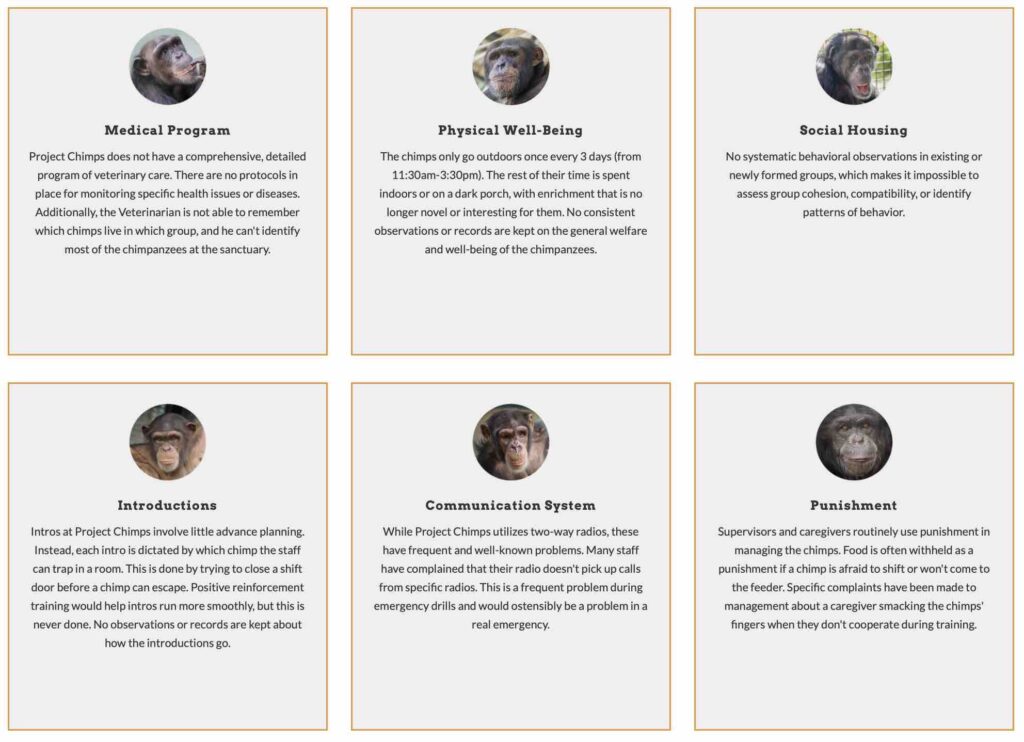
Despite the fact that the chimpanzees spend their days in concrete rooms, HSUS has used its PR machine to lead the public and its donors into believing that Project Chimps is a true sanctuary, and The Global Federation of Animal Sanctuaries (GFAS) is enabling HSUS to perpetuate this falsehood. GFAS, a global sanctuary accrediting organization, continues to accredit Project Chimps despite the fact that it does not meet many of the standards it sets for great ape sanctuaries. In fact, whistleblowers at Project Chimps identified 21 examples.
Whistleblowers documented 21 conditions at Project Chimps that fail to meet GFAS standards for great ape sanctuaries. Click the illustration to see all 21 conditions.
Puzzled by the GFAS accreditation, TheirTurn researched the relationship between GFAS and HSUS and identified several conflicts of interests, outlined in detail in another article. In short, GFAS is comprised of people affiliated with HSUS; has administrative ties to HSUS; and is partially funded by HSUS. How can GFAS make unbiased assessments of an HSUS sanctuary if HSUS is one of its donors?
GFAS defines a sanctuary as “any facility providing temporary or permanent safe haven to animals in need while meeting the principles of true sanctuaries: providing excellent and humane care for their animals in a non-exploitative environment.” GFAS knows that the chimpanzees are not receiving excellent or humane care. Project Chimps doesn’t even have a veterinarian on staff with primate experience. It also knows that, by transforming Project Chimps into a tourist attraction, HSUS is not creating a “non-exploitive environment.”
Click image to play video
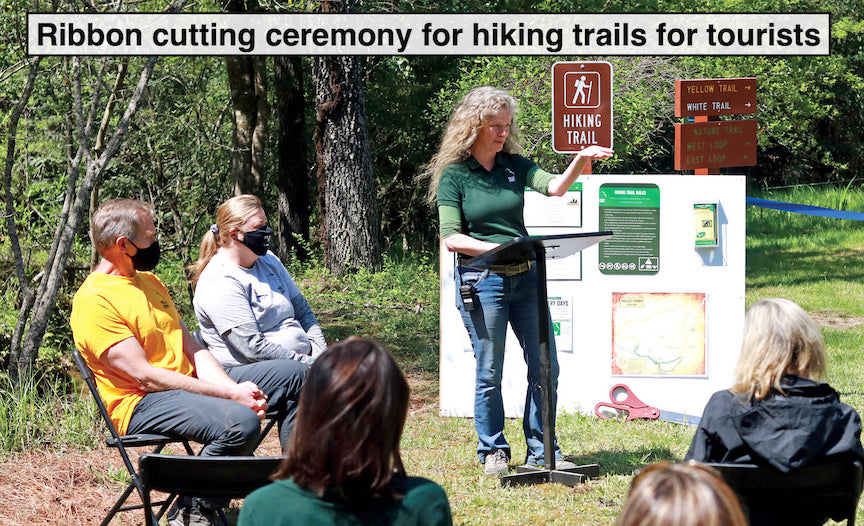
In May 2021, Project Chimps held a ribbon cutting ceremony – with no sense of irony – to announce the opening of new hiking trails for visitors. “The hiking trails are one of many amenities designed to entertain visitors, but true sanctuaries are created for and designed around the needs of animals, not visitors,” said Bob Ingersoll, a primatologist who advocates on behalf of captive chimpanzees. “If Project Chimps is going to hold a ribbon cutting ceremony, it should be to announce the creation of new outdoor yards or a clinic for the chimps, not a tourist concession.”
At Project Chimps, HSUS has prioritized amenities for tourists ahead of some of the basic needs of the chimps.
On July 2nd, 2021 Kitty Block, the CEO of HSUS, issued the following statement in response to a letter-writing campaign calling on her to improve animal welfare at Project Chimps: “The HSUS has clearly communicated that we agree with Project Chimps’ longstanding plan to build out its facilities and staff to support more time in outdoor habitat space for all the chimps at the sanctuary, and that we’ll be directing our future financial support of the sanctuary toward those priority needs.” While advocates are glad that HSUS is finally acknowledging the need to build yards for the chimps, Ms. Block’s statement begs many questions:
If Project Chimps was meant to be a sanctuary where “chimpanzees will thrive” and “make their own decisions on how they live,” then why didn’t HSUS create sufficient outdoor areas six years ago — before they began bringing in the chimpanzees?
What is HSUS’s plan and timeline to create new habitats?
What steps will Project Chimps take now to increase outdoor time in the existing habitat?
Why does the Global Federation of Animal Sanctuaries (GFAS) continue to accredit a sanctuary that provides its animals with so little time outdoors and that prioritizes amenities for tourists ahead of the some of the basic needs of the animals?
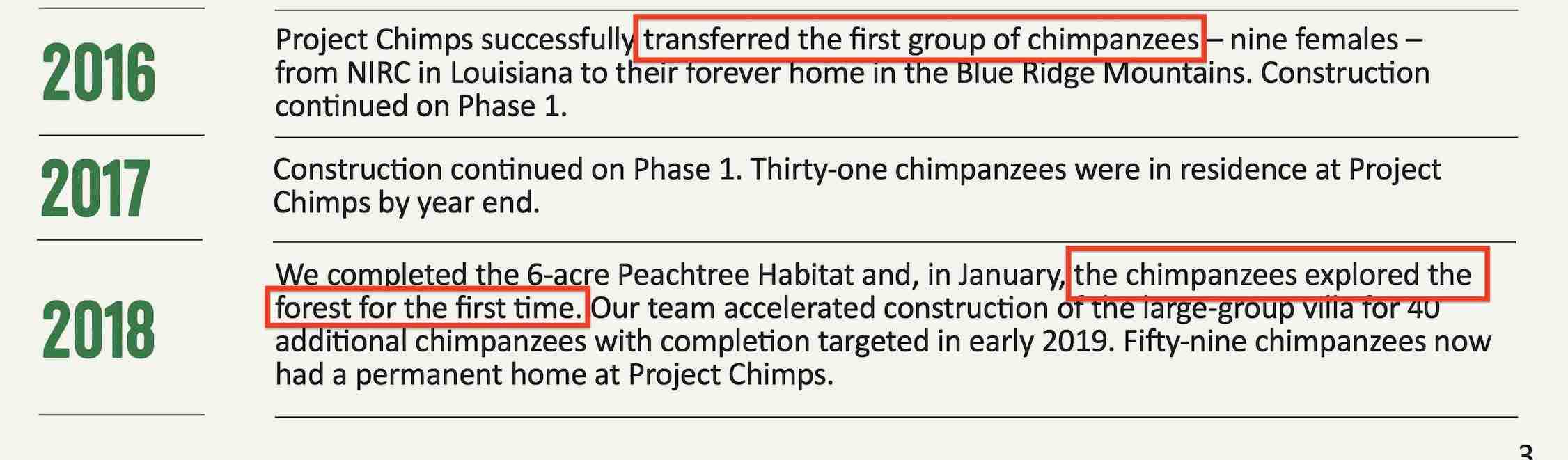
Despite the fact that it didn’t have outdoor space for the chimpanzees util 2018, Project Chimps began bringing in chimpanzees in 2016.
On July 2nd, Kitty Block, the CEO of the Humane Society of the United States (HSUS), sent the following statement to people who participated in a letter-writing campaign calling on the organization to improve animal welfare at Project Chimps, HSUS’s sanctuary in Georgia that is home to 77 chimpanzees.
HSUS STATEMENT
Letter sent by HSUS CEO Kitty Block to advocates who contacted her regarding inhumane treatment at its chimpanzee sanctuary in Georgia, Project Chimps
OUR RESPONSE
The organizations and activists advocating on behalf of these chimps are pleased that HSUS is finally acknowledging the need to create new yards so that the chimps have access to the outdoors every day. However, we are disappointed that HSUS is denying other serious deficiencies and using PR spin and misinformation to give the impression that conditions at the sanctuary are humane.
We realize that powerful organizations can be intransigent, but, given HSUS’s mission to help animals, we are baffled by the poor welfare conditions; by HSUS’s refusal to acknowledge and fix them; and by its unwillingness to apologize to the whistleblowers whom they sued after they exposed these conditions.
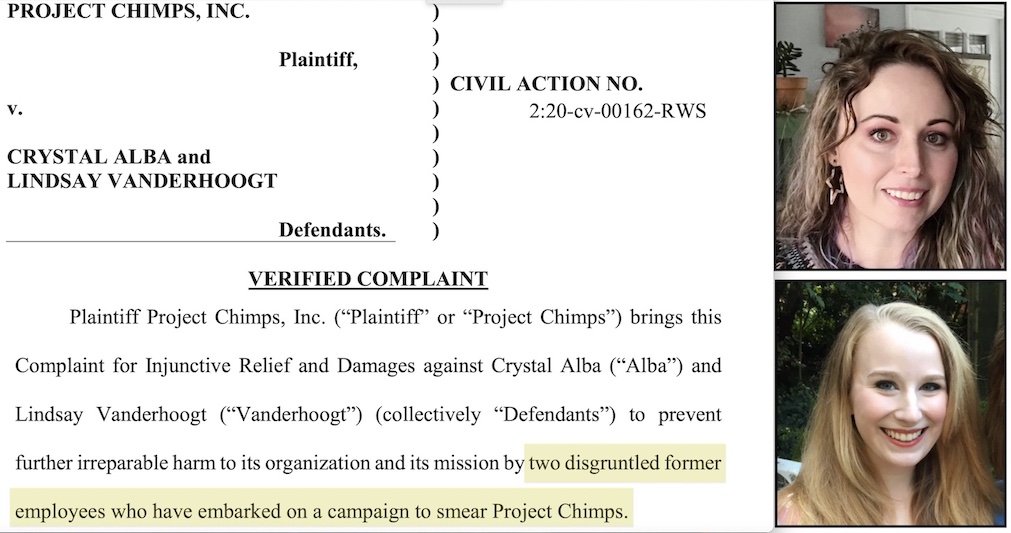
HSUS sanctuary Project Chimps filed – and ultimately dropped – a lawsuit against former employees Crystal Alba and Lindsay Vanderhooght after they came forward publicly with evidence of animal cruelty
HSUS can continue to use its PR machine to discredit the advocates and portray us as uninformed. The truth, however, is on our side. We will continue to be a voice for the 77 chimps until HSUS transforms Project Chimps into a true sanctuary that meets the standards set by the Global Federation of Animal Sanctuaries (GFAS).
Outdoor Access
HSUS states that the chimps should have “more time in outdoor habitat space.” Until now, HSUS has dismissed our concerns about the long stretches of confinement by falsely claiming that the chimps have access to the outdoors every day on porches. The porches, however, are concrete rooms with metal bars through which chimps can merely see the outdoors. HSUS further deceives the public and its donors by posting photos that give the impression that the chimpanzees spend their days in a lush outdoor habitat.
The chimpanzees at HSUS sanctuary Project Chimps have access to the outdoors just once every three days for a few hours, but the facility’s social media pages would lead the public to believe that they spend seven days a week in the habitat.
In its statement, HSUS attributes the delays in creating new outdoor habitats to COVID and bad weather, but the chimpanzees have been living without sufficient outdoor space for six years. Furthermore, if Project Chimps was able to build hiking trails for tourists during the pandemic, then why couldn’t it create yards for the chimps? Sanctuaries are not zoos; they are supposed to prioritize the needs of the animals, not amenities for tourists.
HSUS claims that COVID and poor weather prevented Project Chimps from creating yards for the chimps, yet these conditions didn’t stop the sanctuary from creating hiking trails for tourists.
If advocates hadn’t exposed the fact that Project Chimps was warehousing these chimps instead of providing them with a true sanctuary, then HSUS would not be acknowledging the need to “begin build-out efforts in the near future.” It would still be suing the whistleblowers who publicly exposed this gross deficiency in the first place.
Veterinary Care
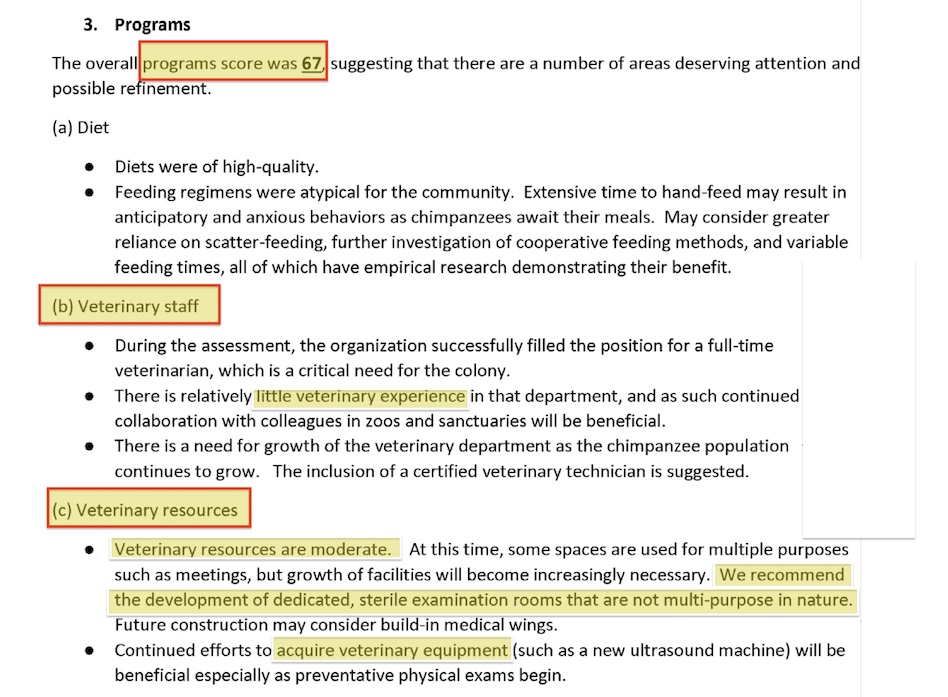
HSUS states that the chimpanzees are “receiving good medical care” according to “independent sources.” That is not true. In a highly anticipated assessment of Project Chimps conducted in late 2020, Dr. Steve Ross gave Project Chimps a D grade on its welfare management programs, which assesses veterinary services, enrichment, training, safety, staffing and diet. In his report, Dr. Ross emphasized, “There is relatively little veterinary experience.” Dr. Ross published his critical assessment eight months ago (11/2020), and, still, HSUS has not hired a veterinarian with chimpanzee experience.
In a 2020 assessment of HSUS sanctuary Project Chimps, primatologist Dr. Steve Ross gave Project Chimps a D on its welfare management programs, which include veterinary care.
At Project Chimps, medical care is administered by a retired small animal veterinarian who has no prior chimpanzee experience and who spends just a few hours, one day a week at the sanctuary. Since May 2020, two chimpanzees needlessly died after he ignored the pleas of chimp caregivers to address their serious and recurring symptoms.
“Chimps would still be in a lab”
HSUS states that the chimps “would still be in a lab without Project Chimps.” That is misleading. More than a hundred chimps are STILL in a lab because of HSUS’s failure to create a true sanctuary environment.
A contract between New Iberia Research Center (NIRC) and HSUS stipulates that all of the chimps will be sent to Project Chimps, but NIRC has stopped sending chimps due to welfare concerns at the sanctuary.
The contract between HSUS and the lab (New Iberia Research Center – NIRC) stipulates that NIRC will send all of its chimpanzees to Project Chimps, but NIRC has stopped sending chimps because HSUS is not fulfilling its obligation to provide them with a true sanctuary. If HSUS hired a veterinarian and care staff with chimpanzee experience and modified the yards to increase time outdoors (while creating new yards), then NIRC would be able to send the remaining chimpanzees to Project Chimps.
“Attacks on the Sanctuary”
HSUS states that “attacks on the sanctuary” are “actively undermining the support the sanctuary needs to achieve the best outcomes for these animals.” That is false. It is only because of these “attacks” (aka advocacy) that HSUS is finally acknowledging at least one of the sanctuary’s serious deficiencies – a shortage of outdoor space for the chimps.
The whistleblowers, activists and national advocacy groups (Nonhuman Rights Project and PETA) that are advocating for these chimpanzees never intended to speak out publicly, but HSUS’s arrogant dismissal of the concerns that we raised in private left us – and continues to leave us – with no choice. Normally, the Global Federation of Animals Sanctuaries (GFAS), not activists, would ensure that accredited sanctuaries are treating their animals humanely. However, because GFAS was created by and is, in part, funded, by HSUS, it is not enforcing its own standards at Project Chimps. The chimpanzees are victims of this conflict of interest.
How can GFAS independently assess a sanctuary operated by an organization funds it?